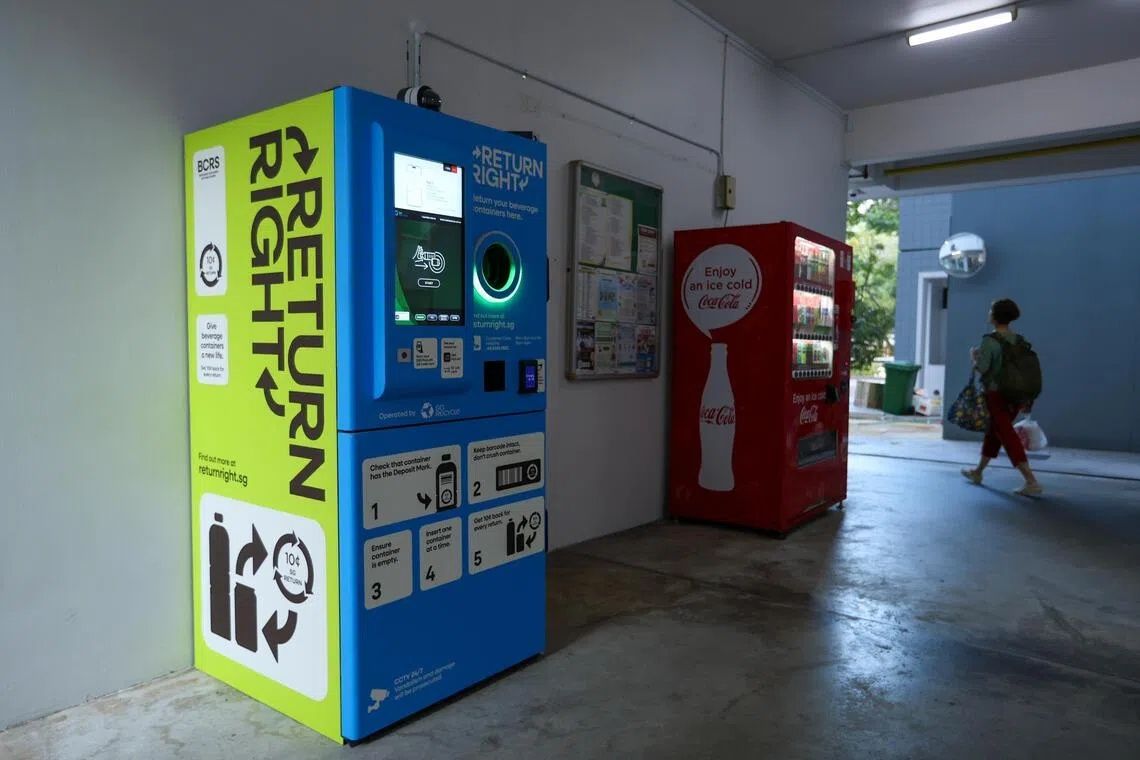
Singapore's National Environment Agency has moved swiftly to quash online allegations of misappropriation and corruption stemming from confusion over how refunds are tallied under the country's fledgling beverage recycling initiative. The NEA issued a detailed rebuttal on August 15, characterising claims circulating on social media as fundamentally misplaced and rooted in a misinterpretation of publicly disclosed programme statistics.
The controversy began when Senior Minister of State for Sustainability and the Environment Janil Puthucheary outlined preliminary results from the Beverage Container Return Scheme during parliamentary proceedings on August 5. He reported that between April and July, the scheme processed more than one million successful refund transactions involving 5.5 million returned bottles and cans deposited at reverse vending machines across the island. Some online commentators seized on these figures, suggesting that refunds were issued for only one million of the 5.5 million containers submitted—an interpretation that would imply roughly four-and-a-half million containers went uncompensated.
The NEA's clarification addresses a fundamental misunderstanding of how the technology operates. When consumers use the reverse vending machines, they can return multiple containers in a single transaction and receive refunds accordingly. The agency explained that the one million-plus transactions encompassed the entire 5.5 million container haul, meaning consumers averaged approximately 5.5 containers per visit to the machines. This distinction is crucial for understanding the scheme's financial mechanics and overall performance during its initial months.
Mathematically, the numbers now align coherently. With each beverage container attracting a 10-cent deposit—a mechanism designed to incentivise participation and cover administrative costs—the total refunds distributed reached approximately S$550,000 (US$429,822). This figure corresponds directly to the volume of containers returned across the programme's first four months of operation. The NEA's explicit rejection of misappropriation allegations rests on this straightforward accounting, rendering accusations of financial impropriety fundamentally baseless according to the agency's position.
The Beverage Container Return Scheme itself represents Singapore's approach to circular economy principles and waste reduction targets. Launched on April 1, the initiative requires consumers to pay an additional 10 cents per canned or bottled beverage at point of purchase but permits them to recover this deposit by returning used containers to designated reverse vending machines. The deposit mechanism creates financial incentives for participation while generating data on recycling behaviour patterns and container diversion rates from landfills.
Since inception, the scheme has encountered operational friction that attracted public attention and contributed to an environment where misunderstandings could flourish. During the April-to-July period, some users reported experiencing machine malfunctions that prevented them from obtaining their deposits immediately. Others described having legitimate returns rejected by the equipment, necessitating follow-up communications with the scheme operator to resolve discrepancies and obtain refunds through alternative channels. These technical issues, while isolated, generated frustration among early adopters and created a backdrop of scepticism.
Janil acknowledged during his parliamentary statement that most transactions at the reverse vending machines functioned as intended, with the overwhelming majority of returns processed successfully. He indicated that where technical problems did emerge, the scheme operator worked collaboratively with machine manufacturers to diagnose and remediate issues expeditiously. This characterisation of rapid problem-solving stands in contrast to social media narratives suggesting systemic financial mismanagement, though the existence of any rejection issues likely contributed to heightened scrutiny of the scheme's refund mechanisms.
The necessity for the NEA's public statement reflects broader challenges facing environmental policy implementation in the digital age. When detailed programme data circulates online, it becomes vulnerable to misinterpretation, particularly when commentators lack full context about operational mechanics. The agency's decision to issue a direct Facebook rebuttal signals recognition that online discourse shapes public perception and confidence in government initiatives, even when those perceptions rest on factual misunderstandings rather than genuine malfeasance.
For Malaysia and the wider Southeast Asian region observing Singapore's environmental policy experiments, this episode offers instructive lessons about implementation and communication. As countries across the region consider deposit-return schemes and extended producer responsibility frameworks to address plastic waste, the experience underscores the importance of designing systems where transaction mechanics are readily understood by the public. Clear, accessible communication about how deposits are calculated, when refunds are processed, and what transaction data represents can prevent the emergence of conspiracy theories that undermine support for otherwise sound environmental initiatives.
The accountability mechanisms underlying the Beverage Container Return Scheme provide some assurance against actual misconduct. BCRS is statutorily required to submit annual financial reports to the NEA, creating an auditable record of refunds distributed and deposits collected. This regulatory framework, while not immune to weakness, provides transparency mechanisms that citizens and oversight bodies can invoke to verify compliance and identify genuine irregularities if they were to occur.
Moving forward, the Beverage Container Return Scheme's credibility depends substantially on maintaining clear communication with the public whilst continuing to address technical issues that generate legitimate complaints. As the programme matures beyond its initial months, the data it generates will become increasingly valuable for understanding recycling behaviour and fine-tuning implementation. However, that data must be communicated in ways that minimise opportunities for misinterpretation and enhance public understanding of how the system functions.

