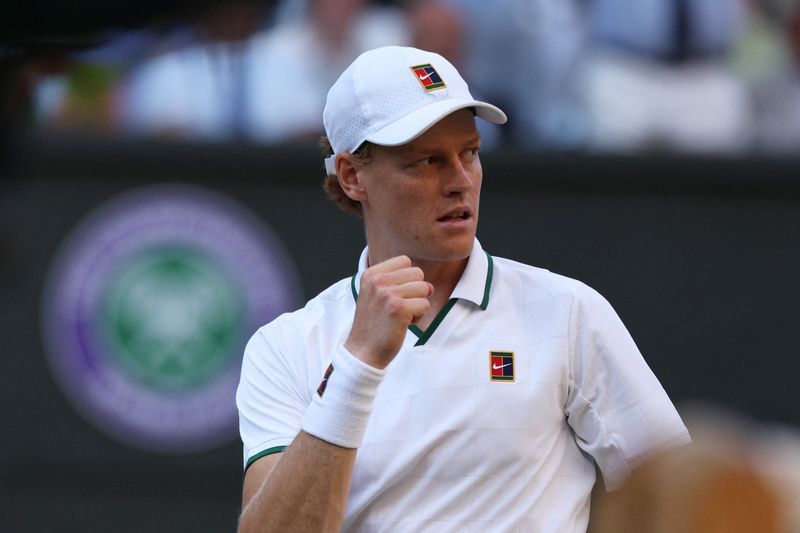
Jannik Sinner successfully defended his Wimbledon singles title on Sunday, overcoming a determined Alexander Zverev in a demanding final that showcased the Italian's resilience and technical mastery on the grass courts of the All England Club. The top-seeded Sinner prevailed 6-7(7) 7-6(2) 6-3 6-4 in a match that stretched nearly four hours and tested both players' physical and mental fortitude under demanding conditions. With this victory, Sinner secured his fifth Grand Slam title and etched his name into tennis history as only the tenth man in the professional era to successfully defend a Wimbledon crown.
The 24-year-old Italian's repeat championship represents a remarkable turnaround after a disappointing campaign at Roland Garros just weeks earlier, where a second-round exit threatened to undermine his form ahead of the grass-court season. Yet Sinner demonstrated exceptional composure throughout Wimbledon, not surrendering a single service game during both his semi-final and championship encounters. His ability to navigate pressure situations and convert crucial moments proved decisive against an opponent who had arrived at the final riding a wave of confidence following his maiden Grand Slam triumph at the French Open.
Zverev's journey to the Wimbledon final represented a significant career milestone for the 29-year-old German, who had never previously advanced beyond the opening rounds at the tournament. The German's breakthrough major title at Roland Garros provided him with newfound belief that he could compete at the highest level across different surfaces. At Wimbledon, he delivered an inspired performance that saw him take an intense opening set and threaten a monumental upset, pushing Sinner to the very edge of defeat for much of the encounter. However, his energy levels ultimately diminished under the weight of Sinner's counterpressure, allowing the defending champion to steadily impose his game and seize control.
The opening set proved a microcosm of the match's broader narrative, with both players serving aggressively and striking fearlessly from the baseline. During the first hour of play on a hot and breezy Centre Court, marginal differences separated the two competitors, with just a single break point presented across the opening twelve games. Sinner squandered his opportunity when he uncharacteristically misfired a forehand wide at 4-3, failing to capitalise on Zverev's serve. The German's forehand proved particularly formidable throughout this period, contradicting his reputation for inconsistency during major championships, while he relinquished merely eight points on serve in the opening set.
The first-set tiebreak encapsulated the tightness of their contest, with both players reaching critical junctures. Zverev secured set point initially but fell victim to a net-rushing tactic after chasing a rare Sinner drop shot. He then saved Sinner's set point with a well-placed ace before finally claiming the set with a commanding forehand winner. This tiebreak victory proved psychologically significant for Zverev, as it ended an earlier streak during which Sinner had captured fourteen consecutive sets against him. The German's ability to compete at such an elevated level and break through Sinner's dominance suggested he might sustain his challenge throughout the match.
However, Sinner's response was emphatic, reasserting his superiority during the second-set tiebreak by elevating his intensity and precision. Despite early frustration visible on his features when confronted with Zverev's seemingly impenetrable serve in the second set's regulation play, Sinner recalibrated his approach and seized control of the decider. The match remained extraordinarily balanced as play extended deep into the third set, with both competitors unleashing thunderous forehands and serves that left spectators breathless. At 3-3 in the third set, after two hours and forty-two minutes, Zverev earned his first break point of the entire match, suggesting a dramatic shift in momentum remained possible.
The decisive moment arrived when Zverev attempted to respond to one of Sinner's drop shots, slipping awkwardly at the baseline while changing direction. This tumble, while not incapacitating, visibly affected the German's movement and confidence during the remainder of the match. Sinner demonstrated sportsmanship by checking on his fallen opponent, yet recognising the opportunity to press his advantage. He held serve and subsequently broke Zverev's serve for the first time, with the German noticeably moving gingerly and expressing his mounting frustration by hurling his racket across the turf. This turning point fundamentally altered the match's trajectory, as Sinner locked into his rhythm and began converting chances with clinical efficiency.
Despite Zverev's attempt to recover his composure during the fourth set, Sinner had entered a destructive phase where his serving and baseline hitting achieved near-perfect synchronisation. The Italian broke serve again to lead 4-3, effectively sealing the outcome. When Sinner subsequently served for the championship, the match concluded with two remarkable rallies that showcased the extraordinary tennis both players had produced throughout the afternoon. Victory came after three hours and forty-six minutes, confirming Sinner's superiority and his place among the game's elite defenders of major titles.
For Malaysian and Southeast Asian tennis enthusiasts, Sinner's achievement carries particular significance given the region's growing investment in developing young tennis talent. His success at such a young age, coupled with his composed demeanour and respectful conduct on court, represents the modern archetype of professional excellence that emerging players across the region might emulate. The victory also reinforces Italy's resurgence as a tennis powerhouse, following Sinner's breakthrough major title last year when he defeated Carlos Alcaraz, suggesting that European tennis continues to produce players capable of sustaining excellence across multiple seasons.
While Zverev endured his fourth Grand Slam final defeat, the context of his journey rendered the loss less devastating than previous setbacks. At twenty-nine years old, he had finally broken through at Roland Garros, validating decades of investment and perseverance. His strong showing at Wimbledon, coupled with competitive performances at other majors throughout this calendar year, indicates he has assembled the psychological and technical tools necessary to challenge for additional titles. The German remains poised to influence the sport's competitive landscape for several seasons, particularly if his breakthrough major generates momentum for subsequent campaigns.
Sinner's post-match comments reflected the emotional weight he attaches to defending his crown, emphasising that returning to Wimbledon and performing at championship level carries profound meaning. He acknowledged the significance of the achievement while celebrating both players' willingness to contest at the highest intensity, demonstrating the mutual respect that characterises modern professional tennis. His assertion that he never takes opportunities for granted, combined with his recognition that athletes cannot predict future opportunities to compete at this level, provides insight into the mentality required to sustain success across multiple Grand Slam campaigns. As the tennis calendar progresses toward the American swing, Sinner has positioned himself as the clear favourite for additional major honours, while Zverev's breakthrough suggests the competitive landscape will feature multiple players capable of challenging for championships.

