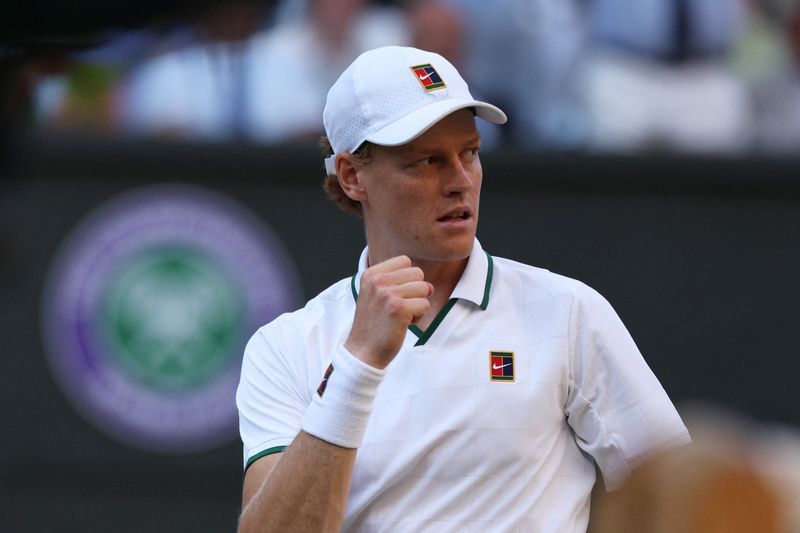
Jannik Sinner has successfully defended his Wimbledon championship, retaining the trophy with a hard-fought victory over Alexander Zverev in the final on Sunday. The 24-year-old Italian triumphed 6-7(7) 7-6(2) 6-3 6-4 in a match that showcased both players' considerable skill on grass while underscoring Sinner's exceptional consistency at major tournaments this year. The win adds significantly to his already impressive resume, bringing his Grand Slam tally to five titles and continuing an extraordinary run of form that has seen him dominate opponents across multiple surfaces.
Sinner's back-to-back Wimbledon titles place him among an exclusive group of players who have successfully defended the championship in the professional era. Becoming only the tenth man to accomplish this feat represents a significant milestone in his career trajectory, cementing his status as one of tennis's most formidable competitors. His victory also represents a symbolic moment in the broader narrative of tennis at the moment, as younger players continue to challenge the established hierarchy dominated by figures like Carlos Alcaraz, who currently holds seven Grand Slam titles. With five majors now in his possession, Sinner is closing the gap and establishing himself as Alcaraz's most serious rival in the coming years.
The match itself proved to be a compelling contest that tested both finalists across nearly four hours of tennis. The opening set exemplified the standard of play throughout, with both players engaging in extended rallies that demanded precision and athleticism. Zverev ultimately claimed this crucial opening set through a tiebreak, demonstrating the clinical execution required at the highest level of professional tennis. However, Sinner's ability to respond immediately, levelling the match at one set apiece, revealed the mental fortitude that has become his trademark this season.
A critical moment emerged in the third set when Zverev slipped and fell to the grass court after being deceived by one of Sinner's characteristic drop shots. The fall appeared serious as the second seed clutched his right knee in visible distress, prompting genuine concern from the Centre Court spectators. Despite the evident discomfort, Zverev courageously continued playing, though his mobility appeared compromised from that point forward. The injury seemed to prove pivotal in the match's trajectory, as Sinner capitalized immediately thereafter to break serve and establish what would ultimately prove an insurmountable advantage.
Sinner's composure under pressure manifested throughout the closing stages, particularly when consolidating his break advantage in the fourth set at 4-3. His ability to maintain focus and execute key shots when it mattered most reflected the experience he has accumulated through consecutive major tournament successes. The Italian ultimately closed out the contest with the kind of clinical efficiency that separates champions from contenders, before collapsing to the turf in a moment of emotional release that underscored the intensity of defending a Grand Slam title.
For Malaysian tennis enthusiasts and Southeast Asian followers of the sport, Sinner's sustained excellence represents an important reminder of the constantly evolving competitive landscape in professional tennis. The rise of younger players like Sinner, alongside contemporaries such as Alcaraz and Frances Tiafoe, indicates that dominance at the highest levels is no longer concentrated among a small group but distributed across a broader cohort of exceptionally talented athletes. This development creates a more unpredictable and compelling environment for fans across the region who follow international tennis.
The victory also extended Sinner's remarkable personal record against Zverev to ten consecutive victories, a statistic that underscores the mental edge the Italian has established over his German rival. This psychological advantage, combined with his superior technical execution in crucial moments, suggests that whenever these two meet in the future, Sinner will be considered the clear favourite. For Zverev, the loss represents his fourth Grand Slam final defeat, a reality that must weigh heavily on a player of his considerable talent and ambition.
In his post-match remarks, Sinner demonstrated the graciousness and perspective that increasingly characterizes his public persona. His acknowledgement of the privilege inherent in competing at Wimbledon, one of tennis's most iconic venues, reflected a maturity that extends beyond his on-court performance. He emphasized never taking such opportunities for granted, a sentiment that resonates particularly with younger athletes in developing tennis nations across Asia who aspire to reach such heights.
Zverev's response to the defeat, while understandably tinged with disappointment, illustrated the respect existing between these competitors. His self-deprecating humor and acknowledgement of Sinner's superiority suggested a player willing to learn from defeat rather than make excuses. The German's continued presence in Grand Slam finals despite his winless record in such matches indicates his quality remains undimmed, even if fortune and execution have not yet aligned in his favour.
Looking forward, Sinner's back-to-back Wimbledon triumphs establish him as the clear favourite for upcoming major tournaments on the calendar. His confidence, momentum, and refined grass-court skills suggest he will remain a formidable obstacle for any challenger in the months ahead. For the sport itself, the emergence of such talented younger players promises an exciting period of competitive tennis that should captivate audiences across Southeast Asia and beyond.

