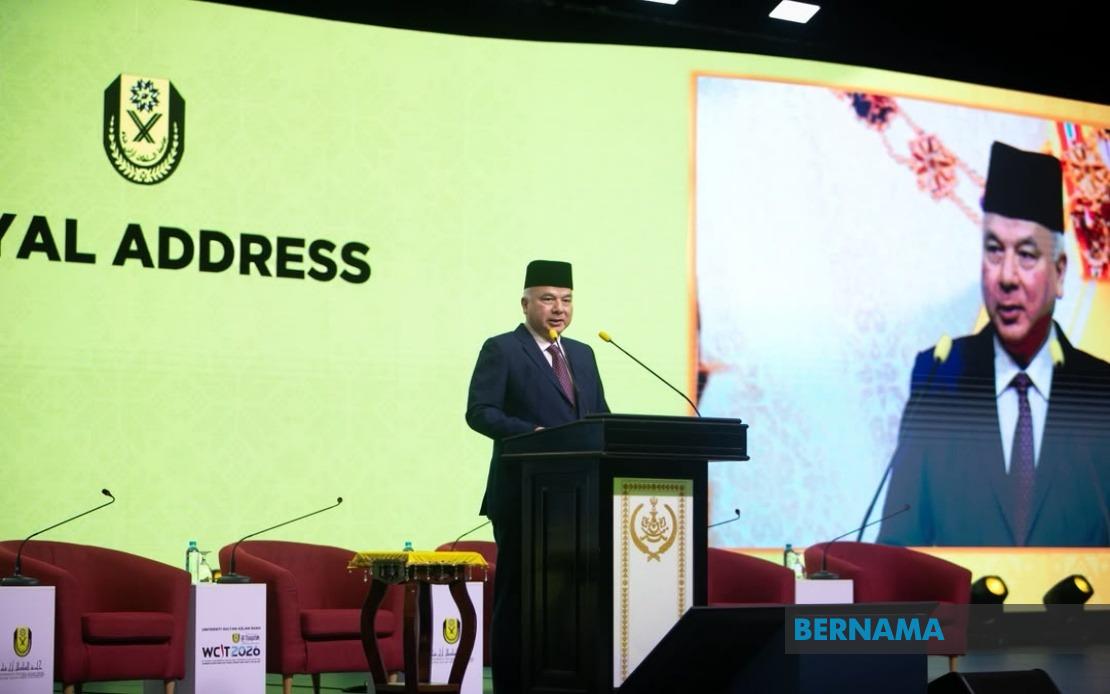
At the 8th World Conference on Islamic Thought and Civilisation in Ipoh on July 21, the Sultan of Perak, Sultan Nazrin Shah, presented a vision of national security that fundamentally challenges conventional military and counter-terrorism perspectives. While acknowledging that border defense and efforts to counter cyber threats and extremism remain necessary components of state security, His Royal Highness contended that these mechanisms pale in importance compared to the binding force of genuine social cohesion among citizens. This framing carries particular weight in Southeast Asia, where rapid modernization, religious diversity, and digital connectivity have created new fault lines that traditional security approaches struggle to address.
Central to Sultan Nazrin's argument is the distinction between security derived from coercive state apparatus and security rooted in citizens' fundamental sense of belonging and stake in national progress. The Sultan articulated a concern that extends beyond Malaysia's borders to the broader Muslim world: the weaponization of religious sentiment for factional political advantage. He specifically cautioned against narratives that exploit faith to justify division rather than unity, or that marginalize certain groups in the name of national interest. This formulation resonates with post-colonial nation-building challenges across the region, where competing visions of national identity have sometimes been weaponized by political actors seeking narrow electoral or ideological gains.
The Sultan's emphasis on inclusive governance structures reveals a sophisticated understanding of institutional design. His Royal Highness stressed that national integrity cannot be sustained through uniformity or suppression of dissent. Instead, genuine security emerges when every community perceives itself as having genuine agency within the nation's political and economic institutions. He pointed to the critical importance of seeing one's community represented fairly in legislation, economic policy, educational curricula, and leadership pipelines. Without such visibility and voice, he suggested, citizens lack the psychological investment necessary to uphold collective security arrangements, regardless of how well-funded the security sector becomes.
Particulately striking is Sultan Nazrin's diagnosis of the stability problem. He argued that a nation securing itself from external military threats while remaining corrupted internally and stratified by injustice has not genuinely achieved security at all, but merely postponed its reckoning. This observation speaks directly to governance challenges across Southeast Asia, where some nations boast impressive defense spending and military capabilities yet struggle with citizen alienation, institutional decay, and social fragmentation. The Sultan's framework suggests that investment in inclusive institutional legitimacy may deliver greater security dividends than equivalent expenditure on military equipment or surveillance systems.
The distinction between what Sultan Nazrin termed "unity built on coercion" and "unity built on shared belonging" provides a useful analytical tool for understanding regional security trajectories. Coercive approaches—whether through heavy-handed law enforcement, restrictions on expression, or marginalization of minority communities—create brittle social arrangements vulnerable to sudden rupture under stress. Conversely, societies in which diverse communities genuinely perceive themselves as stakeholders in shared success develop what the Sultan called "resilience," a quality increasingly recognized as essential for navigating contemporary challenges from pandemics to climate disruption to economic dislocation.
Sultan Nazrin's remarks also implicitly critique the securitization of religious discourse that has characterized portions of Malaysian and broader Southeast Asian politics. By explicitly framing religious faith as a vector for either unity or division, and emphasizing that authentic Islamic education cultivates the capacities for critical thought and ethical reasoning rather than compliance, the Sultan positioned sophisticated religious literacy as a counterweight to populist manipulation. His formulation suggests that communities with deeper theological understanding and historical consciousness are less susceptible to reductionist narratives that instrumentalize faith for political ends.
The educational dimension of the Sultan's address provides crucial specificity to his security framework. He argued that preparing citizens for an age of artificial intelligence and rapid technological change requires moving beyond rote memorization and standardized testing toward cultivation of critical thinking, ethical reasoning, creativity, and adaptability. Notably, he resisted a false choice between technical and humanistic education, instead arguing for equal dignity and investment in both academic and vocational pathways. This perspective reflects emerging evidence that societies maintaining broad-based human capital development, rather than narrow credentialing systems, generate more inclusive economic growth and lower social stratification.
Sultan Nazrin's emphasis on integrating revealed knowledge with rational inquiry within Islamic educational frameworks carries particular significance for the region. Many Southeast Asian Muslim-majority nations face questions about how to modernize educational systems while maintaining religious and cultural identity. The Sultan's framing suggests these need not be opposed, and that authentically Islamic education—properly conceived—naturally cultivates the capacities modern economies and resilient societies require. This offers intellectual cover for educational reformers seeking to expand STEM instruction and critical thinking within religiously-informed contexts.
The presence of high-ranking government officials at the conference—including Deputy Prime Minister Datuk Seri Fadillah Yusof, Perak Menteri Besar Datuk Seri Saarani Mohamad, and Higher Education Minister Datuk Seri Dr Zambry Abd Kadir—signals official endorsement of this reframed security paradigm. This institutional alignment suggests potential shifts in how Malaysian policymakers conceive security investment and national integrity priorities. For a region often characterized by tensions between technocratic governance and democratic legitimacy, between religious identity and secular modernization, the Sultan's synthesis offers a potentially stabilizing framework.
The practical implications of Sultan Nazrin's argument extend to specific policy domains across Southeast Asia. If social cohesion truly constitutes the most durable security foundation, then investments in transparent governance, equitable economic opportunity, inclusive educational access, and genuine community voice in decision-making processes may yield superior security returns compared to comparable spending on military capabilities or surveillance infrastructure. This reorientation would require substantial shifts in budgetary priorities and institutional arrangements across the region.
Ultimately, Sultan Nazrin's argument inverts conventional security hierarchies. Rather than treating citizen welfare and social inclusion as secondary benefits of a secure state, he positions genuine social cohesion—rooted in shared belonging and institutional legitimacy—as the irreducible foundation upon which all other security depends. For Malaysia and the broader region navigating identity questions, religious tensions, economic inequality, and technological disruption, this framework offers a compelling alternative to both militarization and fragmentation.

