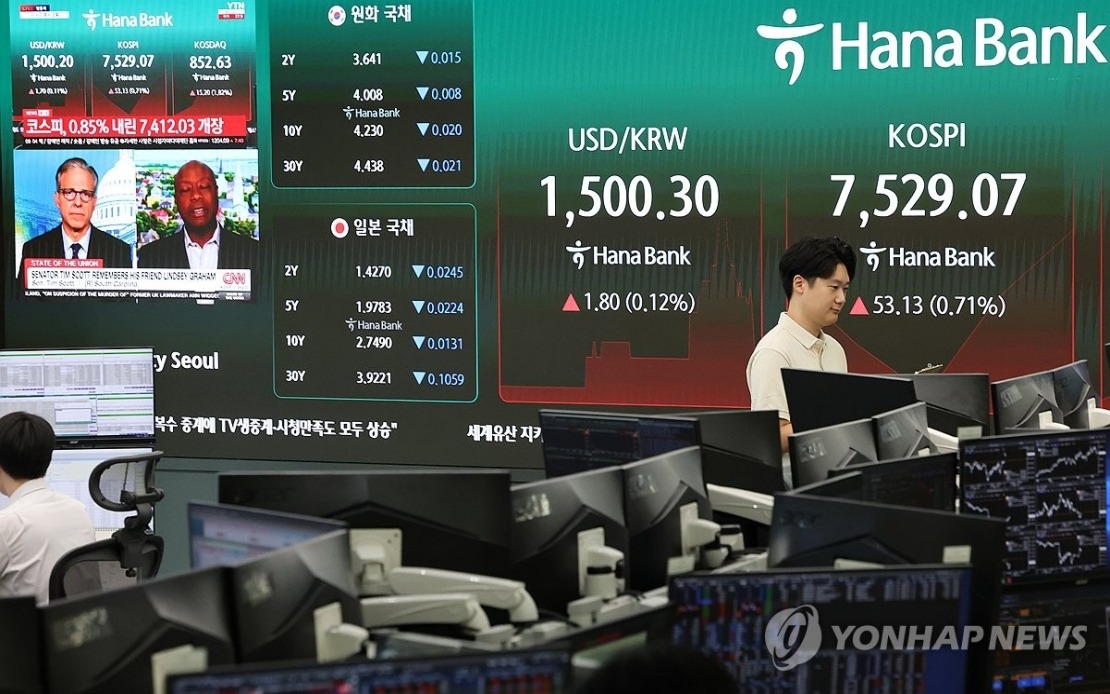
South Korea's main stock exchange triggered a trading halt on Monday as investor anxiety over military confrontation in the Middle East sent the nation's primary equity benchmark into freefall. The Korea Exchange (KRX) suspended trading in KOSPI-listed securities for 20 minutes after the Korea Composite Stock Price Index dropped sharply, marking a significant pullback from Friday's closing levels and underscoring the vulnerability of Asian markets to geopolitical shocks emanating from beyond the region.
The circuit breaker mechanism activated at approximately 1:28 p.m. local time once the KOSPI had declined more than 8 percent, a threshold breach that reflects the depth of selling pressure that gripped the market during the morning and early afternoon session. This defensive measure, designed to prevent panic-driven trading dynamics and allow market participants time to reassess their positions, has now been deployed seven times in 2024—a frequency that suggests heightened volatility remains embedded within South Korean equities.
Underlying the sharp downturn was renewed military escalation between the United States and Iran, with both powers executing fresh strikes in contested waters near the Strait of Hormuz. The geographic proximity of this flashpoint to critical global shipping lanes and energy supply routes creates cascading economic consequences that ripple far beyond the immediate conflict zone. For South Korea, a nation heavily dependent on energy imports and deeply integrated into global supply chains, any disruption to Middle Eastern stability carries outsized implications for inflation, manufacturing costs, and economic growth projections.
Investor caution in Seoul reflected broader unease spreading through Asian equity markets as traders reassessed the likelihood and potential scale of wider Middle Eastern conflict. The timing proved particularly sensitive given that South Korea's manufacturing sector remains vulnerable to commodity price shocks and any prolonged disruption to crude oil supplies could undermine the export-driven growth model that has anchored the economy for decades.
The KOSPI's vulnerability to external security incidents demonstrates how integrated modern financial markets have become with geopolitical risk factors. Unlike domestic political developments or earnings surprises, which allow for measured analytical responses, military confrontations introduce binary outcomes and uncertainty that institutional investors struggle to price with confidence. This asymmetry typically favors defensive positions and risk-off sentiment, precisely the dynamics that triggered Monday's heavy selling.
The circuit breaker system itself reflects hard-learned lessons from past market crises. By enforcing mandatory pauses during sharp declines, regulators aim to interrupt momentum-driven selling that can spiral into broader financial instability. Yet the mechanism's frequent activation this year suggests that structural volatility—whether rooted in geopolitical tensions, macroeconomic uncertainty, or shifting monetary policy expectations—remains a defining characteristic of current market conditions rather than an anomaly.
For Malaysian investors with exposure to South Korean equities or those monitoring regional market dynamics, Monday's gyrations carry instructive value. The event underscores how quickly sentiment can shift across Asia when external threats materialize, particularly those involving energy security or global trade disruption. Malaysian businesses operating in similar manufacturing and export-dependent sectors face comparable vulnerabilities, making careful monitoring of Middle Eastern developments not merely an academic exercise but a practical necessity for portfolio management and corporate planning.
The seventh circuit breaker activation of 2024 also signals that market volatility indices may remain elevated throughout the remainder of the year. Asset managers, pension funds, and retail investors across Southeast Asia operating within derivative markets or leverage positions need to account for these dynamics when calibrating hedging strategies and position sizing. A market prone to sudden halts and sharp reversals demands different risk management approaches than one exhibiting steady trends.
Technically, the 8 percent decline that triggered the circuit breaker represents substantial damage to equity valuations in a single session and typically requires significant fundamental reassessment or major tactical rotation among institutional investors. The sustainability of any recovery will depend heavily on whether fresh developments escalate or de-escalate the US-Iran situation, and whether markets assess the confrontation as isolated or the prelude to broader regional instability that would necessitate further downward repricing of growth expectations.
For the Korea Exchange, managing market stability during episodes of external shock remains a core operational challenge. While circuit breakers prevent the most chaotic trading conditions, they cannot fully insulate markets from the economic consequences of geopolitical disruption. Monday's trading halt provided breathing room but could not eliminate the underlying concerns driving the selloff, a limitation that structural safeguards will always face when confronting substantive shifts in risk perception.

