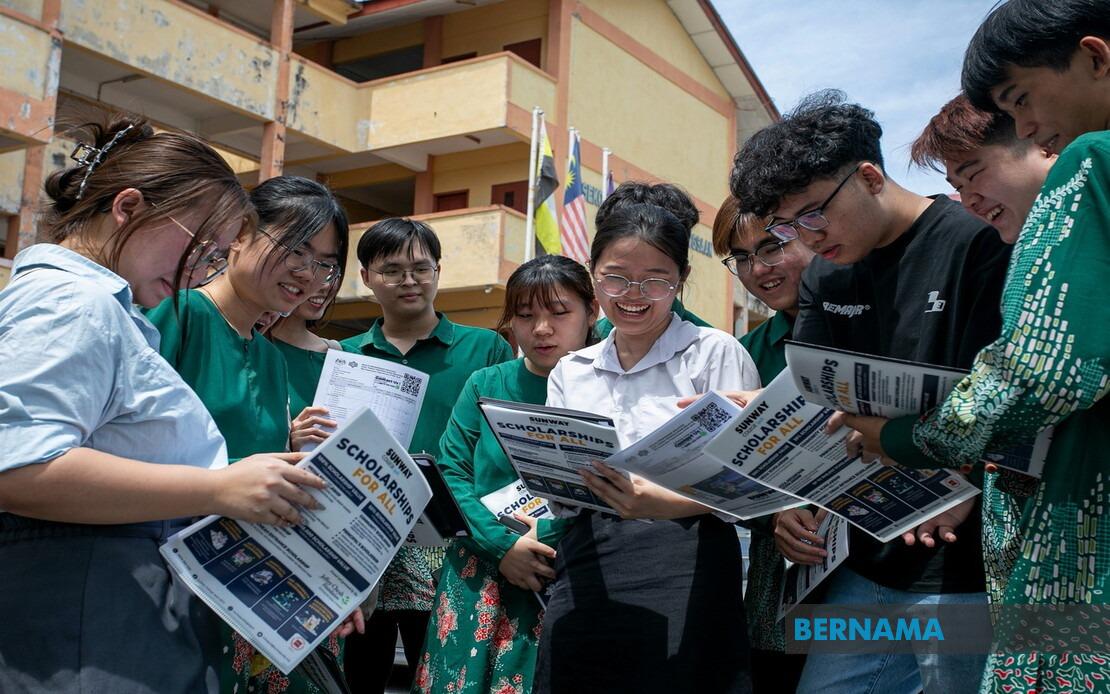
Malaysia's Sijil Tinggi Persekolahan Malaysia continues to establish itself as a viable and increasingly attractive option for school leavers seeking entry to university, drawing students from economically disadvantaged communities, minority groups, and those with disabilities who have excelled within its framework. The message from this year's cohort of top performers is clear: Form Six merit is not confined to a particular demographic, and the pathway deserves greater recognition among families unfamiliar with its benefits and competitive standing in both local and international contexts.
Hazaril Hakimi Hassan, a student from the indigenous settlement of Kampung Paya Mendoi in Kuala Krau, Pahang, emerged as one of Malaysia's highest achievers with a flawless 4.00 Cumulative Grade Point Average in the 2025 STPM examination. His accomplishment carries particular significance given that awareness of Form Six's advantages remains uneven across Malaysia, particularly in rural and marginalised communities where vocational and other post-secondary pathways have historically dominated career counselling. Hazaril's journey underscores the pivotal role played by educators and family encouragement in broadening horizons beyond conventional expectations.
At his award ceremony held at the Malaysian Examinations Council headquarters in Kuala Lumpur, Hazaril articulated how his understanding deepened once he grasped the genuine competitive edge that Form Six provides. His subsequent enrolment aspiration—a degree in Malay Language Education at Universiti Putra Malaysia leading toward an academic career—reflects a deliberate career pathway informed by confidence in his preparation. This trajectory illustrates how STPM equips students not merely with examination credentials but with the intellectual foundations necessary for specialised professional study.
Simultaneously, Ng Yu Yong from SMK Tsung Wah in Perak also achieved a perfect 4.00 CGPA while maintaining particular excellence in Physics and Biology—subjects fundamental to medical training. Ng's perspective carries weight for cost-conscious families: he explicitly identified Form Six's financial accessibility as a decisive advantage over alternatives, a consideration that resonates widely across households unable to finance international or private tertiary education upfront. His advocacy for STPM as a deliberately superior choice for those targeting excellence rather than merely passing demonstrates how perception among peers influences uptake of the qualification.
Ng's ambition to study Bachelor of Medicine and Bachelor of Surgery at Universiti Malaya reflects a confidence born of rigorous preparation within the STPM system. He positioned Form Six not as a compromise pathway but as the optimal foundation for competitive entry into high-demand professional programs. His encouragement to younger students to view Form Six as personally transformative—a means of developing capacity and academic capability—counters the lingering perception among some Malaysian families that the qualification represents a less ambitious choice compared to alternatives.
The international dimension of STPM's value proposition emerged plainly in graduate commentary: the qualification maintains recognition across leading universities worldwide, facilitating mobility for Malaysian students who wish to pursue postgraduate or professional qualifications abroad. This global portability, combined with locally recognised credentials, positions Form Six as genuinely flexible for families with varied aspirations, whether their children intend to remain within Malaysia's higher education ecosystem or seek opportunities internationally.
Yeoh Chwen Yih's achievement—a perfect 4.00 CGPA while navigating visual impairment—represents perhaps the most compelling argument for STPM's inclusivity credentials. As a student at St John's Institution, Yeoh benefited from screen-reading technology integrated into Form Six's learning environment, enabling access to course materials more swiftly than Braille-based alternatives. This pedagogical accommodation transformed the learning experience from one of constraint into one of genuine inclusion, permitting a visually impaired student to compete academically on terms approaching equality with sighted peers.
Yeoh's case illuminates a critical distinction often overlooked in discussions of tertiary access: infrastructure and technological support matter as much as raw admission policy. While Form Six may not be the sole provider of such accommodations within Malaysia's education system, the demonstrated willingness to implement assistive technologies signals an institutional commitment to removing barriers that disadvantaged learners face. For students with disabilities contemplating their options beyond Form Five, STPM's track record of facilitating participation represents a tangible advantage warranting serious consideration.
The diversity evident across these award-winning cohort members—spanning rural indigenous populations, urban middle-class strivers, and students with disabilities—testifies to STPM's capacity to serve as a genuinely broad-based educational platform. Yet awareness of this inclusive reality remains patchy. Many Malaysian families, particularly those without recent experience of the education system or lacking professional networks to provide guidance, remain unduly influenced by residual perceptions of Form Six as an outdated or inferior option. Investment in targeted information campaigns highlighting success stories from diverse backgrounds could substantially influence enrolment patterns and school selection decisions among younger cohorts.
The cost differential between STPM and fee-paying alternatives merits emphasis, particularly for policymakers concerned with equity in tertiary access. Ng Yu Yong's explicit advocacy for Form Six as the financially prudent choice for families of modest means addresses a genuine constraint shaping educational opportunity in Malaysia. As private tertiary providers expand and international study becomes increasingly marketed as a status symbol, the public STPM pathway risks being marginalised despite its superior value proposition for many households.
Looking forward, the visibility accorded to top STPM performers through formal recognition from the Malaysian Examinations Council serves a valuable function in reshaping institutional reputation and influencing family decision-making around Form Six enrollment. When prospective students encounter narratives of perfect academic achievement, international recognition, inclusive learning environments, and cost-effectiveness emanating from verified STPM graduates, the case for the pathway strengthens considerably. The challenge now lies in ensuring such narratives reach the families and communities for whom information accessibility remains most limited.