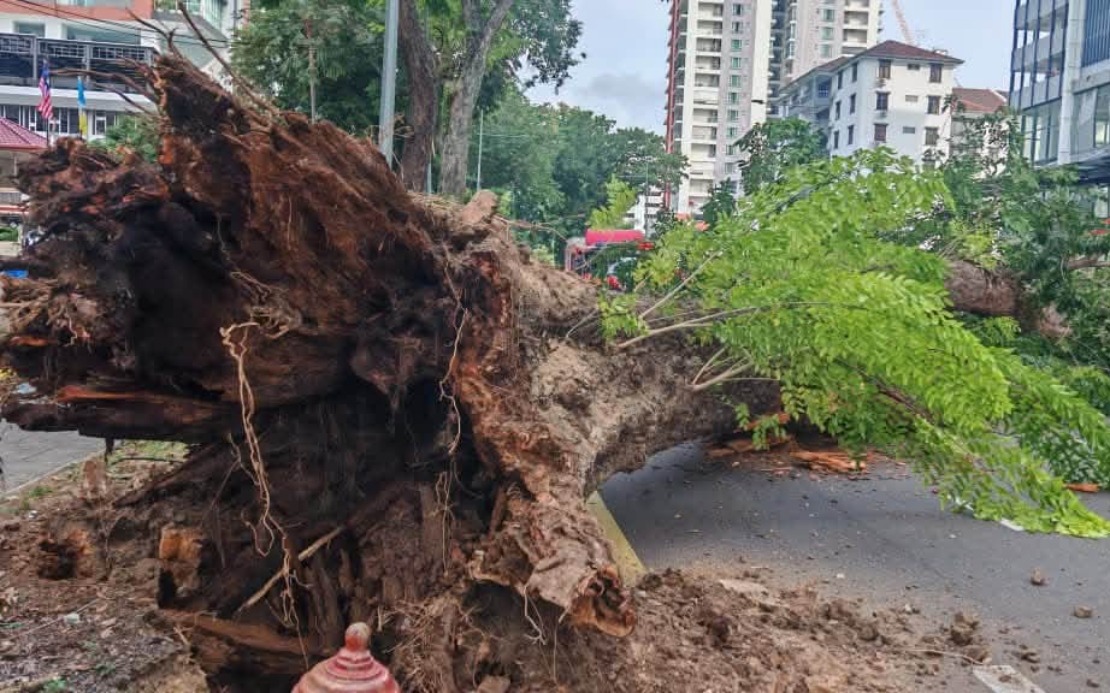
A towering 90-year-old Angsana tree came down on Jalan Macalister in George Town on August 9, crushing a Perodua Ativa SUV carrying three people, including an elderly couple and their grandchild. The collapse of the 28-metre Pterocarpus indicus has prompted Penang's municipal authority to launch a wider reassessment of ageing trees across the city's streets, highlighting the challenges of urban forestry management in tropical cities where structural decay can advance rapidly beneath an apparently healthy canopy.
MBPP Mayor Datuk A. Rajendran attributed the incident to a convergence of degenerative factors that weakened the tree's structural integrity. Internal examination revealed approximately 30 per cent root rot within the root system, while cavity decay consumed roughly 40 per cent of the base trunk. These organic failures were amplified by external pressures: chronic soil compaction around the tree's base, severely restricted rooting space, and the considerable vertical load imposed by the tree's height. The combination created a critical structural liability that ultimately gave way, though notably without preceding heavy rain or strong winds that might have provided obvious warning signs.
The incident occurred at approximately 9 am, and emergency response teams began removing the fallen timber by 9.41 am the same morning. Municipal authorities completed clearing operations and reopened Jalan Macalister to traffic by 2.20 pm. The swift response prevented secondary complications from the blockage, though questions about earlier detection and prevention have naturally surfaced given the tree's advanced age and the extent of internal damage ultimately discovered.
Municipal authorities had undertaken a systematic assessment of mature and aged trees along Jalan Macalister during 2024, identifying 13 specimens as candidates for removal. All 13 have now been felled as a precautionary measure. Notably, the most recent maintenance intervention on the street occurred on January 29 this year, suggesting that routine care had been undertaken relatively recently. A remote sensing study conducted in the preceding year had classified trees along the corridor as being in generally sound condition with no obvious warning indicators, underscoring how technological monitoring can sometimes miss internal decay processes that progress silently within the heartwood.
The broader context reveals that Penang's municipal government operates within significant resource constraints when managing the city's aging arboreal infrastructure. During 2024 alone, 179 high-risk trees received formal approval for felling citywide, of which 148 had been removed by the time of the Jalan Macalister incident. Through the first three quarters of the year, 247 trees had been felled across the municipality for various reasons. These removals addressed multiple urban forestry challenges: trees obstructing stormwater drainage systems, specimens that had died despite treatment efforts, trees leaning at dangerous angles, specimens posing imminent collapse risks, trees situated within development project footprints, and trees encroaching on infrastructure corridors including those belonging to Penang Water Supply Corporation.
A comprehensive audit conducted in 2024 identified 2,535 trees requiring attention across various risk categories and situations. These included 45 cases where trees obstructed drainage function, 138 that were formally classified as dead, 2,242 assessed as presenting risk factors or falling under miscellaneous problem categories, and 110 connected to development or infrastructure expansion projects. This granular cataloguing suggests that Penang's municipal authorities have developed systematic methodologies for risk stratification, though the sheer volume of problematic specimens indicates that implementation timelines necessarily extend across multiple budget cycles.
Following the Jalan Macalister collapse, municipal officials have adopted a more aggressive posture regarding tree safety on that corridor specifically. Authorities have instructed the contracted tree management company to accelerate work schedules focused on reducing the height of vulnerable specimens and removing additional trees that certified arborists have flagged as presenting potential collapse hazards. This reactive intensification highlights the practical dilemma confronting tropical municipalities: comprehensive preventive action would be economically optimal, yet budget constraints typically force a crisis-response model where action accelerates following high-profile incidents.
For Malaysian municipal administrators and urban planners, the incident illustrates a critical tension in contemporary city management. Mature trees provide invaluable ecosystem services—cooling effects that reduce urban temperatures, stormwater absorption, air quality improvement, and psychological benefits to residents. Yet as trees age in constrained urban environments with soil compaction and infrastructure pressures, their structural failure risks escalate exponentially. The Angsana tree's internal decay had progressed to advanced stages before external manifestations triggered removal.
Regional cities across Southeast Asia face similar challenges as post-independence street trees planted 50 or 60 years ago now reach senescence simultaneously. Kuala Lumpur, Bangkok, and Singapore grapple with comparable assessments of aging urban forests. The technical solution—systematic arboricultural auditing, risk-based removal and replacement programmes—requires sustained funding and political commitment. Penang's experience suggests that even relatively well-resourced municipalities struggle to maintain optimal urban forest health when confronted with the scale of simultaneous aging across extensive tree populations.
The incident also raises questions about soil management in urban contexts. The compacted soil conditions noted by authorities represent a chronic problem in tropical cities where intensive development and repeated infrastructure construction cycles crush rooting zones. Future tree health depends not only on selecting appropriate species but on creating adequate soil volumes with proper drainage and aeration. Current practices often reflect historical design standards that underestimated these requirements.
Moving forward, Penang's experience offers practical lessons for other Malaysian municipalities and regional cities. Systematic risk assessment protocols, certified arborist involvement in decision-making, and acceptance that some mature trees will require removal despite their heritage value all represent necessary components of responsible urban forestry. The challenge lies in communicating these decisions to communities that may regard older trees as irreplaceable elements of urban heritage, even when structural science indicates imminent failure risks.
The replacement and replanting strategy following large-scale removals deserves equivalent attention. Simply felling problematic trees without establishing robust regeneration protocols leaves gaps in urban canopy cover. Penang's municipal authorities have implicitly acknowledged this through their concurrent maintenance and removal activities, though specific replanting targets and species selection criteria remain less publicly detailed. For Southeast Asian cities planning to manage their aging urban forests responsibly, such integrated approaches—combining removal of hazardous specimens with intentional regeneration—offer the most sustainable pathway forward.

