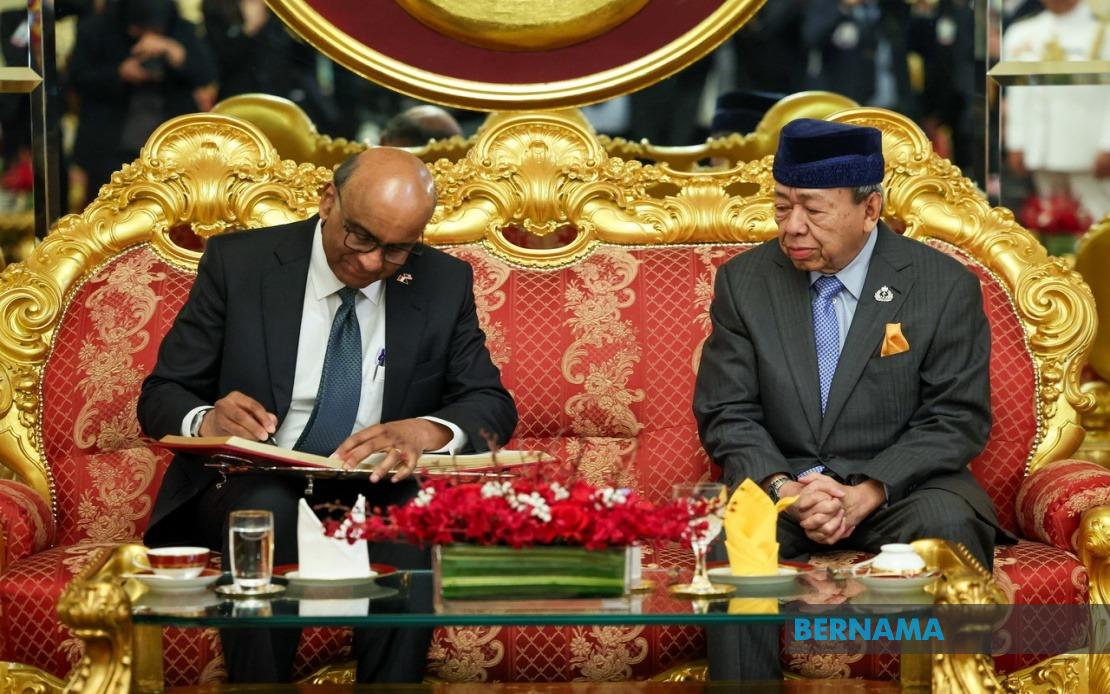
The Sultan of Selangor, Sultan Sharafuddin Idris Shah, welcomed Singapore President Tharman Shanmugaratnam at Istana Alam Shah on July 14 in a formal audience that underscored the ceremonial importance of the neighbouring state's current visit to Malaysia. The meeting, which commenced at 11 am, represented a key diplomatic engagement during the president's three-day stay in the country from July 13 to 15, a visit undertaken at the invitation of His Majesty Sultan Ibrahim, King of Malaysia.
The 90-minute audience concluded at 12.40 pm, providing an extended period for bilateral discussions at the highest level. Tharman was met upon arrival by the Raja Muda of Selangor, Tengku Amir Shah, reflecting the protocol accorded to visiting heads of state. The formal nature of the reception demonstrated the significance both Kuala Lumpur and Singapore place on their bilateral relationship and the state institution's role in representing Malaysian sovereignty during international engagements.
Minister for Entrepreneur Development and Cooperatives Steven Sim attended the session in his capacity as minister-in-attendance, facilitating the visit on behalf of the federal government. His presence illustrated the coordinated approach between state and national authorities in managing high-level diplomatic interactions. The appointment of a specific minister to oversee visiting dignitaries ensures smooth protocol arrangements and serves as a liaison between the palace and the government establishment.
The Singapore president's journey to Selangor forms part of a broader reciprocal diplomatic exchange. The Foreign Ministry clarified that this state visit mirrors His Majesty Sultan Ibrahim's own visit to Singapore on May 6 and 7, 2024, continuing the established pattern of leadership visits that periodically reinforce ties between the two nations. Such reciprocal arrangements are standard practice among neighbouring Southeast Asian governments and signify mutual respect and commitment to maintaining robust bilateral relations.
The timing and nature of this audience acquire additional significance given the scale of economic interdependence between Malaysia and Singapore. Singapore stands as Malaysia's second-largest trading partner worldwide and represents the most substantial trading relationship Malaysia maintains with any of its fellow ASEAN member states. This commercial dimension underpins the political engagement, as sustained trade flows worth billions of ringgit annually depend partly on the stable diplomatic environment that state visits help reinforce.
Beyond the immediate commercial considerations, the bilateral relationship encompasses critical infrastructure linkages, investment flows, and people-to-people contacts. The causeway connections between the two territories facilitate daily movement of tens of thousands of workers, students, and traders, making consistent diplomatic engagement essential for managing the complexities arising from such intensive cross-border activity. Presidential visits to state capitals like Selangor signal recognition of regional governance structures and their role in the broader national framework.
From a Malaysian perspective, hosting visiting heads of state at istana ceremonies affirms the constitutional monarchy's position as guardian of national sovereignty and custodian of diplomatic relations. The Sultan's audience with President Tharman demonstrated how state rulers participate in international protocol, lending legitimacy and gravitas to government-to-government interactions. This ceremonial dimension remains particularly important in Malaysia's Westminster-influenced constitutional system, where monarchical institutions serve significant symbolic and diplomatic functions.
The three-day duration of the visit allows for multiple levels of engagement beyond the Selangor audience. Such visits typically encompass meetings with the federal government, parliamentary leadership, and visits to economic or cultural institutions, creating multiple touchpoints for substantive dialogue. The spread of engagements across both state and national levels reflects the federated nature of Malaysian governance and ensures that both administrative tiers benefit from exposure to international counterparts.
For Singapore, such state visits reaffirm the small nation's standing as an equal diplomatic partner despite its size and population. The formal reception at Istana Alam Shah, with appropriate ceremonial protocols, sends a clear message about Singapore's status within the regional hierarchy. These gestures carry particular weight for island city-states whose security and prosperity depend significantly on the goodwill and stability of neighbouring larger nations.
The economic relationship between Malaysia and Singapore deserves emphasis precisely because it extends well beyond simple trade statistics. Singapore hosts significant Malaysian investments, particularly in the financial and petrochemical sectors, while Malaysian companies operate extensively in Singapore's port, shipping, and services industries. The diplomatic framework that visits like this help sustain provides the confidence necessary for private sector actors to undertake long-term commitments across borders.
Looking forward, the outcomes of such visits often materialise gradually in the form of enhanced cooperation agreements, joint working groups, or renewed commitments to existing frameworks. While formal joint statements may not immediately emerge, the goodwill generated through respectful high-level engagement creates conditions favourable for resolving bilateral issues and pursuing mutually beneficial initiatives. The 90-minute discussion between the Sultan and the Singapore president likely touched on trade facilitation, regional security concerns, and people-to-people exchanges.
The visit also illustrates how Malaysia's federated system allows state governments and institutions to participate meaningfully in international relations. Unlike unitary nations where all diplomatic activity emanates from the centre, Malaysia's constitutional arrangement gives rulers significant ceremonial and symbolic roles in receiving foreign dignitaries. This distribution of diplomatic responsibilities across state and federal levels reflects the country's unique constitutional design and the special position of the Malay Sultanate.

