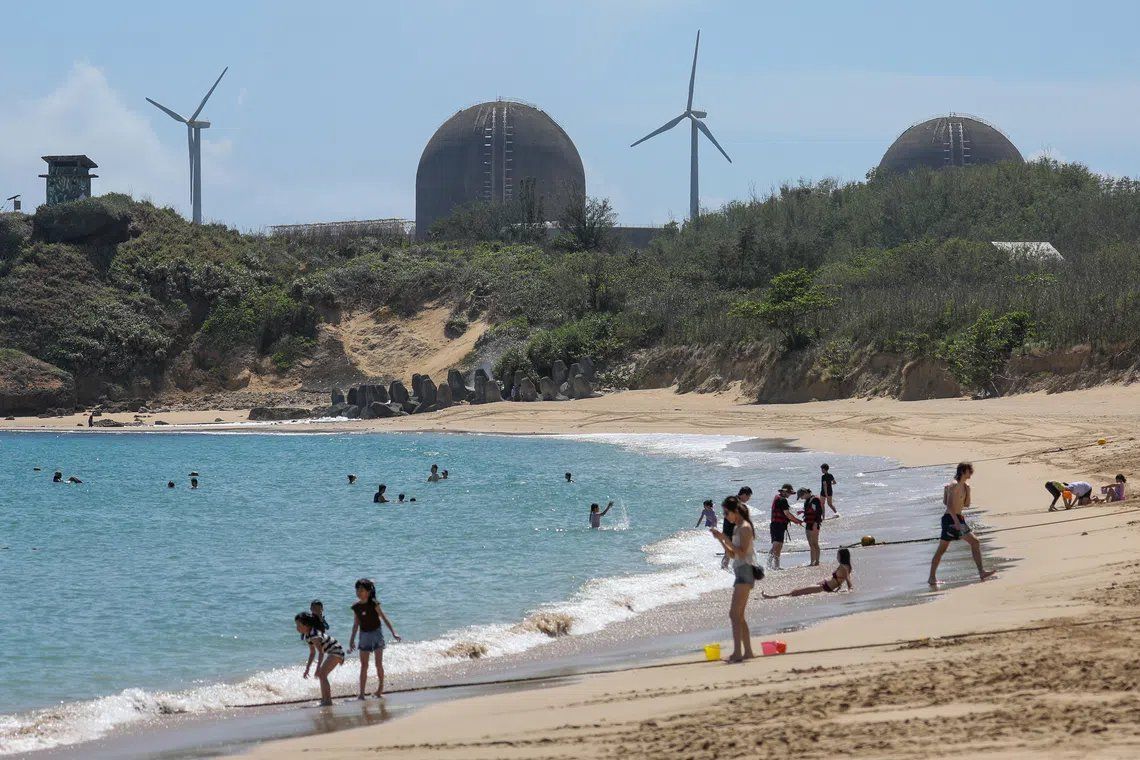
Taiwan faces another pivotal decision on nuclear energy this November, as voters head to the polls for comprehensive local elections that will determine the leadership of counties, cities, and multiple administrative levels across the island. The referendum on whether to abandon the government's "Nuclear-Free Homeland" policy represents a continuation of the energy debate that has animated Taiwanese politics for years, yet observers increasingly question whether such direct democracy mechanisms have been captured by partisan interests rather than serving as genuine expressions of popular will.
The November 28 "nine-in-one" elections will be accompanied by a nuclear referendum that asks whether the government should reverse course on its zero-nuclear commitment in order to address mounting concerns about electricity supply reliability, affordability, and the island's capacity to support energy-intensive artificial intelligence development. This represents the fourth time Taiwanese voters have weighed in on nuclear policy within just eight years, with the previous referendum occurring merely a year ago in August 2024. The rapid succession of identical questions raises fundamental concerns about whether the referendum process has become untethered from meaningful policy deliberation and instead functions as an extension of electoral campaigns.
The Central Election Commission approved only one of three proposed referendums submitted this year, offering insights into how Taiwan's political system filters these initiatives. Authorities rejected a separate referendum on legalising caning for serious crimes, determining it would violate human rights principles. Another defeated proposal would have earmarked all traffic fine revenue for road safety improvements and public transport subsidies. The approval of the nuclear referendum while rejecting others suggests that institutional gatekeepers do exercise discretion, yet the pattern of approving repeated votes on identical energy questions warrants scrutiny.
Explaining the timing and substance of this referendum requires acknowledging genuine shifts in Taiwan's energy landscape since the August 2024 vote. Disruptions to global petroleum supplies resulting from tensions at the Strait of Hormuz have renewed urgency around securing reliable power sources. The explosive growth in artificial intelligence deployment has simultaneously sparked legitimate concerns about whether Taiwan's electricity infrastructure can sustain the computational demands of this sector. These material circumstances provide a plausible policy justification for revisiting the nuclear question. Yet among Taiwanese political scientists and analysts, the consensus increasingly points toward electoral calculation as the dominant motive driving the referendum onto the November ballot.
The opposition Kuomintang and Taiwan People's Party appear to view the nuclear question, alongside other contentious issues, as a mechanism to mobilise their conservative-leaning voter bases during the local election cycle. Political precedent supports this theory. When Taiwan held ten national referendums alongside the 2018 local elections, the KMT achieved exceptionally strong results, suggesting that concurrent ballot measures can effectively drive turnout among opposition sympathisers. Qi Dongtao, a senior research fellow specialising in Taiwanese politics at the National University of Singapore's East Asian Institute, characterises this electoral consideration as potentially weightier than the substantive policy merits of the referendum itself. The higher turnout generated among conservative voters through contentious referendum questions could prove decisive in closely contested races for county magistrates and city mayors, where margins often remain razor-thin.
Beyond simple turnout mechanics, opposition parties utilise referendums as vehicles for framing broader narratives about governance competence and values alignment. The rejected caning referendum proposal illuminates this dynamic particularly clearly. The KMT has strategically positioned itself as defending tough-on-crime policies while characterising the ruling Democratic Progressive Party as hampering law enforcement through permissive laws and constitutional constraints. Chong Ja Ian, an associate professor of political science at NUS, notes that Singapore functions symbolically within Taiwanese political discourse as an exemplar of orderly governance and material prosperity, making it a powerful reference point when opposition parties attempt to demonstrate their commitment to security and discipline. By proposing measures they know will fail but that resonate with their supporters' values, opposition politicians craft narratives about which party truly represents their constituents' preferences and priorities.
The proliferation of referendums represents a relatively recent phenomenon in Taiwanese politics, directly traceable to 2017 institutional reforms that fundamentally lowered the barriers to holding and passing popular votes. Previously, referendums required 50 per cent turnout to achieve validity, a threshold that proved insurmountable even when voters overwhelmingly supported the measures on the merits, as demonstrated when Chen Shui-bian's cross-strait relations referendums in 2004 failed despite commanding overwhelming support. Current rules allow a referendum to pass whenever "Yes" votes exceed "No" votes and affirmative votes represent at least 25 per cent of the total electorate. This dramatic lowering of the passage threshold, combined with reduced procedural requirements for initiating referendums, unleashed a flood of popular votes that critics argue has fundamentally compromised the process.
Taiwanese legal scholars have begun expressing alarm at the quality and pace of deliberation surrounding these referendums. Associate Professor Lin Jia-he from National Chengchi University's College of Law points out that Switzerland, frequently cited as a model of direct democracy, typically allows three to five years between a referendum proposal's initial submission and the final vote, providing ample opportunity for government agencies and citizens to engage in thorough deliberation about complex policy tradeoffs. Taiwan's current process compresses this timeline dramatically, with the 2026 nuclear referendum announced on August 28 and scheduled for a November 28 vote just three months later. Within such a compressed timeframe, meaningful public discussion of "rigorous, complex and diverse" energy policy combinations becomes practically impossible, leaving voters to decide consequential technical questions without adequate information or time for reflection.
The transformation of referendums into instruments of partisan competition represents a corrosive development for Taiwan's democratic institutions. Qi Dongtao argues that when political parties strategically weaponise referendums by proposing contentious issues specifically designed to mobilise their supporters and attract media attention, direct democracy mechanisms become "another arena of partisan competition" rather than genuinely popular expressions of policy preference. The ideal function of referendums, in this analysis, should be reserved for genuinely major questions where compelling reasons exist to bypass representative institutions and seek direct popular authorisation. When used routinely as supplementary weapons in party competition, referendums lose their legitimacy as expressions of the popular will and instead become perceived as manipulative electoral tactics.
Taiwanese voters themselves increasingly exhibit scepticism toward the referendum process, suggesting that this instrumental weaponisation has not gone unnoticed by the electorate. Sean Chang, a 39-year-old public relations professional and Taipei resident, initially viewed referendums as well-intentioned democratic mechanisms but has come to regard them as "a tool for each political party to manipulate public opinion." His experience reflects broader patterns of disengagement, as the constant stream of ballot measures has prompted some voters to abandon the effort of developing informed opinions on every issue placed before them. Chang participated in the 2018 election cycle when ten referendums appeared alongside local races but has since withdrawn from active engagement with subsequent rounds of popular votes.
The November elections will determine the fate of approximately 11,051 local public officials across Taiwan's counties and municipalities. While local campaigns typically emphasise domestic governance issues directly affecting residents' daily lives, political analysts view these contests as harbingers of sentiment that will shape Taiwan's national political trajectory leading toward presidential elections scheduled by 2028. The concurrent nuclear referendum will neither resolve nor settle Taiwan's energy policy debate; rather, it will constitute another chapter in an ongoing partisan struggle over how direct democracy mechanisms should function within a vibrant electoral system. Whether Taiwan's institutions can eventually restore referendums to their intended function as genuine expressions of popular will, rather than allowing them to remain tools of electoral manipulation, will likely determine the credibility of direct democracy in Taiwan for years to come.

