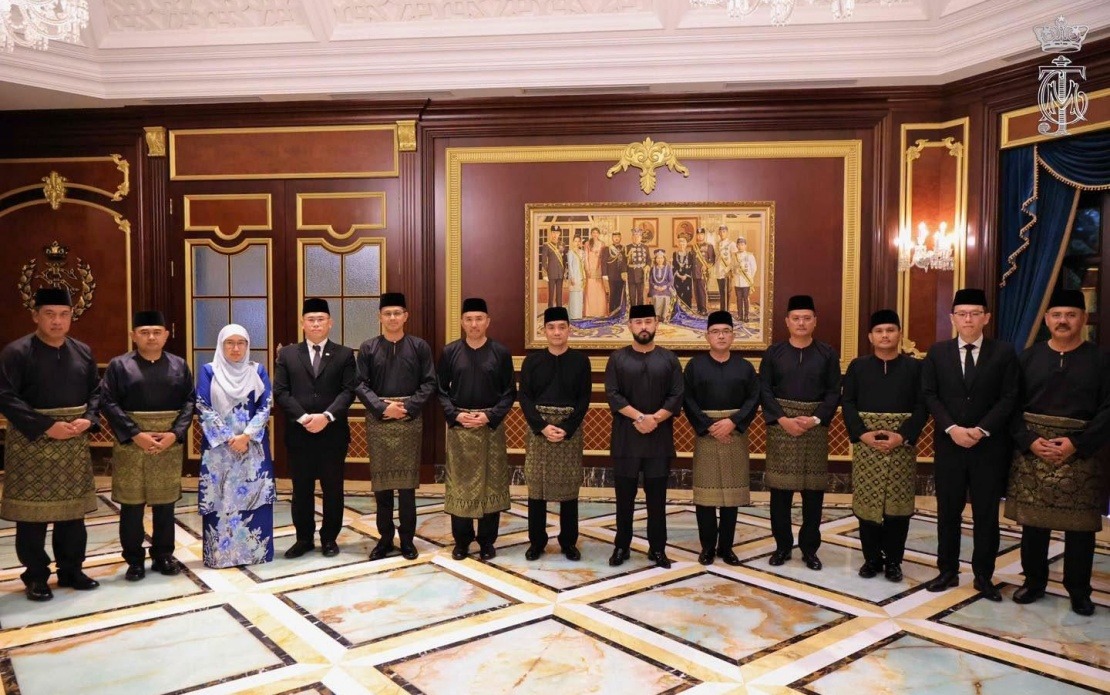
Ten Johor assemblymen were formally sworn in as members of the state's Executive Council during a ceremony held at Istana Bukit Serene in Johor Bahru, with the Regent of Johor, Tunku Mahkota Ismail, presiding over the proceedings. The swearing-in marked the completion of the state cabinet formation following Barisan Nasional's decisive performance in the recently concluded state elections, underscoring the coalition's control over the state apparatus for the foreseeable future.
The new executive council brings together a mix of experienced political figures and fresh talent entering the state cabinet for the first time. Among those taking office were Mohd Hairi Mad Shah from Larkin, Datuk Mohd Jafni Md Shukor representing Bukit Permai, Mohd Fared Mohd Khalid of Semerah, Ling Tian Soon from Yong Peng, Lee Ting Han from Paloh, and Mohamad Fazli Mohamad Salleh of Bukit Pasir. These six members bring established track records in state-level politics and represent the continuity of leadership that voters endorsed during the election.
Four additional assemblymen made their maiden entry into the state executive council, signalling efforts to inject new perspectives into government decision-making. Md Israk Abdullah, elected from Kukup, P. Pannir Selvam from Perling, Hasrunizah Hassan representing Pulai Sebatang, and Muhammad Naqib Md Ghazali from Panti will now shoulder responsibilities in managing state affairs. The inclusion of these four first-time exco members reflects a deliberate strategy to blend experienced governance with emerging leadership talent within the Barisan coalition.
The ceremony witnessed the presence of key state officials, including Menteri Besar Datuk Onn Hafiz Ghazi, who leads the new administration. Also in attendance were Royal Court Council Yang Dipertua Datuk Dr Abdul Rahim Ramli and State Secretary Datuk Mohammed Ridha Abd Kadir, underscoring the formal and constitutional importance assigned to the occasion. The gathering at the royal palace reinforced the ceremonial weight of the transition and the legitimacy conferred by the royal institution on the newly formed executive council.
Onn Hafiz, the Machap assemblyman and Johor Barisan Nasional chairman, had secured his position as Menteri Besar for a second consecutive term following Barisan Nasional's sweeping performance in the 16th Johor state election. His return to the top post came just days before the exco swearing-in, establishing continuity in state leadership and allowing him to proceed with cabinet formation without delay. The Menteri Besar's re-election demonstrated voter confidence in his administration's performance during his first term and the broader appeal of Barisan's platform within Johor's electorate.
Barisan Nasional's electoral dominance in Johor cannot be overstated, with the coalition capturing 48 out of 56 available state seats—a commanding majority that grants substantial legislative room to pursue the government's agenda without reliance on independent or opposition support. This overwhelming mandate provides the administration with a five-year window to implement policies and programmes without the constraints that narrow majorities often impose. For a state as economically and strategically important as Johor, the clear electoral outcome offers stability and policy continuity that can benefit long-term planning and investment.
Onn Hafiz's personal victory in Machap exemplified the strength of his political position within the state. Securing the seat with a majority of 15,375 votes reflected not merely personal popularity but also broader acceptance of Barisan's governance approach among the Machap constituency. His commanding performance at the grassroots level provided him with enhanced authority to shape the state cabinet and pursue his policy priorities without internal factional challenges that might otherwise complicate decision-making at the executive level.
The formation of this new executive council occurs at a critical juncture for Johor's development agenda. As one of Malaysia's most economically dynamic states, Johor faces multiple simultaneous challenges including rapid urbanisation, the need to maintain manufacturing competitiveness, and balancing growth with social stability. The exco members will need to oversee state finances, infrastructure development, and implementation of state government programmes while managing the expectations of a diverse electorate that delivered such a decisive mandate. The cabinet's composition suggests an attempt to ensure geographical representation across different districts within Johor.
The swearing-in ceremony also symbolised institutional continuity within Johor's governance framework. Despite electoral contests and political transitions, the formal procedures conducted at Istana Bukit Serene demonstrate that constitutional processes remain paramount in Malaysia's federal system. The royal institution's central role in administering oaths reflects the constitutional monarchy's enduring significance in legitimising political authority and ensuring that changes in government occur within established legal frameworks rather than through extra-constitutional means.
The time gap between Onn Hafiz's own swearing-in as Menteri Besar and the exco members' oath-taking was brief, allowing the new administration to assume full operational capacity relatively quickly. This expedited formation process stands in contrast to some other state governments where cabinet-building has taken considerably longer, sometimes leading to prolonged uncertainty regarding specific ministerial portfolios and their allocation. Johor's faster transition offers a clearer picture of how the state government intends to function and which leaders will oversee specific policy domains during the coming term.
As Malaysia continues to decentralise certain functions to state governments and as Johor assumes greater responsibility for economic development and social services, the capability and cohesion of state executive councils become increasingly important. The new Exco's effectiveness in addressing issues from education and healthcare to infrastructure and economic diversification will significantly impact not only Johor's residents but also broader regional economic dynamics within Southeast Asia. The state's role as a crucial economic hub and its strategic geographic position bordering Singapore mean that governance decisions made in Johor carry implications extending well beyond state boundaries.

