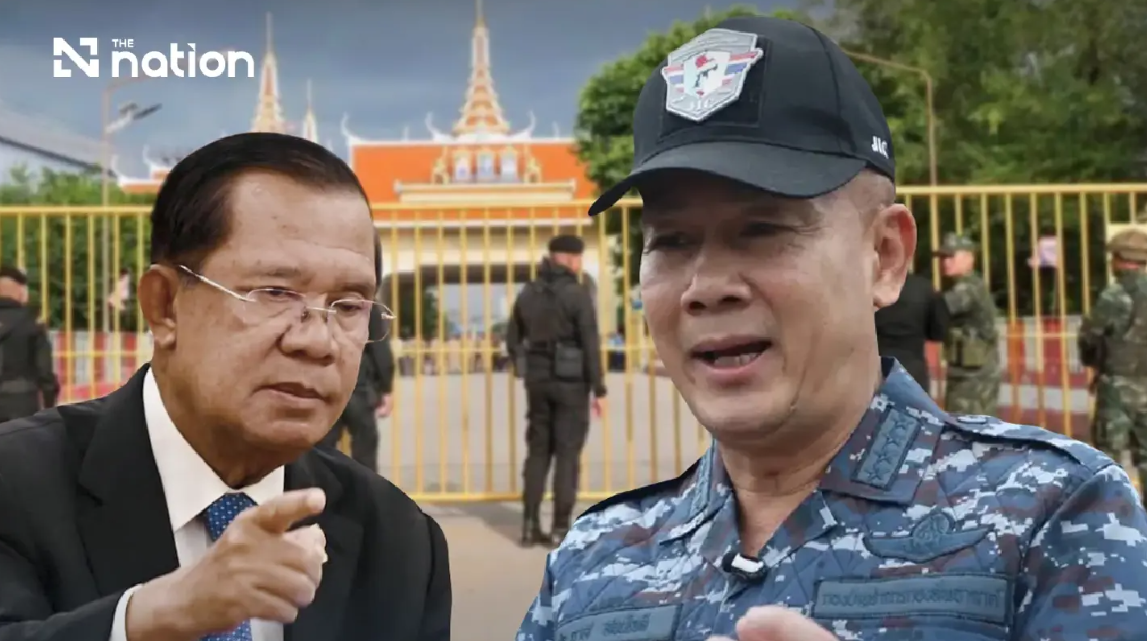
The Thai government has firmly contested accusations from Cambodian Senate President Hun Sen that it exploited a crackdown on scam operations as justification for occupying territory across their shared border. Air Chief Marshal Prapas Sonjaidee, director of the Joint Information Centre on the Thailand-Cambodia Situation, dismissed the characterisation of Thailand's actions as "modern warfare" during remarks on Friday, insisting that such serious allegations demand rigorous factual scrutiny rather than speeches at international forums.
The dispute centres on how the two nations interpret military activities along their porous and disputed frontier. Hun Sen has framed Thailand's response to transnational scamming networks—which have become a significant regional problem affecting multiple countries—as a facade concealing military ambitions. This argument reflects broader tensions over demarcation of their border, a source of friction since the Cambodian-Thai border was formally delineated over a century ago. The allegation also touches on deeper concerns within Cambodia about Thai military presence and influence in a strategically sensitive region.
Prapas countered by demanding a clearer separation between two distinct issues: whether a particular location hosts criminal scamming infrastructure, and whether that same location serves military purposes. This distinction carries weight in the context of Southeast Asian border enforcement, where transnational crime networks routinely exploit porous boundaries. The official argued that if Thailand identified buildings or areas being used to station troops, cache weapons, or conduct military operations, those uses must be evaluated according to applicable legal frameworks—not conflated with law enforcement against cybercriminals.
A critical component of Thailand's rebuttal focuses on the sequence of events in the border conflict. Prapas contended that constructing a historical narrative requires beginning with the initial military action, not merely the response to provocation. He asserted that according to Thai records, Cambodia initiated weapons use in ways that affected Thai civilian areas, prompting Thailand's defensive measures to protect its own personnel and citizens. This argument seeks to reframe the dispute within a self-defence paradigm rather than accepting Hun Sen's framing of Thai aggression.
The Thai position also references a bilateral ceasefire agreement establishing principles for post-conflict force positioning. Under the accord, both nations' military forces were supposed to remain at locations designated when the ceasefire commenced, avoid advancing toward each other, and minimise inflammatory actions. Prapas emphasised that maintaining troops at these agreed positions should not be retroactively redefined as occupation—a legal distinction that becomes crucial if either side pursues formal claims through international mechanisms.
A fundamental disagreement exists over border demarcation itself. Prapas stressed that military deployments should not determine where an international boundary lies; rather, joint border commissions and established bilateral mechanisms must resolve such questions. This reflects a principle accepted by both governments, yet clearly remains contested in practice. The positioning argument carries particular significance for Malaysia and other Southeast Asian nations managing their own disputed territories, as it touches on how military presence in contested areas may be interpreted legally under international law.
Prapas also addressed civilian protection, a humanitarian concern transcending nationalism. He argued that both Thai and Cambodian civilians deserve equal safety, with schools and populated areas in both countries warranting protection regardless of political differences. This rhetoric attempts to elevate the discussion beyond nationalist competition by appealing to universal humanitarian standards. However, he also contended that civilian casualties must be examined comprehensively—considering weapon types, firing directions, coordinates, timing and targets on both sides—rather than selectively highlighting one nation's suffering.
A significant portion of Prapas' statement addressed "information warfare," Hun Sen's allegation that Thailand has mounted a psychological campaign damaging Cambodia's reputation. The Thai official acknowledged that disinformation and competing narratives characterise contemporary conflicts, particularly in the digital age where information spreads rapidly across borders. Rather than mounting counter-accusations, he advocated transparency: releasing complete chronologies, evidence and factual records for independent examination. This approach implicitly challenges Cambodia to do likewise, betting that comprehensive disclosure favours Thailand's account.
The Thai narrative on scam operations seeks to reclaim the legitimate anti-crime agenda from being weaponised in geopolitical rhetoric. Prapas proposed that suppressing transnational scamming networks should be a cooperative endeavour between nations, not fodder for territorial disputes. This positions Thailand as defending regional stability while Cambodia appears to shield criminal enterprises by using them as political ammunition. For Malaysia, which has also struggled with scam operations originating from border regions, the distinction carries practical significance in designing regional enforcement cooperation.
Regarding Thailand's broader objectives, Prapas articulated a position emphasising defensive motivations: protecting civilians and military personnel, not territorial expansion or hostile feelings toward Cambodian people. This framing seeks to separate specific security concerns from nationalist ambitions. The statement reflects Thailand's diplomatic strategy of portraying itself as a reluctant participant forced into confrontation by Cambodian provocations, even as it maintains military presence in disputed areas.
The Thai official concluded by proposing a path forward centred on evidential transparency, cessation of hostilities, restoration of border mechanism functions, and revival of negotiations. This prescription implicitly criticises Cambodia for elevating disputes to international platforms rather than resolving them through bilateral channels. For regional observers, the disagreement illustrates how border conflicts in Southeast Asia become entangled with narratives about military conduct, international law, criminal networks and national honour—making resolution extraordinarily complex even when both sides nominally accept ceasefire agreements.
The exchange between Thai and Cambodian officials reflects deepening information warfare accompanying their military tensions. Thailand's insistence on fact-based dialogue and comprehensive chronologies represents a gambit that detailed transparency will vindicate its position. However, Cambodia's counter-narrative suggests competing interpretations of the same events will likely persist absent third-party verification, pointing to the enduring challenge of resolving border disputes in a region where historical grievances, competing sovereignties, and transnational crime intersect.

