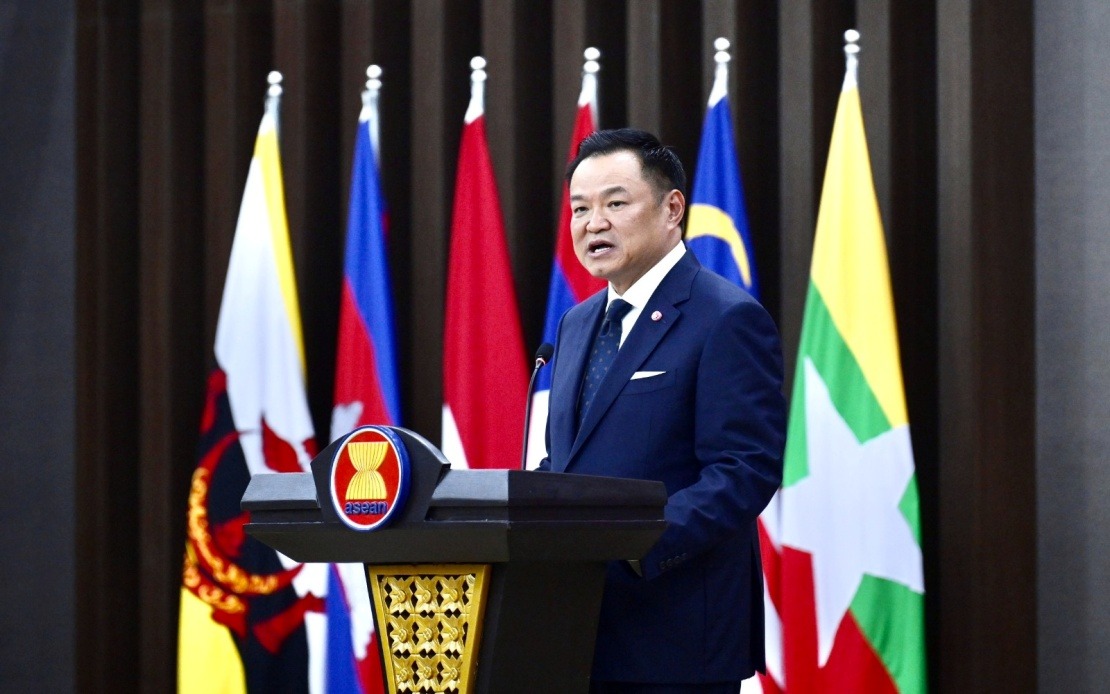
Thailand's Prime Minister Anutin Charnvirakul has articulated an ambitious roadmap for ASEAN's evolution, emphasizing the need for a regional bloc that is demonstrably stronger, more resilient to external shocks, and fundamentally oriented towards delivering concrete improvements in the lives of its citizens. Speaking at the ASEAN Secretariat in Jakarta during his official visit to Indonesia, Anutin presented a three-pronged strategic framework that reflects Bangkok's thinking on how the ten-member association should navigate an increasingly volatile geopolitical landscape marked by great power competition and technological disruption.
The Thai premier's central argument rested on a straightforward but challenging premise: that many of the pressures confronting ASEAN member states—spanning geopolitical fractures, economic volatility, digital transformation, and security threats—cannot be effectively managed by nations acting in isolation. Instead, Anutin contended, the bloc must strengthen the architecture of regional cooperation itself, ensuring that ASEAN mechanisms can respond with greater agility and precision to emerging problems. This framing is particularly significant for Malaysia and other regional powers concerned about maintaining ASEAN's collective bargaining power amid competition from larger external actors seeking to divide the association.
A noteworthy element of Anutin's address was his assertion that ASEAN's founding principles of consensus and non-interference should be applied with greater flexibility. This suggestion touches on a recurring tension within the bloc: the challenge of maintaining unity without sacrificing the ability to act decisively on urgent matters. By advocating for a more flexible interpretation of these principles, Thailand appears to be signalling support for a middle path that preserves ASEAN's inclusive character while enabling swifter, more coordinated responses to crises. For Malaysian observers, this reflects broader debates about institutional reform that have periodically surfaced in regional forums, particularly when consensus mechanisms have appeared to paralyse collective action.
On economic and infrastructure matters, Anutin identified several priority areas that resonate across Southeast Asia. Strengthening regional supply chains—a concern amplified since the pandemic disrupted global trade flows—ranks alongside efforts to secure food and energy supplies. The emphasis on digital connectivity is particularly germane for Malaysia and other nations seeking to position themselves as regional tech hubs and leverage digital transformation for competitive advantage. Equally significant is Anutin's call to expand ASEAN's engagement with middle powers and the Global South, a diplomatic strategy that could help the bloc diversify its partnerships and reduce dependency on traditional great power relationships.
The Thai premier's insistence that ASEAN must move from reactive to proactive crisis management—preparing in advance rather than responding after problems materialise—reflects lessons learned from recent regional challenges. This preventative orientation has clear implications for how ASEAN might address everything from transnational crime networks to health emergencies and environmental crises. The call to equip younger generations for the digital economy signals recognition that ASEAN's long-term prosperity depends on human capital development and ensuring that demographic dividends are not squandered through inadequate education and training.
Thailand's articulation of success metrics for ASEAN—framed in terms of tangible economic opportunities, improved security outcomes, and effective action against organised crime—represents a deliberate pivot away from measuring the bloc's worth primarily through institutional processes or diplomatic declarations. This people-centric framing is strategically important because it connects abstract regional cooperation to the lived experiences of ASEAN citizens, a connection that can strengthen public support for integration efforts and justify continued investment in regional mechanisms.
Anutin's position on Myanmar reflects Thailand's delicate balancing act in managing a neighbour in crisis while respecting ASEAN consensus. By reaffirming support for ASEAN's Five-Point Consensus while simultaneously advocating for what he termed "calibrated re-engagement," Thailand is attempting to maintain dialogue pathways without appearing to legitimise the military junta's actions. The reference to the International Committee of the Red Cross' visit to Aung San Suu Kyi serves as evidence that engagement, even carefully calibrated engagement, can yield humanitarian benefits. However, this approach remains controversial among observers who view any dialogue as rewarding authoritarian behaviour.
Thailand's emphasis on rebuilding relations with Cambodia and resolving differences through international law mechanisms suggests Bangkok is also focused on settling bilateral disputes in ways that reinforce rather than undermine ASEAN solidarity. This is strategically significant for Malaysia, which also maintains complex border and maritime arrangements with neighbours and has a stake in ensuring ASEAN norms support peaceful resolution mechanisms. By demonstrating willingness to resolve its own issues through principled frameworks, Thailand implicitly supports an institutional culture that benefits all member states.
The timing of Anutin's Jakarta visit carries particular weight: it marked the first Thai prime ministerial visit to Indonesia in 15 years, reflecting the significance both nations attach to bilateral relations and their role in shaping ASEAN's trajectory. Thailand's explicit commitment to playing a more active role in shaping the bloc's future ahead of its 60th anniversary next year suggests Bangkok intends to position itself as a thought leader on regional architecture and institutional reform. For Malaysia and other ASEAN members, this signals that substantive debates about the bloc's future direction and operational effectiveness are likely to intensify over the coming months.
Anutin's three-pronged vision essentially invites the broader ASEAN community to think ambitiously about what collective action can achieve. By coupling calls for stronger regionalism with explicit acknowledgement that benefits must reach ordinary citizens, he articulates a vision of ASEAN that addresses both structure and substance. Whether member states can achieve the flexibility, coordination, and forward-thinking he describes remains an open question, but his articulation of the challenge provides a useful benchmark against which to measure ASEAN's progress as it enters its seventh decade.

