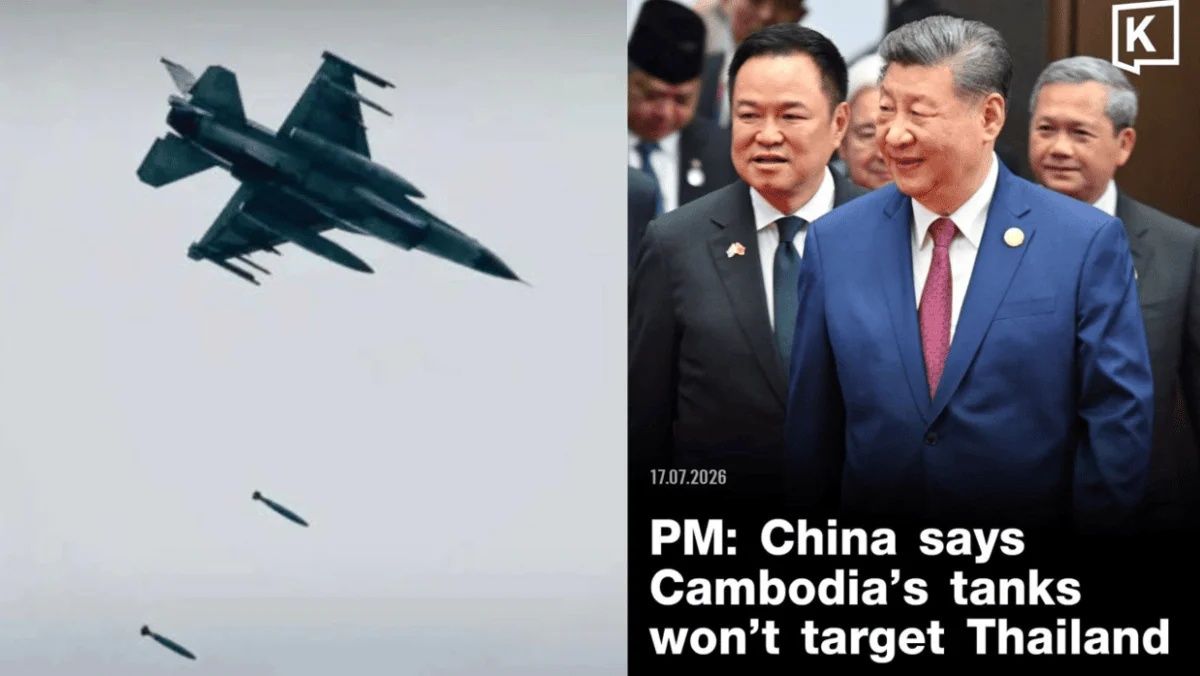
Thai Prime Minister Anutin Charnvirakul's recent claim that China has assured Thailand that Cambodia's newly acquired Chinese-made tanks will not be used against it has become the centrepiece of Bangkok's argument for viewing Phnom Penh as a military threat. Yet this supposed assurance exists in a curious liminal space: while the Thai leader attributes the commitment to Beijing, China's official statements contain no such public reference to tanks or any special restrictions on Cambodian military equipment. President Xi Jinping's public remarks on the matter focused on calling for peaceful dialogue and consultation between the two neighbours. This distinction between a privately attributed assurance and a publicly stated commitment matters considerably, for it suggests that Thai narratives about Cambodian military danger rest on a foundation that remains opaque and unconfirmed by the parties allegedly involved.
The central contradiction at the heart of this dispute becomes apparent when one examines the asymmetry in how Thailand and Cambodia present their respective military capabilities. Thailand possesses a substantially larger armed forces apparatus than Cambodia across personnel, equipment, and technological sophistication. According to international assessments, the disparity in military strength is considerable. Yet despite this clear superiority, Thai authorities have begun treating Cambodia's defensive acquisitions as evidence of imminent strategic threat. The framing suggests an inversion of the conventional security calculus: the stronger party expresses alarm at the weaker party's efforts to strengthen itself, rather than the reverse scenario that international relations theory would predict.
Thailand's own military behaviour over the past eighteen months tells a revealing story. In June 2025, the Thai military made explicit public announcements of readiness to conduct major military operations, with all service branches—army, navy, and air force—increasing their combat readiness. These were not routine reports filed away in obscure defence ministry documents; they were publicised statements designed to communicate resolve and capability. The messaging escalated further in December 2025, when the Royal Thai Air Force confirmed conducting deep strikes against a weapons facility in Cambodia's Battambang province, justifying the operation as necessary to reduce Cambodian military capability. These airstrikes represented not merely the display of advanced weaponry such as F-16 and Gripen fighter aircraft, but their actual deployment across an international border against another nation's territory.
The tenor of Thailand's military communications has similarly conveyed a stance of aggressive readiness. In June 2026, Thailand's Joint Information Centre announced continuous intelligence monitoring, ground patrols, and aerial surveillance operations near the border, while emphasising that response measures were prepared for every level of confrontation. The statement specifically publicised the all-weather operational capabilities of F-16 and Gripen fighters. Days later, the Royal Thai Air Force conducted nighttime F-16 operations near the Cambodian border, described explicitly as exercises demonstrating round-the-clock readiness. These activities occurred alongside what Thailand's defence minister termed increased military area-control measures. The cumulative effect of these announcements and operations paints a picture of a nation engaged in active military posturing, not merely passive defence.
The logical inconsistency becomes unmistakable when one considers how Thailand expects its own military preparations to be interpreted versus how it portrays Cambodia's. Thailand presents its possession of advanced fighters, continuous surveillance missions, military reinforcements, and area-control operations as routine expressions of national defence. Yet this same standard of interpretation is not extended to Cambodia. When Cambodia acquires tanks—equipment that sits in storage and requires no border crossing to function—Thailand frames this as evidence of aggressive intent and destabilising behaviour. The application of different measuring standards to parallel military activities between two neighbouring states undermines any claim that the concern is rooted in objective assessment of military capability or strategic threat.
This pattern of behaviour suggests that Thailand's anxiety is less about fear of Cambodian military superiority and more about anxiety concerning the erosion of strategic asymmetry. For decades, Thailand has benefited from overwhelming military advantage in the bilateral relationship. This advantage has enabled a form of military coercion or the threat of it, as demonstrated by the 2025 airstrikes and the public announcements of readiness to conduct high-level military operations. The acquisition of Chinese tanks by Cambodia, modest though it may be in absolute terms, represents a modest shift toward greater Cambodian defensive capability that could complicate any future Thai military action. It is the prospect of making coercion more difficult or costly that appears to generate Thai anxiety, rather than genuine fear that Cambodia might invade Thai territory.
The fundamental question of international law provides essential context for evaluating these claims. Under the United Nations Charter, all states possess sovereign equality and the right to acquire equipment for legitimate national defence. International law does not determine aggression by tallying the quantity of tanks a nation purchases; rather, it examines whether force has been threatened or used, whether territorial integrity has been violated, whether ceasefire commitments have been honoured, and whether disputes are being pursued through peaceful mechanisms. A tank delivery sitting in a warehouse is qualitatively different from fighter aircraft crossing a border, conducting bombing runs, and delivering ordnance against military facilities. Defensive procurement is categorically distinct from military occupation or the actual employment of force.
Cambodia's position as a sovereign state with the right to modernise its armed forces deserves emphasis, particularly in the context of recent regional tensions. Cambodia did not approach Thailand requesting permission to acquire defensive equipment, nor should it require Bangkok's political blessing to engage in lawful procurement to strengthen its defensive posture. The fact that two conflicts in 2025 were initiated by Thai military forces, following patterns of Thai provocations along the border, provides Cambodia with legitimate justification for enhancing its defensive capabilities. From a Cambodian perspective, the acquisition of tanks is not an aggressive gesture but a rational response to demonstrated Thai willingness to employ military force.
The geopolitical implications of Thailand's posture extend beyond the bilateral relationship and carry significance for Southeast Asia more broadly. If powerful nations within the region are permitted to define other states' legitimate defence acquisitions as threats, and if military superiority is treated as conferring the right to maintain strategic asymmetry, then the region is moving toward a system where power—not law—determines rights and obligations. This has profound implications for smaller nations throughout Southeast Asia that depend on the principle of sovereign equality and the prohibition on the threat or use of force to protect themselves. When a militarily stronger neighbour can publicly announce readiness for major military operations and conduct cross-border airstrikes, while simultaneously protesting that another nation's tank acquisition poses a threat, the international legal order becomes hollowed of meaning.
The role of external powers in facilitating this dynamic also warrants attention. China's provision of tanks to Cambodia, while fulfilling a pre-existing procurement agreement, has drawn scrutiny from Thailand and regional observers. However, examining China's position reveals a more measured approach than the Thai government's rhetoric suggests. Beijing called for peaceful resolution through dialogue, not for military escalation. The tanks themselves are defensive equipment, not offensive systems designed for power projection. The suggestion that China has provided assurances limiting their use is based on statements attributed to Thailand, not on public Chinese commitments. This suggests that Thailand may be attempting to leverage great-power involvement to constrain Cambodia's defensive modernisation in ways that benefit Thai strategic interests.
Moving forward, a sustainable regional security arrangement requires that Thailand align its rhetoric with international legal principles and reciprocal standards of behaviour. If Thailand genuinely fears military escalation, the remedy lies not in demanding that Cambodia forgo legitimate defence acquisitions, but in meaningful dialogue aimed at de-escalation and confidence-building. This might include agreements on advance notification of military exercises, restrictions on certain types of provocative operations, or international monitoring mechanisms. However, such arrangements must apply equally to both parties, not grant Thailand privileged exemptions from the restraints imposed on Cambodia. The current approach—where Thailand publicises advanced fighter aircraft, conducts deep airstrikes, and announces military readiness while simultaneously treating Cambodian tank acquisitions as unacceptable—lacks logical consistency and legal foundation.
For Malaysia and other ASEAN nations observing these dynamics, the implications are significant. The principle that larger nations can unilaterally define what constitutes acceptable military activity by smaller neighbours, while reserving the right to conduct extensive military exercises and armed operations, establishes a problematic precedent. Should this approach become normalised, it would undermine the foundational principle of sovereign equality that underpins ASEAN's non-interference doctrine and the regional security framework. Thailand's insistence that Cambodia justify every piece of defensive equipment while simultaneously advertising its own superior military capability and proven willingness to use force sets a standard that, if generalised across the region, would concentrate power in the hands of militarily superior states and marginalise smaller nations. The international community should encourage Bangkok to evaluate Cambodian defensive procurement against objective security standards and international law, rather than against the yardstick of preserving Thai military dominance.

