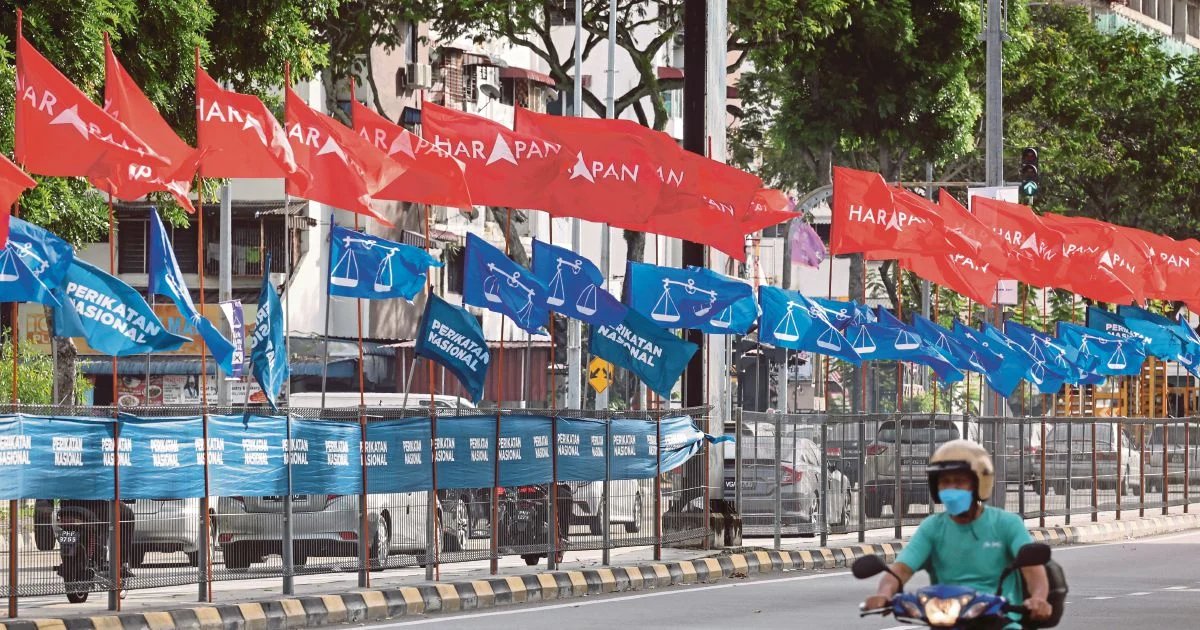
The upcoming Johor state election is set to feature unprecedented three-way contests that will reshape the political landscape of Malaysia's southern industrial heartland. Barisan Nasional, Pakatan Harapan and Perikatan Nasional are anticipated to field competing candidates in 33 of the 56 state assembly seats, transforming the election into a complex triangular battle that could fundamentally alter the region's political alignment.
The concentration of three-way contests in more than half the state seats reflects the fragmented nature of Malaysian politics following the collapse of the Pakatan Harapan-Barisan Nasional cooperation agreement at the federal level. None of the major coalitions appears confident enough in their grassroots support to cede territory entirely, creating a volatile electoral environment where vote splitting could prove decisive. In constituencies where support is evenly distributed among the three blocs, even marginal shifts in voter preference could swing results unexpectedly.
Johor's electoral significance extends well beyond state boundaries. As Malaysia's second-largest economy and home to the port of Tanjung Pelepas, one of the world's busiest maritime hubs, the state's political complexion carries implications for national governance and economic policy. A strong performance by any single coalition could reshape their bargaining position in federal politics, particularly in relation to economic stimulus packages, infrastructure investment and trade negotiations affecting the region's manufacturing and logistics sectors.
Barisan Nasional's traditional stronghold in Johor faces mounting pressure from both opposition camps. The coalition has governed the state continuously since independence, but internal discord and leadership transitions have weakened its organisational machinery in certain constituencies. Pakatan Harapan, emboldened by its role in federal government and stronger urban support bases, has intensified its campaign operations particularly in cities like Johor Baru and Skudai. Meanwhile, Perikatan Nasional has emerged as a disruptive force, positioning itself as an alternative to both established coalitions and appealing to voters fatigued by traditional partisan alignments.
The geographic distribution of three-way contests is uneven, with certain districts experiencing particularly acute competition. Rural constituencies traditionally loyal to Barisan Nasional now face infiltration from Perikatan Nasional candidates, potentially fracturing the rural Malay-Muslim vote that has anchored the ruling coalition's strength for decades. Urban and semi-urban seats have become battlegrounds where Pakatan Harapan's social media savvy and cross-community appeals compete against both rivals simultaneously.
Electoral dynamics in Johor also reflect broader demographic shifts in Malaysian politics. Younger voters, particularly those who came of age during the Pakatan Harapan era from 2018 to 2020, exhibit less automatic loyalty to Barisan Nasional than their parents' generation. Simultaneously, concerns about Islamic governance and federal-state relations have created openings for Perikatan Nasional despite its controversial track record during the COVID-19 pandemic. These fractures in traditional voting patterns mean that assumption-based predictions carry heightened risk, and local conditions in individual constituencies matter more than ever.
The three-way contest format also complicates campaign messaging. Each coalition must simultaneously attack its rivals and articulate a positive vision, stretching campaign resources and forcing difficult prioritisation decisions. Television debates and campaign rallies become particularly consequential when audiences are genuinely uncertain which coalition will perform best. Incumbency becomes a weaker advantage when voters face genuine alternatives rather than binary choices.
For Malaysia's broader political system, the Johor election serves as a crucial test of whether the post-2020 realignment toward multi-coalition competition is becoming entrenched or remains fluid. If three-way contests produce governing coalitions marked by extreme fragility, with single-seat majorities requiring perpetual negotiation, state governance could suffer from paralysis and opportunistic defections. Conversely, if one coalition emerges with a commanding majority despite the competitive environment, it would signal that structural advantages in resources and organisation still outweigh the fragmentation evident in voting patterns.
The financial implications of contesting 33 seats simultaneously across three major coalitions will be substantial. Campaign infrastructure, candidate vetting, advertising, and ground operations demand significant budgetary commitments that will stretch resources, particularly for Perikatan Nasional which commands fewer established fundraising networks than its competitors. This disparity in financial capacity could ultimately prove as decisive as policy differences or voter sentiment.
Regional observers are monitoring the Johor election closely as a potential indicator of Malaysian electoral trends ahead of subsequent state and federal contests. If the three-way pattern established here becomes replicated across other states, Malaysian politics would transition definitively toward a more competitive but also more unpredictable system. The era of comfortable two-coalition contests and foreordained outcomes would give way to genuine uncertainty in which organisational discipline, local personalities and issue salience interact in ways that defy simple prediction.
As voting approaches, all three coalitions are calibrating strategies to convert three-way contests into victories. Barisan Nasional is banking on organisational depth and rural consolidation, Pakatan Harapan on urban momentum and generational appeal, while Perikatan Nasional is attempting to position itself as the disruptive force capable of ending established patterns. The state that industrialised Malaysia's economy may be about to teach the nation's political establishment new lessons about competition and coalition-building.

