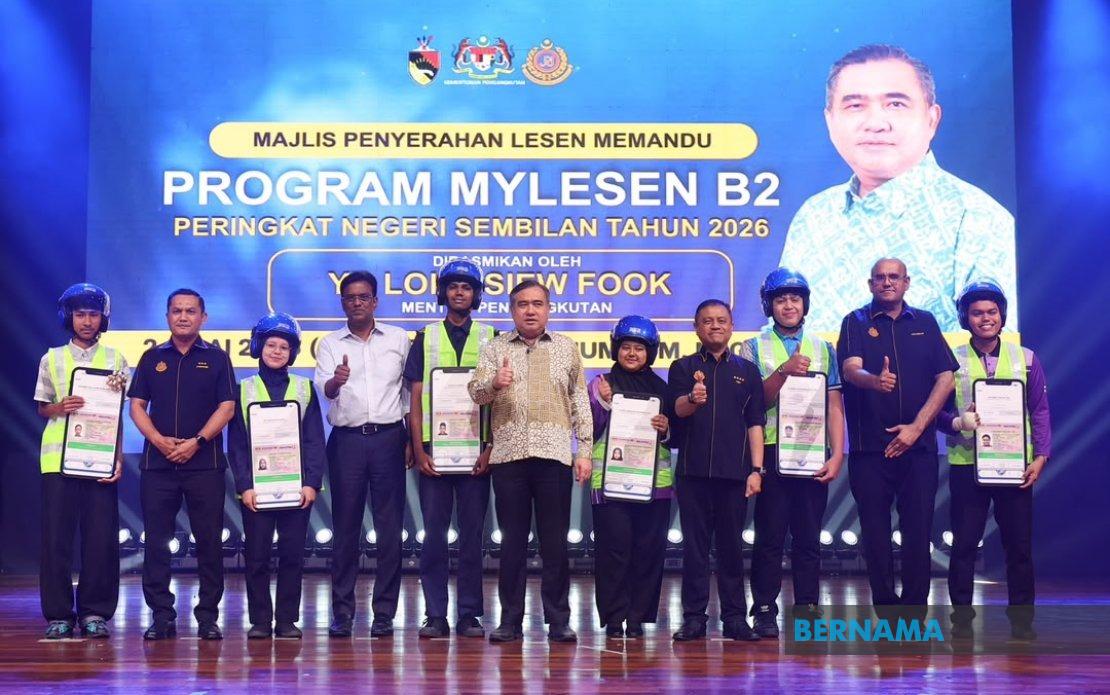
Transport Minister Anthony Loke has issued a pointed message to young riders receiving motorcycles through the MyLesen B2 Programme: their newly acquired licence represents a privilege that demands careful stewardship, not a green light for dangerous behaviour on public roads. Speaking at a licence distribution ceremony in Seremban on July 2, Loke stressed that the free credentials being handed to participants came with a clear social contract to prioritise safety and comply with established traffic regulations.
The urgency of Loke's warning reflects troubling national statistics on motorcycle-related fatalities. Approximately 60 per cent of all road accident deaths recorded each year across Malaysia involve motorcyclists and their pillion passengers, with a sobering majority of these victims falling below the age of 30. This demographic reality underscores why the government has chosen to focus its road safety messaging on young riders, who represent both the largest cohort of motorcycle users and the group bearing the highest mortality burden from traffic incidents.
Loke articulated the government's dual motivation for the MyLesen B2 initiative, which has now expanded to serve more than 100,000 recipients nationwide since its 2023 launch. Beyond the immediate safety imperative, the programme functions as a socio-economic mobility tool, granting eligible Malaysians the legal right to operate motorcycles while simultaneously creating pathways to employment, tertiary education, and improved living standards through reliable transportation access. This framing positions road safety not merely as a regulatory concern but as integral to the broader development agenda.
The scale of the programme's growth in Negeri Sembilan exemplifies its rapid implementation across states. The quota for the state jumped sharply from 1,000 participants in the previous year to 2,300 this year, indicating both strong demand and government commitment to universal access. Of those enrolled, 1,979 had already secured their Learner's Driving Licence, whilst 1,879 had progressed further to complete training modules and pass competency assessments, securing their Probationary Driving Licence. These progression metrics suggest a well-structured pathway that emphasises preparation before full licensing.
Crucially, Loke made explicit reference to escalating legal consequences for those who misuse their motorcycles for illegal racing and speed testing. The Dewan Rakyat's passage of the Road Transport (Amendment) Bill 2026 represents a legislative hardening of penalties, extending beyond financial fines to include potential imprisonment for participants in illegal racing. This legislative shift signals the government's determination to treat such behaviour as a serious criminal matter rather than a minor traffic violation, a message clearly directed at the demographic most tempted by such activities.
The minister's specific admonition about weekends and recreational activities betrays awareness that many young riders view non-school hours as an opportunity for unregulated behaviour. By directly mentioning that weekends should not become occasions for racing, Loke acknowledged the cultural appeal of illegal street racing among certain cohorts whilst attempting to reorient attitudes toward safe, law-abiding conduct. His emphasis on "illegal activities" served as a reminder that the government possesses enforcement mechanisms to detect and prosecute such violations.
Another dimension of Loke's guidance concerned the technical specifications of safety equipment. He urged all new licence holders to wear only SIRIM-certified helmets when riding or serving as pillion passengers, a recommendation grounded in specific Malaysian safety standards rather than generic advice. This detail matters because it suggests the government's approach combines legal requirements with quality assurance, ensuring that young riders adopting safety practices do so with equipment meeting rigorous certification criteria. The specificity of this recommendation may also reflect previous problems with counterfeit or substandard protective gear circulating in the market.
The broader context for this initiative involves Malaysia's sustained struggle with road safety outcomes that rank poorly relative to developed nations. Young motorcyclists have historically represented a concentration point for preventable deaths, making licence distribution programmes that incorporate safety messaging an opportunity to establish good habits early. By providing free access to legal licensing whilst simultaneously conditioning that access on education about responsible riding, the government attempts to prevent the formation of problematic attitudes before they solidify.
The presence of senior officials at the Seremban ceremony—including Transport Ministry Secretary-General Datuk Seri Jana Santhiran Muniyan and Road Transport Department Director-General Datuk Aedy Fadly Ramli—underscored the institutional seriousness with which the ministry regards both the programme's implementation and its safety dimensions. Such high-level attendance signals that this extends beyond routine administrative functions into strategic policy territory.
Looking forward, Loke's remarks suggest the government will maintain a balanced approach combining expanded access to mobility with tightened enforcement against dangerous behaviour. The MyLesen B2 Programme continues the government's stated commitment to improving road safety, facilitating broader accessibility to transportation, and developing a more integrated and sustainable transport ecosystem serving all Malaysian communities. Whether these efforts substantially reduce fatality rates among young motorcyclists will require sustained commitment to enforcement, ongoing safety education, and cultural shift toward viewing motorcycling as an activity requiring discipline rather than daring.

