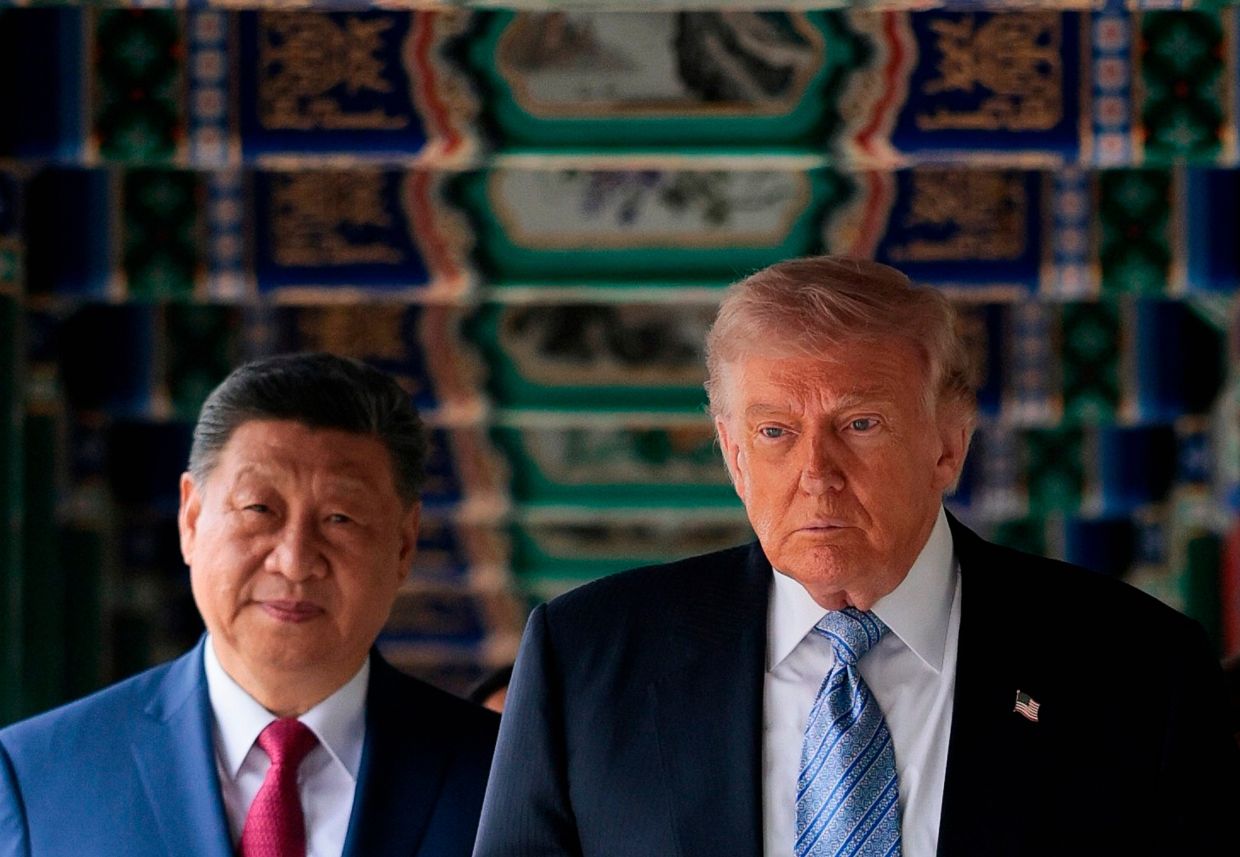
The incoming Trump administration's approach to China continues to oscillate between confrontation and engagement, with the US president delivering sharply contradictory statements that undermine strategic clarity at a critical moment in Sino-American relations. His latest remarks—expressing disappointment should Beijing supply weapons to Iran whilst simultaneously preparing for Xi Jinping's visit to the United States on September 24—exemplify a pattern of mixed signals that characterises his broader China policy and raises questions about what Washington actually intends to achieve in its dealings with Beijing.
Domestic political considerations appear to be colliding with diplomatic necessity in Trump's positioning. Earlier this week, he launched a scathing attack on his social media platform against long-time US health official Anthony Fauci, reviving claims that Covid-19 originated in a Wuhan laboratory and accusing Fauci of consistently shielding China from scrutiny. Trump stated without qualification that "the virus came from the Wuhan Laboratory in China" and alleged that Fauci "strongly disagreed, always trying to protect China." These characterisations echo Trump's longstanding preference for the laboratory-leak hypothesis, despite the broader scientific consensus indicating a natural spillover from animals remains more probable based on available evidence.
The weapons allegation adds another layer to the administration's contradictory messaging. Reuters reported that China intended to fly arms supplies from western regions through Pakistani territory to Iran under a contract valued between US$60 million and US$70 million. Beijing's foreign ministry swiftly rejected the report as "untrue and not factual at all," reasserting China's commitment to de-escalation and conflict resolution. This follows an earlier Chinese denial in May, when Beijing dismissed weapons-supply allegations as "completely groundless" ahead of Trump's visit to Beijing at that time.
Trump's response to the weapons report revealed his preference for personal diplomacy over confrontational posturing. When questioned about the allegation, he suggested it would be "surprising" if true, citing assurances from Xi that the Chinese leader had personally pledged not to participate in supplying Iran. "He told me very strongly he wouldn't partake. But he knows I'd be quite disappointed," Trump said, implying that personal relationships and promises could constrain Beijing's actions more effectively than sanctions or other punitive measures. This reliance on Xi's word reflects Trump's historical comfort with personalised diplomacy and his belief that strong personal bonds can transcend systemic rivalries.
Yet this moderate tone stands in stark contrast to Trump's rhetoric just days earlier. In a prime-time address to the nation, he accused China of perpetrating "the largest compromise of election data in history," claiming that Beijing had unlawfully obtained 220 million American voter files. Trump went further by declassifying documents he asserted supported his allegation and characterised the situation as an "unprecedented election security nightmare." The severity of these accusations—essentially alleging a massive breach of American electoral integrity—would typically warrant immediate diplomatic and economic consequences against the offending nation.
Inexplicably, the Trump administration has announced no new sanctions, trade penalties, or diplomatic repercussions targeting China in response to the alleged election interference since that dramatic address. Instead of escalating pressure, the administration has proceeded with preparations for Xi's visit, suggesting that whatever concerns Trump publicly articulated about Chinese cybercrimes against American electoral systems do not translate into actual policy changes. This disconnect between rhetoric and action undermines the credibility of both the allegations and the administration's commitment to defending American interests.
This pattern of oscillation reflects what analysts describe as the fundamental tension within Trump's China strategy. The "America first" president frequently launches fierce public attacks on Beijing, emphasising Chinese competition, alleged unfair trade practices, and security threats. Simultaneously, he appears committed to preserving diplomatic channels and pursuing direct negotiation with Xi, suggesting that constructive engagement remains possible and perhaps preferable to sustained confrontation. Last week, Trump stated in his "opinion" that China and Russia were not "participating" in the Iran war, and he asserted that Xi had promised during their May Beijing meeting that China would not assist Iran "under any circumstances."
Trump's expressed willingness to take Xi "at his word" demonstrates his confidence in personal relationships as a governing tool in international affairs. He even issued what might be interpreted as a veiled threat, noting that if China did assist Iran, "it would be very bad for them—certainly not in their best interests." This formulation—warning of consequences whilst simultaneously expressing trust in Xi's assurances—encapsulates the contradictory nature of Trump's approach. It suggests that he believes strategic deterrence operates through personal understanding rather than institutional mechanisms or binding agreements.
For Southeast Asian observers, this unpredictability presents both opportunity and risk. Nations in the region have long sought to maintain balanced relationships with both Washington and Beijing, and Trump's inconsistent signalling may actually provide tactical space for countries to manoeuvre without appearing to choose sides. However, the broader strategic ambiguity also complicates regional security planning. If the United States cannot maintain a coherent policy toward China—oscillating between serious accusations of electoral interference and willingness to host Xi for extended diplomatic engagement—then regional powers cannot reliably predict American responses to their own security challenges or disputes with China.
The September visit itself will likely reveal more about Trump's actual intentions than his current contradictory statements. Whether Xi's visit materialises as planned, how long it lasts, what agreements might be reached, and whether any consequences follow regarding the alleged weapons supplies or election interference will clarify whether Trump's harsh rhetoric masks underlying pragmatism or whether his diplomatic overtures represent tactical positioning ahead of escalation. Until then, observers must contend with a China policy that sends fundamentally inconsistent signals about American priorities and willingness to enforce its stated red lines.
The credibility problem extends beyond Sino-American relations. Trump's simultaneous accusations of massive Chinese cybercrimes and apparent willingness to move past them without consequences undermine his broader positioning on election security. Allied nations watching this episode may question whether the Trump administration's security commitments rest on firm principles or fluid personal calculations. For China, the mixed messaging creates ambiguity about which threats Trump takes seriously and which represent political theatre for domestic consumption, potentially enabling Beijing to calibrate its own responses without fear of proportional consequences.

