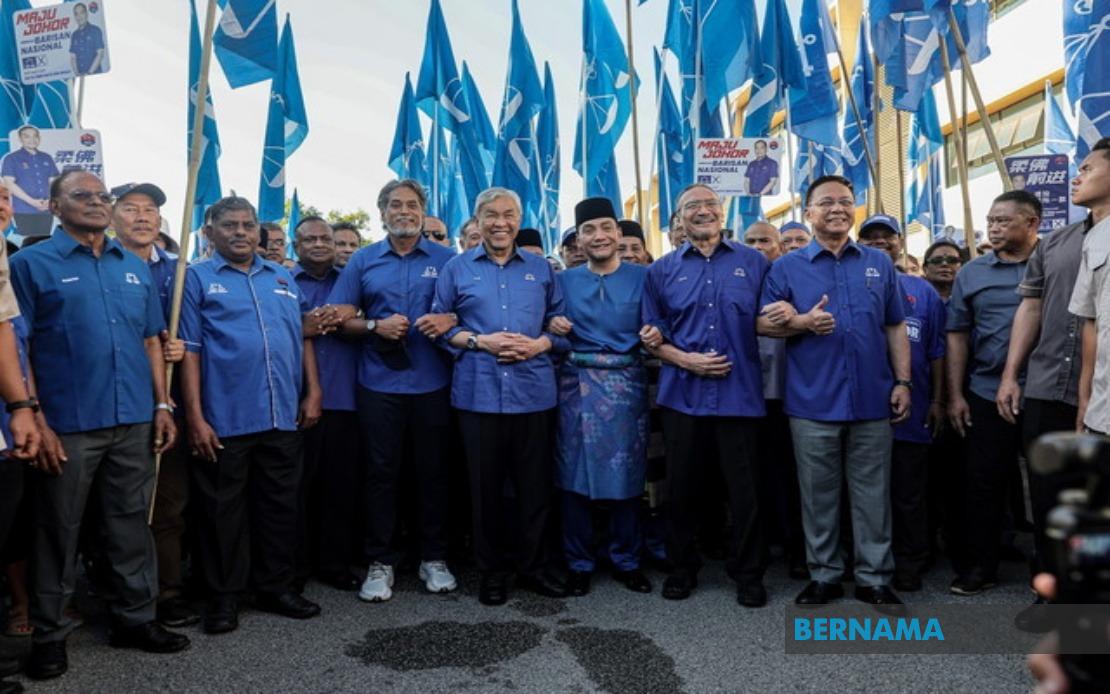
Johor Barisan Nasional chairman Datuk Onn Hafiz Ghazi officially entered the race for the Johor state election on Thursday morning, submitting his nomination papers at 9.10 am at the Muafakat Hall in Simpang Renggam District Council. The move underscored the ruling coalition's determination to retain control of the southern state, with the incumbent Machap assemblyman receiving a show of force from the party hierarchy that reflected UMNO's commitment to consolidating its position ahead of polling day.
The nomination submission became a carefully orchestrated display of party unity, with UMNO president Datuk Seri Dr Ahmad Zahid Hamidi accompanying Onn Hafiz to the nomination centre. The presence of the national party chief signalled that the federal leadership was invested in the Johor campaign, treating the state election as integral to UMNO's broader political narrative. This level of personal involvement from the top of the party hierarchy is seldom seen during routine nomination filings, suggesting the election carries significant implications for the party's standing.
Sembrong MP Datuk Seri Hishammuddin Tun Hussein also joined the delegation, bringing his credentials as a senior frontbencher to bear on the occasion. Hishammuddin's attendance was particularly noteworthy given his portfolio responsibilities at the federal level, where he holds a Cabinet position. His willingness to take time to support Onn Hafiz demonstrated the interconnectedness of state and federal UMNO operations, with senior leaders recognising that outcomes in Johor ripple outward to affect the party's overall standing in the nation.
Khairy Jamaluddin, a former minister known for his organisational acumen within UMNO, was also present to publicly back the nomination filing. Khairy's involvement reflected attempts to present a broad coalition of party talent united behind Onn Hafiz's candidacy. The former minister's participation sent a signal that internal party divisions, if they existed, had been set aside in favour of presenting a united front to the Johor electorate. Such displays of solidarity often precede elections when parties are keen to avoid any perception of fracture that might undermine their campaign message.
Former Johor Menteri Besar Datuk Seri Hasni Mohammad also graced the event with his presence, providing historical continuity and institutional memory. Hasni's attendance linked the current campaign to Barisan Nasional's track record of governance in the state, implicitly arguing that the coalition's experience positioned it to deliver for Johor voters. The presence of former state leaders at such events typically serves to reassure party members and supporters that the succession is orderly and that established leaders endorse the direction being taken by their successors.
The nomination centre at Simpang Renggam attracted significant attention, with supporters converging in the vicinity dressed in their respective party colours and displaying banners and flags. The visual spectacle of party workers and supporters mobilising around the nomination process reflected the grassroots energy that campaigns seek to generate. Such scenes are common features of Malaysian electoral contests, where visible displays of party presence at key moments help build momentum and demonstrate organisational capacity to both media observers and rival camps.
The Johor state election represents a consequential contest within Malaysia's broader political landscape. As one of the nation's most populous and economically significant states, Johor's electoral outcome carries weight beyond its borders. A Barisan Nasional victory would reinforce the coalition's dominance in the peninsula's southern tier, while any setback would prompt soul-searching within UMNO about its appeal to voters in its traditional heartland. The strong turnout of federal-level leaders at Onn Hafiz's nomination filing suggested that the party viewed the stakes as appropriately high.
Onn Hafiz's positioning as the coalition's standard-bearer in Johor reflected both his status as incumbent Machap assemblyman and his elevation to the BN chairman role within the state. The dual responsibilities placed him at the junction of state party management and electoral candidacy. His backing by the federal party leadership suggested confidence that he possessed the stature and organisational capability to lead Barisan Nasional's campaign across the state, managing both the mechanics of the electoral machinery and the political messaging required to persuade voters.
The show of support also carried implications for the broader Opposition in Johor. By visibly demonstrating party unity and organisational readiness, UMNO sought to project an image of a coalition confident in its prospects. Whether such displays translate into electoral advantage depends on numerous factors including on-the-ground campaign effectiveness, local grievances, and the Opposition's own momentum. However, the willingness of senior federal figures to invest their time and political capital in the Johor campaign indicated that internal assessments favoured a positive outcome.
The election represents a crucial opportunity for Barisan Nasional to demonstrate resilience and retain voter confidence in state governance. The coalition's strong showing of support for Onn Hafiz at the nomination stage was merely the opening move in what would prove to be a hotly contested campaign. The weeks ahead would reveal whether the party's visible unity at Simpang Renggam translated into the kind of sustained effort required to win over voters across Johor's diverse constituencies.

