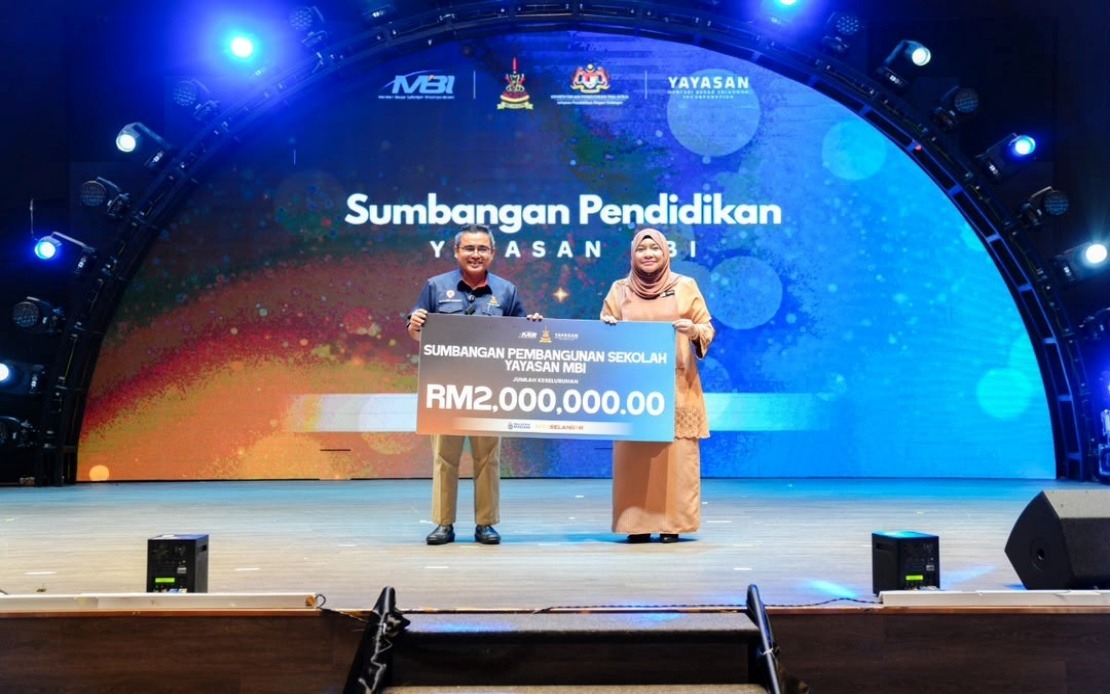
Yayasan Menteri Besar Selangor (Incorporated) has released RM2 million in funding dedicated to improving educational facilities and infrastructure across the state, marking a significant commitment to the sector that already dominates the foundation's portfolio. The disbursement through its School Development Contribution programme underscores a deliberate strategy to enhance the learning environment for both educators and pupils, addressing gaps in physical amenities and operational capacity at the school level.
Ahmad Azri Zainal Nor, heading the foundation, characterised education as far more than a charitable endeavour. His framing of the investment as a long-term commitment to human capital development reflects a strategic outlook increasingly common among Malaysian state institutions—viewing immediate educational expenditure as foundational to broader economic and social development trajectories. With approximately two-thirds of Yayasan MBI's activities already concentrated in education, this latest disbursement underscores the priority assigned to the sector in Selangor's development agenda.
The allocation was formally unveiled during the Yayasan MBI Education Aspiration 2026 event, an occasion that functioned simultaneously as a recognition of teaching professionals' contributions and a convening platform for stakeholders. Such events serve dual purposes in Malaysia's education governance landscape—they generate symbolic affirmation of educator value while creating spaces for strategic partnerships to crystallise among government agencies, civil society, and school management bodies.
Beyond the immediate RM2 million commitment, Yayasan MBI operates several targeted programmes designed to extend support beyond infrastructure alone. The Back to School Tour Programme addresses seasonal challenges in school readiness, while the Selangor People's Tuition Programme and Didik Kasih Programme explicitly target learning gaps through subsidised or free academic support. These interventions acknowledge that educational quality depends on multiple dimensions—physical infrastructure alone cannot overcome socioeconomic barriers to learning that many Selangor students encounter.
The foundation's intensifying collaboration with the Selangor State Education Department represents a critical governance consideration. Alignment between philanthropic and state resources requires institutional coordination mechanisms that translate identified needs into concrete programme design. This partnership model, increasingly visible across Malaysian state education systems, attempts to move beyond ad-hoc assistance toward systematic, needs-based allocation of resources that state bureaucracies are theoretically better positioned to identify.
For Malaysian education observers, Selangor's approach carries implications extending beyond state boundaries. As Malaysia's most economically developed state outside Kuala Lumpur, Selangor's education investments often function as policy laboratories for other jurisdictions. The emphasis on teacher welfare and facility improvement, coupled with free learning support initiatives, represents a composite strategy addressing multiple constraints simultaneously—a model potentially adaptable elsewhere in the federation where state capacities and fiscal positions permit similar investment levels.
The foundation's focus on accessibility and inclusion aligns with national education policy frameworks emphasising equitable access to quality learning. However, implementation at state level reveals the practical challenges underlying such commitments. Selangor's relatively stronger fiscal position enables initiatives that less affluent states struggle to replicate, potentially widening educational disparities across Malaysia unless complementary federal support mechanisms strengthen.
Yayasan MBI's emphasis on teacher support carries particular significance given Malaysia's ongoing challenges in educator retention and professional satisfaction. Infrastructure improvements and recognition initiatives function partially as non-monetary compensation for teaching professionals, a consideration increasingly central to state-level education planning as Malaysia confronts competitive labour markets drawing talent away from public education.
The strategic articulation linking immediate facility improvements to longer-term human capital development reflects sophisticated education policymaking. This approach acknowledges that school environments influence educational outcomes through multiple pathways—physical comfort affects student concentration and attendance, improved facilities enable pedagogical innovation, and institutional investment signals societal valuation of education that potentially motivates both professional and student engagement.
Moving forward, Yayasan MBI's trajectory will likely attract scrutiny regarding implementation effectiveness and measurable outcomes. Malaysian civil society has increasingly demanded evidence that philanthropic and state education investments translate into demonstrable improvements in learning quality, completion rates, and equity outcomes. The foundation's existing programme portfolio—with its emphasis on free tutoring and infrastructure—positions it to contribute meaningful data on intervention effectiveness that could inform broader state education policy refinement.
The RM2 million disbursement ultimately reflects Selangor's positioning of education as a central development priority requiring sustained, multi-dimensional investment. While the allocation represents meaningful commitment at state level, the broader significance lies in the integrated approach combining facility improvement, direct learning support, educator recognition, and institutional coordination. This comprehensive model, replicated thoughtfully elsewhere, could meaningfully strengthen Malaysia's education ecosystem at a period when demographic and economic transitions demand sustained human capital development investment.

