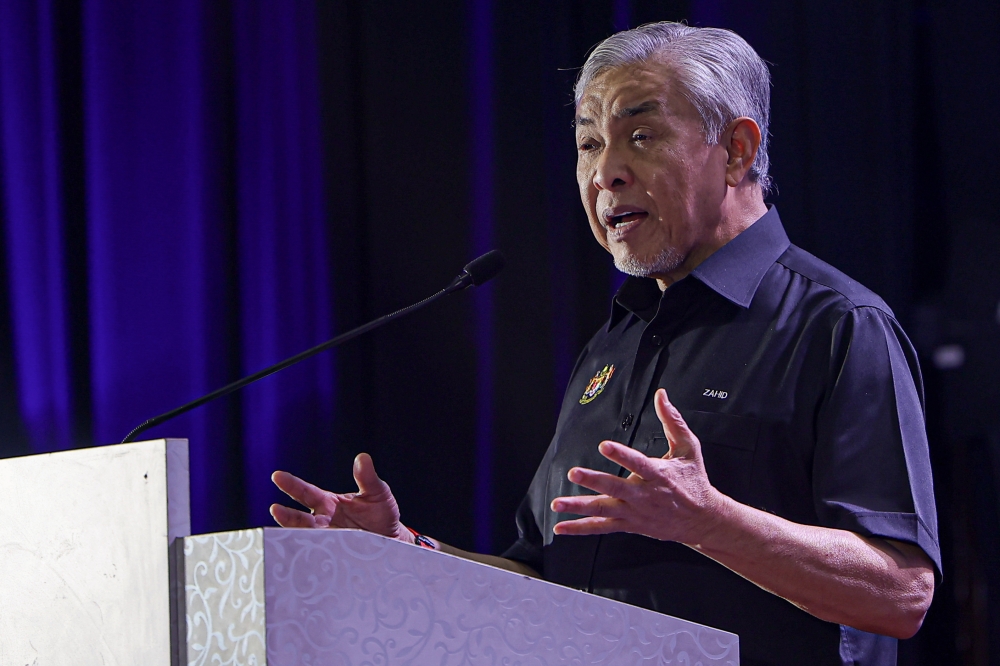
Deputy Prime Minister Datuk Seri Ahmad Zahid Hamidi has alleged that certain ministry officials encountered pressure to participate in events linked to the Barisan Nasional coalition during recent state electoral campaigns. The claim, made in Putrajaya, touches on a persistent concern in Malaysian politics regarding the impartiality of the civil service during election periods and the appropriate boundaries between government machinery and partisan political activity.
Zahid's assertion reflects broader tensions within Malaysia's administrative framework. The public sector is theoretically bound by regulations requiring neutrality during electoral contests, yet coordination between ruling coalition parties and government agencies has long been a source of controversy. Such allegations, whether substantiated through formal investigation or anecdotal in nature, underscore the challenges faced by senior officials seeking to maintain institutional credibility while navigating complex political dynamics during campaign seasons.
The timing of these comments is significant given Malaysia's recent electoral calendar. State elections conducted across the nation have intensified scrutiny of how government resources and personnel are deployed. For Southeast Asian observers, Malaysia's experience illustrates the broader struggle many democracies face when distinguishing between legitimate state functions and improper political exploitation of administrative machinery. The issue becomes particularly acute when senior ministers are simultaneously party leaders responsible for campaign strategy.
Civil service regulations in Malaysia explicitly forbid officers from engaging in partisan political activities during working hours or using their official positions for party advantage. However, enforcement remains inconsistent, and the line between attending official government functions that happen to benefit ruling parties and crossing into overtly political participation remains notoriously blurred. Officers may feel implicit pressure to demonstrate loyalty through attendance at coalition events, particularly when superiors hold dual roles as both government executives and party officials.
For the broader Malaysian political landscape, such allegations carry implications beyond immediate electoral cycles. Public confidence in the civil service depends significantly on perceptions of impartiality. When officers are perceived as tools of ruling parties rather than neutral implementers of government policy, it corrodes the institutional legitimacy that professional bureaucracies require to function effectively. This becomes critical in federal systems like Malaysia's, where state and federal authorities must work in tandem regardless of electoral outcomes.
Zahid's comments also reflect internal coalition politics. By raising concerns about pressure on officers, the Deputy Prime Minister may be signalling disapproval of particular campaign tactics by party colleagues, or alternatively, establishing a public position that insulates himself from future accusations of impropriety. In Malaysian politics, such statements often serve multiple rhetorical purposes simultaneously, addressing both genuine governance concerns and immediate factional interests within ruling coalition structures.
The civil service in Malaysia numbers over one million personnel across federal and state governments. Even marginal pressure on these officers to attend partisan events can aggregate into significant mobilisation of state resources toward electoral advantage. This represents a form of competitive imbalance that opposition parties consistently challenge, though their own local governments occasionally face similar accusations. The question of institutional autonomy from party politics thus remains one of the most contested aspects of Malaysian governance.
International observers monitoring Malaysian electoral practices have previously noted the difficulty in isolating government communications, state media coverage, and administrative support from ruling coalition campaign activities. Several election observation missions have highlighted these structural features as factors affecting campaign competitiveness. Zahid's acknowledgment of pressure on officers, regardless of its primary motivation, at least places the issue in public discourse and signals official recognition that such practices warrant scrutiny.
The practical challenge for civil service leadership centres on establishing and enforcing clear guidelines that allow officers to fulfill legitimate government functions during election periods without becoming de facto campaign operatives. Training, explicit messaging from top leadership, and transparent protocols can mitigate ambiguity. Yet in Malaysia's environment, where personal relationships and hierarchical networks heavily influence institutional culture, formal rules alone prove insufficient.
Moving forward, these allegations may prompt internal government reviews of campaign season protocols and officer conduct. Such reviews, if genuinely independent and transparent, could strengthen public confidence in administrative neutrality. However, if perceived as performative gestures designed to deflect criticism without substantive change, they risk deepening cynicism about institutional accountability. The Malaysian public and opposition parties will likely scrutinise whatever follow-up measures the government announces.
For Southeast Asia more broadly, Malaysia's experience with civil service neutrality reflects challenges faced across the region. Many democracies in the area struggle with balancing the electoral advantages inherent to governing coalitions against principles of institutional impartiality. How Malaysia addresses these tensions—through regulatory reform, leadership commitment, or transparency mechanisms—may influence approaches adopted elsewhere in the region.
Zahid's decision to publicly raise these concerns suggests at least some recognition within government circles that perceptions of administrative impartiality matter for institutional legitimacy and democratic health. Whether this recognition translates into meaningful procedural changes that genuinely protect civil servants from political pressure remains an open question, one that will likely be tested during future electoral cycles.

