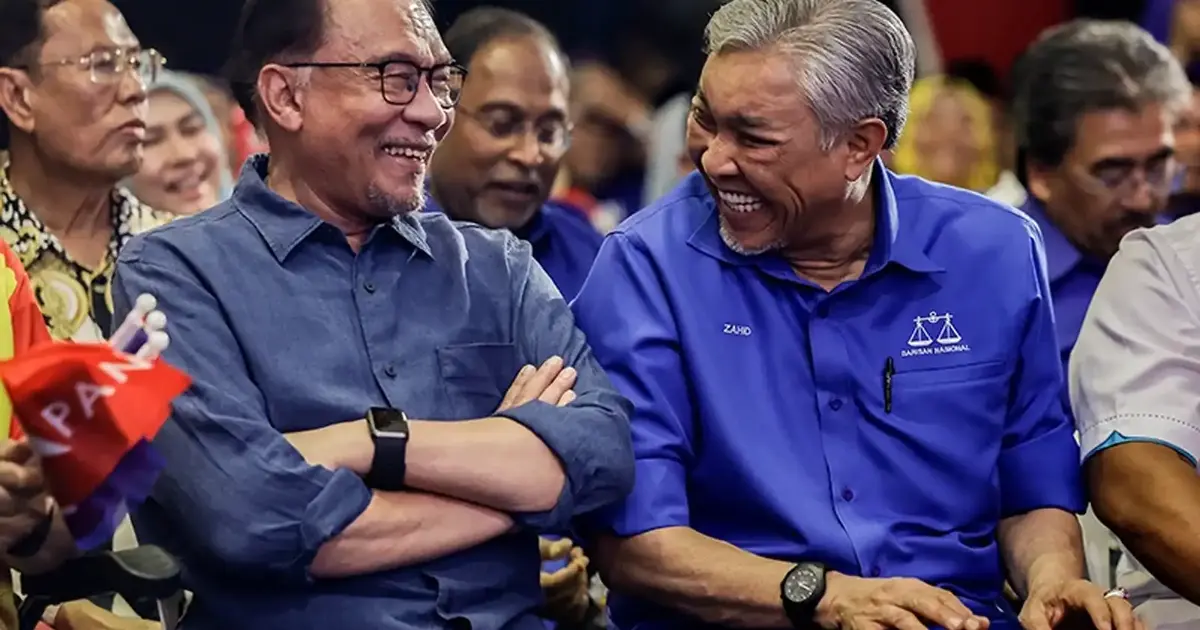
Zahid Hamidah, serving as both Deputy Prime Minister and chairman of Barisan Nasional, has chosen an unusual medium to engage in political discourse by responding to Prime Minister Anwar Ibrahim's recent poem through verse of his own. The exchange, conducted through creative writing rather than conventional political statements, underscores the sometimes theatrical nature of high-level political communication in Malaysia, where leaders occasionally resort to literary devices to convey messages that might otherwise sound stilted or overtly confrontational.
This poetic exchange arrives at a critical juncture in Malaysian politics, where the unity government coalition bringing together parties from across the political spectrum continues to face internal strains and public scrutiny. The coalition, formed following the 2022 general election, united Pakatan Harapan and Barisan Nasional in an unprecedented power-sharing arrangement designed to restore political stability and democratic norms after years of fractious governance. The fact that leaders are now communicating through poetry suggests efforts to maintain civility and restraint even when disagreements arise within the partnership.
The Prime Minister's original poem, which prompted Zahid's literary response, carried implicit messages about governance, direction, and perhaps subtle critiques of coalition partners. By responding in kind rather than through sharper political rhetoric, Zahid has opted for a measured approach that preserves the facade of unity while still asserting Barisan Nasional's perspective on contested matters. This strategy allows both leaders to address their respective political bases without triggering the kind of escalation that could destabilize the fragile balance maintained within government.
Zahid's emphasis on Barisan Nasional's steadfast commitment to the unity government until the completion of the current parliamentary term carries significant weight. As the traditional guardian of Malaysia's establishment and a party that governed for nearly seven decades before the 2018 electoral upset, Barisan Nasional's continued participation remains essential to the coalition's numerical strength in Parliament. Any withdrawal or weakening of support would immediately jeopardize the government's ability to pass legislation and maintain executive authority.
The unity government model represents a departure from Malaysia's post-independence political traditions, where a single dominant coalition typically held power with overwhelming parliamentary majorities. The current arrangement requires constant negotiation, compromise, and careful management of competing interests among parties that were previously implacable opponents. This structural fragility makes public displays of solidarity, even when expressed poetically, strategically important for reassuring investors, international partners, and the domestic electorate that the government remains functional and stable.
For Barisan Nasional specifically, the unity government offers rehabilitation of a sort. The coalition had suffered electoral catastrophe in 2018, losing the popular vote and its parliamentary supermajority for the first time in Malaysian history. Participation in the unity government has allowed the party to recover influence and government positions without immediately confronting voters in another general election. However, this arrangement also subordinates Barisan Nasional to Pakatan Harapan's leadership structure, creating inherent tensions that periodically surface in political discourse.
The choice of poetry as a medium for political exchange also reflects broader cultural currents in Malaysian politics, where appeals to sentiment, history, and shared national identity often carry greater weight than purely technical arguments. Both major political coalitions draw on poetic and nationalist rhetoric to justify their mandates and criticize opponents. This communication style, rooted partly in Malaysia's literary traditions and partly in the rhetorical strategies that have characterized local politics, allows leaders to address multiple audiences simultaneously—party loyalists, coalition partners, the media, and the general public.
Regionally, Malaysia's political stability carries significance beyond its borders. Southeast Asian observers, particularly those concerned with democratic backsliding and authoritarian drift across the region, have viewed the unity government as a meaningful, if tenuous, commitment to democratic governance and power-sharing. Any serious rupture in the coalition could reverberate across regional assessments of democratic resilience in Southeast Asia. Zahid's reassurance about Barisan Nasional's reliability therefore carries implications that extend beyond domestic Malaysian politics into regional geopolitics.
The timing of this poetic exchange also merits consideration. Political tensions within unity governments typically intensify as general elections approach or as factional maneuvering accelerates among coalition partners. By affirming commitment now, through a measured and culturally resonant medium, Zahid signals that Barisan Nasional intends to maintain the arrangement rather than precipitate a collapse that would lead to fresh elections. For many Malaysians exhausted by the political turbulence of recent years, such reassurance—however expressed—carries genuine value in maintaining the predictability that business, investment, and social stability require.

