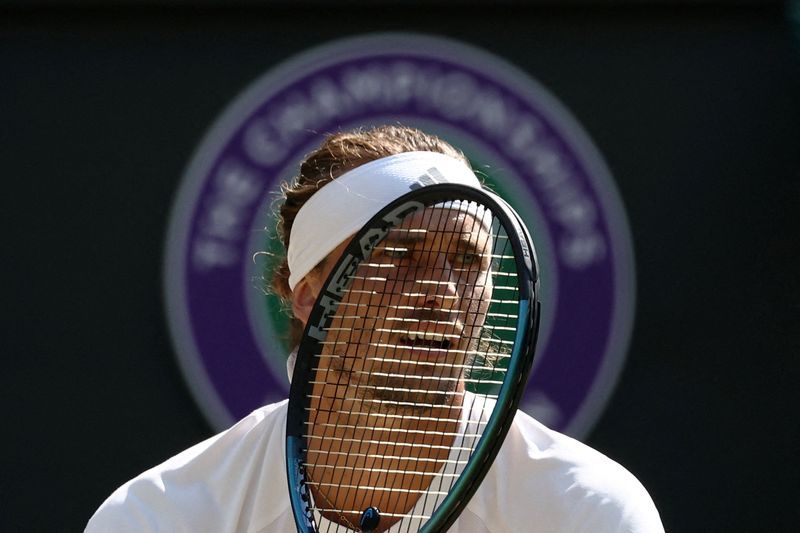
Alexander Zverev has finally vanquished the ghost of Taylor Fritz that has haunted him for over two years, dispatching the American in commanding fashion with a 6-4 6-4 6-2 victory at Wimbledon to reach the semi-finals of the prestigious grass-court championship. The German second seed's clinical performance on Court One represents a watershed moment in his career, not merely because it takes him one step closer to claiming back-to-back Grand Slam crowns following his French Open triumph, but because it represents a psychological breakthrough against an opponent who had won their last seven encounters, including a notable defeat here last year.
The significance of Zverev's breakthrough cannot be understated for those tracking his major championship ambitions. Having fallen short repeatedly against Fritz despite commanding talent, the weight of those accumulated losses could have precipitated another disappointing exit. Instead, Zverev unleashed the kind of comprehensive tennis required at the sport's highest level, dominating from the opening moments and never allowing his opponent sufficient momentum to mount a credible challenge. His aggressive positioning, precise court placement, and refusal to engage in extended baseline exchanges proved devastatingly effective against Fritz's typically dangerous game.
The opening set epitomised Zverev's control. After securing an early break, he advanced to 5-4 and then weathered an unexpected resurgence from Fritz in the tenth game, where his opponent pressed hard under the intense afternoon sunshine. When Zverev successfully held serve to claim the set, the tension visibly drained from the competition. The German's early aggression had set the template for how he would manage the remainder of the match, establishing a rhythm that would only intensify as the match progressed.
Fritz's physical struggles during the second set proved consequential. The American received medical attention for a troublesome right knee issue after just three games, a complication that appeared to compromise his mobility and confidence. Zverev capitalised immediately, breaking serve at a critical juncture and celebrating with palpable relief at finally piercing through his opponent's defences. As news filtered through that British hope Arthur Fery had seized control of his own semi-final contest against Flavio Cobolli, momentum shifted decisively in Zverev's favour. He consolidated his advantage with routine service holds, extending his lead as Fritz's resistance crumbled.
The third set became something of a formality, though Zverev maintained his intensity throughout. A scintillating backhand winner sealed a double break at 4-1, demonstrating the precision and aggression that had characterised his entire performance. He closed out the match with minimal fuss, recording his 12th Grand Slam semi-final appearance and becoming only the fifth German man to reach a Wimbledon semi-final during the professional era that commenced in 1968, joining an illustrious list that includes Boris Becker, Michael Stich, Rainer Schuettler and Tommy Haas.
Zverev's own reflection on the match revealed the psychological intensity required to overcome such a pronounced head-to-head deficit. He acknowledged that the two-year losing streak weighed heavily upon him from the moment he stepped onto court, creating an internal burden that transcended ordinary competitive pressure. The manner in which he addressed this challenge—by elevating his all-court play and refusing to default to patterns that had failed previously—speaks to professional maturation. His acknowledgment that he needed to play nearly flawlessly to overcome Fritz demonstrates the calibre of his opponent, whilst also underlining just how comprehensively he executed his tactical blueprint.
The semi-final pairing with Fery will present an intriguing contrast in narratives. Both players are experiencing maiden Wimbledon semi-final appearances, yet Fery carries the romantic appeal of a home favourite pursuing a breakthrough on the sport's most hallowed grass stage. Zverev, conversely, arrives as the tournament's second seed with proven major championship credentials and a clear pathway toward another title. The German's characteristic self-deprecating humour, inviting the crowd to support Fery whilst simultaneously expressing confidence in his own prospects, reflected the relaxed confidence that comes from a dominant performance.
For Malaysian and Southeast Asian tennis enthusiasts, Zverev's victory reinforces the reality that Grand Slam success increasingly demands not just technical excellence but also psychological resilience. His two-year struggle against Fritz, followed by a definitive breakthrough, illustrates the unpredictable nature of professional tennis and how momentum can shift dramatically with superior execution. Moreover, with Zverev attempting to claim consecutive majors, his progression serves as a reminder of how rarely such achievements occur in the modern game, where depth of competition and physical demands create extraordinary barriers.
The implications of this victory extend beyond Wimbledon itself. Should Zverev maintain his current trajectory and claim another major title, he would join an exclusive group of contemporary players capable of winning consecutive Slams. His comeback against Fritz, therefore, represents more than merely ending a personal curse—it represents a reaffirmation of his capacity to perform under the most demanding circumstances, a prerequisite for any player harbouring genuine ambitions of sustained excellence at tennis's summit. Whether he can translate this momentum through two more matches remains uncertain, but the psychological shackles that Fritz had so effectively fastened appear definitively broken.

