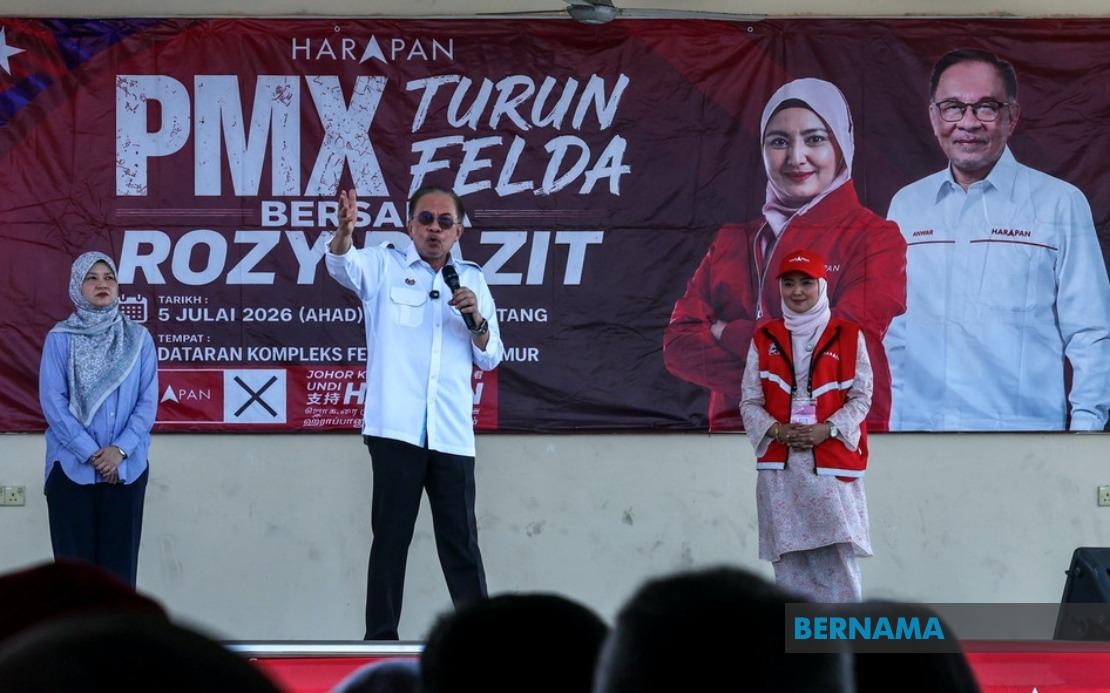
Prime Minister Datuk Seri Anwar Ibrahim has pledged to prioritise resolving the chronic housing shortage affecting the second generation of FELDA settlers, a problem that has festered for multiple decades without resolution. Speaking at a public engagement in Segamat, Anwar framed the issue as a policy priority for his administration, signalling that the government recognises the growing dissatisfaction among younger FELDA-linked families who have struggled to secure residential land allocations despite their parents' contributions to the nation's agricultural development.
The commitment carries particular weight given that FELDA settlements remain significant constituencies across several states, and the second-generation grievance has become an increasingly vocal concern within these communities. The Prime Minister acknowledged that while the federal government's commitment to finding housing solutions is firm, the practical implementation demands substantial coordination with state authorities. This reflects Malaysia's constitutional framework, where land administration and basic infrastructure—two critical components of any settlement programme—fall firmly under state government jurisdiction rather than federal control.
An important dimension of Anwar's statement lies in his explicit pledge to resolve these longstanding grievances during his tenure as Prime Minister, suggesting a degree of personal political capital invested in the outcome. By positioning this alongside the responsible minister for FELDA affairs, he has created an accountability framework that ties both himself and the designated minister to delivering tangible progress. Such personalised commitments, while rhetorically powerful, also establish measurable benchmarks against which his administration's performance will be judged by affected communities.
The structural challenge facing any housing solution involves navigating federalism's complexities. While the federal government can theoretically drive policy direction and potentially provide financing, the state governments—particularly those not under Pakatan Harapan control—retain significant discretionary power over land release and infrastructure provision. This creates a scenario where the Prime Minister's goodwill must translate into negotiated agreements across multiple state administrations with potentially varying political priorities and fiscal constraints. Selangor Menteri Besar Datuk Seri Amirudin Shari's presence at the Segamat gathering underscores that at least one major state government is engaged with the initiative.
The second-generation FELDA housing issue reflects broader challenges within Malaysia's land settlement framework. Originally, FELDA schemes provided smallholdings and housing to rural families, fundamentally transforming agricultural productivity and rural livelihoods. However, the original schemes did not systematically anticipate how second-generation settlers—adult children of pioneers—would access comparable opportunities. As land becomes increasingly scarce and valuable, particularly near developed areas, the government faces mounting pressure to demonstrate that rural development schemes benefit not just initial beneficiaries but their descendants.
Second-generation FELDA settlers occupy an interesting demographic and political space. Many possess higher education levels than their parents and aspire to middle-class stability, yet they lack the automatic land rights that characterised their parents' generation. This cohort represents both a potential political constituency and a potential source of grievance if their expectations remain unmet. Recent years have witnessed growing mobilisation among second-generation settlers demanding formal recognition of their entitlements and concrete pathways to land ownership.
The public articulation of this commitment at a Felda settlement itself—Dataran Putra Felda Palong Timur in Buloh Kasap—demonstrates a deliberate strategy of communicating directly with affected communities. The attendance of Education Minister Fadhlina Sidek and Deputy National Unity Minister R. Yuneswaran, who also represents Segamat as the local MP, suggests that the government is treating this as a substantive priority rather than a perfunctory campaign gesture. The ministerial presence signals that multiple portfolios will coordinate on implementation.
Implementing a credible housing programme faces fiscal and logistical hurdles. Identifying suitable land parcels, securing state government release of those parcels, providing associated infrastructure such as roads, water, and electricity, and financing mechanisms for eligible settlers requires sustained bureaucratic effort across multiple agencies. The federal government would likely need to commit substantial budgetary resources, while states must commit land—a commodity many state governments jealously guard for their own development priorities or revenue generation.
Regionally, Malaysia's approach to this issue carries implications for rural development across Southeast Asia. As agricultural modernisation reduces farming employment and younger rural populations migrate to cities, questions about sustaining rural communities and providing meaningful opportunities for rural youth become increasingly urgent. The FELDA second-generation housing challenge encapsulates this tension between preserving agricultural heritage and meeting contemporary aspirations of rural communities' younger members.
The success of Anwar's pledge will ultimately depend on translating political commitment into concrete deliverables—identifying land, negotiating with states, designing financially sustainable schemes, and actually allocating housing sites to eligible second-generation settlers within a reasonable timeframe. Given the issue's decades-long history, affected communities will likely monitor this commitment closely, viewing it as a test of whether the current administration can deliver on rural development promises where previous governments failed.

