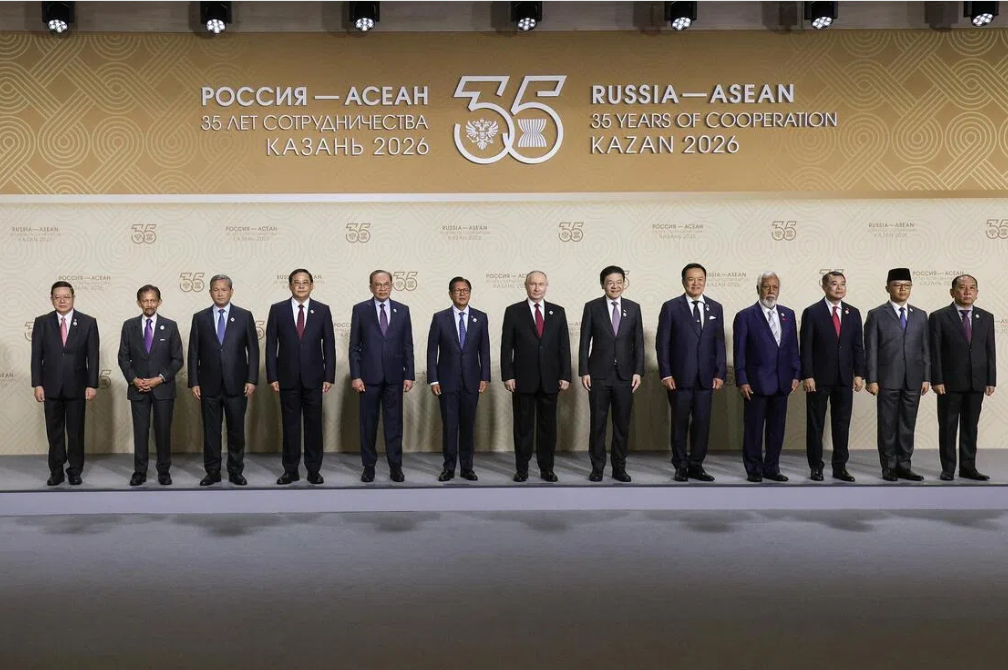
Asean and Russia have used a high-level summit in the Russian city of Kazan to formally recommit themselves to expanding partnership across multiple strategic domains, demonstrating both sides' intent to sustain engagement despite shifting geopolitical tensions. Held on June 17 and 18 under the presidency of Vladimir Putin, the Asean-Russia Commemorative Summit marked a significant juncture: three and a half decades since the establishment of formal relations and thirty years since the creation of the Asean-Russia Dialogue Partnership. The gathering produced several binding documents designed to chart the trajectory of bilateral cooperation through the coming years, signalling that neither party views the relationship as merely transactional or contingent on external pressures.
The centrepiece of the summit's output was the Kazan Declaration, which functioned as both retrospective and prospective instrument. Rather than merely rehearsing past achievements, the declaration sought to evaluate progress across the entire arc of relations and to identify priority areas deserving enhanced attention going forward. Cooperation frameworks were proposed across an expansive range of sectors: maritime security and affairs, commercial and investment linkages, energy transitions and trade, physical and digital connectivity infrastructure, security cooperation broadly defined, educational partnerships, and cultural exchanges. This breadth reflected a recognition that meaningful bilateral engagement cannot be confined to any single domain, but must instead span the full spectrum of state-to-state interaction if it is to prove durable and mutually beneficial.
Supplementing the declaration were two additional instruments with practical implementation value. The Joint Statement on Cultural Cooperation specifically emphasised the human dimension of ties, calling for enriched people-to-people contact and expanded cultural programming. Recognising that national relationships ultimately rest upon broader societal foundations, both governments committed to strengthening these grassroots connections. Equally important was the Asean-Russia Comprehensive Plan of Action covering 2026 through 2030, which moved beyond aspirational language to establish concrete mechanisms and timelines for joint initiatives. This five-year framework essentially operationalised the broader commitments articulated in the declaration, providing clear benchmarks against which progress could be measured.
Singapore's Prime Minister Lawrence Wong, speaking on the summit's final day, articulated a vision of cooperation anchored to shared interests rather than ideological alignment. His remarks carefully balanced acknowledgement of bilateral differences—notably regarding Russia's invasion of Ukraine and Singapore's corresponding imposition of sanctions—with identification of domains where productive collaboration remained feasible. This rhetorical positioning reflected Singapore's broader diplomatic approach: maintaining principled stands on matters of international law and sovereignty while refusing to allow specific disagreements to foreclose all avenues of engagement. PM Wong emphasised that the present geopolitical environment, characterised by unpredictability and volatility, made dialogue and confidence-building measures more essential rather than less so.
A particular emphasis emerged regarding Asean's role and positioning within the evolving regional architecture. PM Wong explicitly welcomed Russia's stated support for Asean Centrality—the principle that the ten-nation grouping should remain the driver of regional diplomacy and institution-building. He highlighted Russia's participation in established Asean mechanisms including the ASEAN Regional Forum and the East Asia Summit, noting that further Russian engagement with these platforms would strengthen regional deliberative capacity. Looking ahead, he indicated that Singapore anticipated Russia's continued involvement when the Philippines hosts both the ARF and EAS later in 2024, and expressed confidence that Moscow would sustain its commitment to Asean-led initiatives when Singapore assumes the rotational chairmanship in 2027.
The domains identified for expanded cooperation reflected both traditional state interests and emergent transnational challenges. Disaster management emerged as a priority, acknowledging that natural calamities—tsunamis, earthquakes, floods—respect no borders and require coordinated regional responses. The fight against narcotics trafficking represented another convergence point, given that drug production and smuggling networks operate across Asean and extend northward into Russia and Central Asia. Educational and cultural exchanges received sustained emphasis, with PM Wong noting that Russian civil servants regularly undertake training programmes in Asean capitals including Singapore, creating networks of professional understanding that might serve broader diplomatic purposes. These initiatives tacitly recognised that institutional and people-to-people channels remain valuable precisely because they can function when official relations face strain.
Underlying PM Wong's remarks was a consistent stress on principles of international law and the rules-based global order. He explicitly connected Asean's longstanding advocacy for freedom of navigation through key maritime passages to the broader framework of dispute resolution based on law rather than coercion. His references to the United Nations Convention on the Law of the Sea underscored that these were not mere rhetorical flourishes but rather foundational commitments that Asean member states expected all partners, including Russia, to uphold. This principled stance explained Singapore's position on Ukraine: not alignment with any particular power, but rather fidelity to norms of sovereignty and territorial integrity that apply universally. The same logic applied to Asean's calls for peaceful resolution of conflicts generally, whether in Ukraine, the Middle East, or elsewhere.
PM Wong's welcome for the peace agreement between the United States and Iran, coupled with hopes for reopening of the Strait of Hormuz, illustrated how Asean approaches regional and global crises through an economic and developmental lens. Interruptions to shipping through critical maritime passages carry profound implications for Southeast Asian trade and energy security. Asean's interest in the Iran-US agreement thus flowed not from alignment with either party but from concern that an open, stable, and predictable international maritime order serves the region's fundamental interests. This perspective, while practical rather than ideological, nonetheless reflects a commitment to liberal internationalism that increasingly distinguishes Asean from some other regional actors.
The bilateral meeting between PM Wong and President Putin, conducted at the Russian leader's request, provided opportunity for direct exchange beyond the formal summit setting. While the substance remained characteristically diplomatic, with both sides emphasising the value of dialogue despite disagreements, such personal engagement carries symbolic weight. It demonstrated that neither party views the relationship as frozen or irretrievable despite fundamental differences on some issues. PM Wong's post-meeting statement emphasised that Singapore values its longstanding ties with Russia and its people, while committing to identify cooperation opportunities in areas of mutual interest. This formulation suggested a relationship compartmentalised rather than comprehensively ruptured: certain activities could proceed even as others remained constrained by principle.
A separate bilateral meeting between PM Wong and Rustam Minnikhanov, the Rais (head) of Tatarstan, added a subnational dimension to Singapore-Russia engagement. The relationship between Singapore and Tatarstan, dating back to Minister Mentor Lee Kuan Yew's 2007 visit, demonstrated that bilateral state relations can be enriched through sustained engagement at regional and city levels. Discussions between PM Wong and Rais Minnikhanov spanning cultural, educational, and people-to-people dimensions reflected this layered approach to international relations.
The Kazan summit ultimately demonstrated that despite significant discord over Ukraine and other matters, Asean and Russia perceive sufficient common interest to maintain and even deepen institutional engagement. For Southeast Asian readers, the gathering underscored their region's importance to major powers and its role in shaping global political outcomes. Asean's capacity to maintain balanced relations while adhering to principles of international law, and to identify cooperation opportunities without sacrificing core commitments, offers a model of sophisticated diplomacy in a fractured geopolitical environment. The documents adopted in Kazan essentially codified this approach: cooperation where interests align, principled restraint where they diverge, and sustained dialogue as the baseline for all interactions.