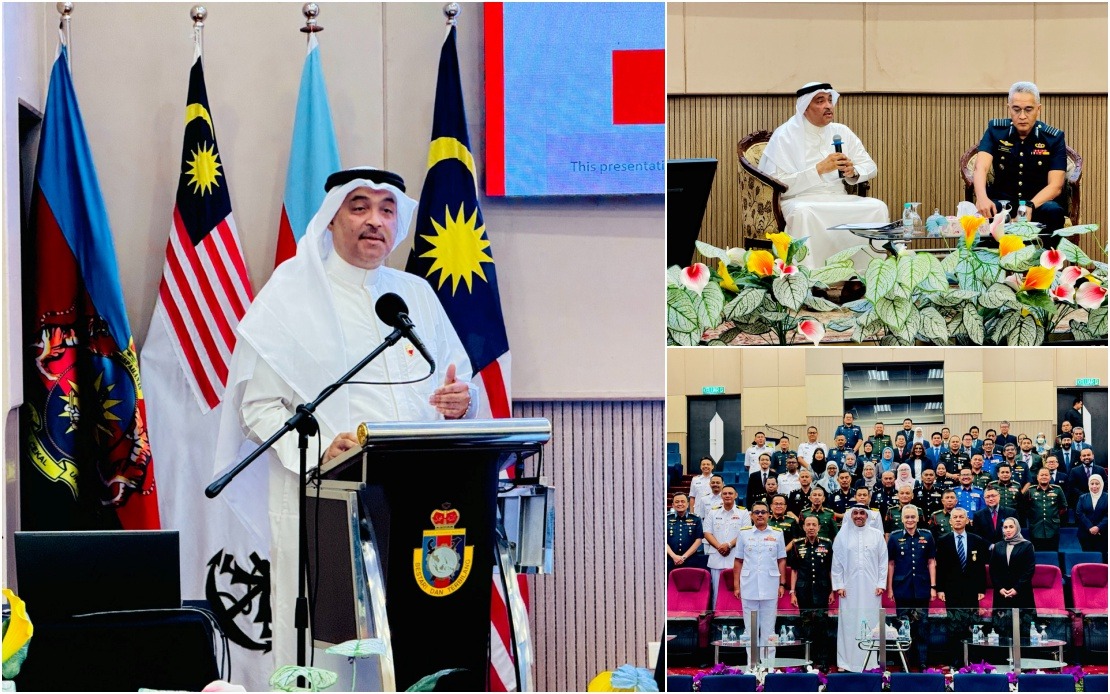
Bahrain and Malaysia are moving closer together on the diplomatic and strategic front, with the Gulf state's ambassador emphasizing the mutual benefits flowing from expanded cooperation across numerous sectors. Speaking at the National Resilience College in Putrajaya on August 3, Dr Waleed Khalifa Al Manea underscored how the two nations are building on a foundation of strong personal ties between their respective monarchs to create concrete partnerships that serve both populations.
The ambassador attributed much of this momentum to the relationship between His Majesty King Hamad bin Isa Al Khalifa, King of Bahrain, and His Majesty Sultan Ibrahim, King of Malaysia. Equally important, he noted, are the collaborative efforts of Bahrain's Crown Prince and Prime Minister, His Royal Highness Prince Salman bin Hamad Al Khalifa, and Malaysia's Prime Minister Datuk Seri Anwar Ibrahim, who have made deepening bilateral cooperation a priority. This high-level political commitment has created space for sustained engagement across defence, maritime security, diplomatic coordination and other critical areas.
One tangible expression of this growing partnership emerged when Malaysia agreed to host the 2026 Formula 1 Gulf Air Bahrain Grand Prix. While superficially a sporting event, such an arrangement represents significant diplomatic recognition and cultural exchange, signalling to the international community that the two nations view their relationship as sufficiently robust to merit joint celebrations on the global stage. For Malaysia, hosting a Gulf-branded Formula 1 event signals openness to Middle Eastern partnerships. For Bahrain, it provides a platform to engage with Southeast Asia's largest economy and a key ASEAN player.
Al Manea's lecture, delivered to an assembled audience of Malaysian military leaders, police officials, maritime enforcement personnel, government representatives and parliamentary members, focused on the security landscape confronting the Middle East and the Gulf region. His remarks reflected Bahrain's perspective on how regional tensions, particularly those emanating from Iranian actions, extend beyond the Persian Gulf to affect global stability and, critically, Southeast Asian interests including Malaysia's.
The ambassador outlined Bahrain's integrated approach to regional security, which combines conventional defence of state sovereignty with civilian protection, factual documentation of incidents, and proactive diplomacy. This framework matters to Malaysian policymakers because it illustrates how smaller states navigate turbulent neighbourhoods without abandoning principles of international law or peaceful resolution. Bahrain's experience managing regional pressures offers lessons for ASEAN nations dealing with their own complex geopolitical environments.
A central focus of Al Manea's presentation was Iran's pattern of military actions against Gulf Cooperation Council member states, including attacks on civilian populations, critical infrastructure and shipping routes. These incidents carry ripple effects far beyond the Middle East. For Malaysia, which depends on stable maritime corridors for trade and energy security, Iranian actions targeting navigation routes represent a direct threat to national interests. The Strait of Hormuz, through which much of Asia's oil passes, remains vulnerable to escalation, making the security of Gulf waters a Malaysian concern.
During Bahrain's presidency of the United Nations Security Council in April, the kingdom leveraged that position to advance international efforts protecting maritime navigation and critical infrastructure in the region. This initiative directly benefits shipping nations like Malaysia, which has substantial commercial interests in ensuring freedom of passage through contested waters. Bahrain's diplomatic work at the Security Council served broader Asian interests, even if that connection remained implicit.
Malaysia's role in this landscape became more visible when it co-sponsored UN Security Council Resolution 2817, which reaffirmed the sovereignty of states targeted by attacks, emphasized civilian protection and called for an end to hostilities. This sponsorship signals Malaysia's commitment to international legal frameworks governing maritime security and state conduct, positioning the country alongside Gulf allies in supporting rules-based international order. For a Southeast Asian nation seeking to maintain equilibrium in global geopolitics, such positions carry weight.
The gathering at the National Resilience College, attended by Major General Dr Abdul Karim Ahmad, Commandant of the institution, and other senior military and civilian officials, reflected how seriously Malaysia's defence establishment views the Bahrain relationship. The Executive Week Programme brought together serving officers and policymakers to engage directly with a senior Gulf diplomat on matters of shared concern. This format ensures that understanding of Middle Eastern security challenges permeates Malaysian defence planning and regional coordination strategies.
For Malaysia, the deepening partnership with Bahrain serves multiple purposes. It strengthens ASEAN's connections with an important Gulf state that plays a stabilizing role in a volatile region. It provides access to Bahraini perspectives on Iran, Saudi Arabia and broader Gulf dynamics that inevitably influence Asian geopolitics. It also positions Malaysia as a neutral, respected voice capable of engaging productively with Middle Eastern actors while maintaining ASEAN's non-aligned principles.
The timing of this partnership expansion coincides with growing Malaysian interest in Gulf affairs, driven partly by energy security concerns and partly by recognition that Middle Eastern stability affects Asian shipping, investment flows and regional security architecture. Bahrain, as a relatively moderate voice within the GCC and a state with sophisticated diplomatic capacity, offers Malaysia a valuable interlocutor for understanding regional dynamics without requiring Malaysia to adopt contentious positions on intra-Gulf disputes.
Looking forward, the 2026 Formula 1 Grand Prix hosting provides a deadline for both nations to demonstrate tangible progress in their partnership. Beyond the sporting spectacle, the event will likely serve as a platform for announcing additional cooperative initiatives in defence coordination, maritime security information-sharing, and perhaps expanded trade and investment frameworks. Such announcements would reinforce the message that Bahrain-Malaysia ties transcend ceremonial diplomacy.
The ambassador's emphasis on shared values and mutual interest suggests both nations view their partnership as enduring rather than transactional. For Malaysia, this represents a strategic hedge, strengthening connections with a responsible Gulf actor while managing broader Middle Eastern relationships through ASEAN frameworks. For Bahrain, it reflects broader efforts to build partnerships across Asia, recognizing that Gulf security is increasingly tied to Asian stability and prosperity. This bilateral evolution, though less visible than major power realignments, quietly reshapes regional alignments in ways that will influence Asian geopolitics for years ahead.

