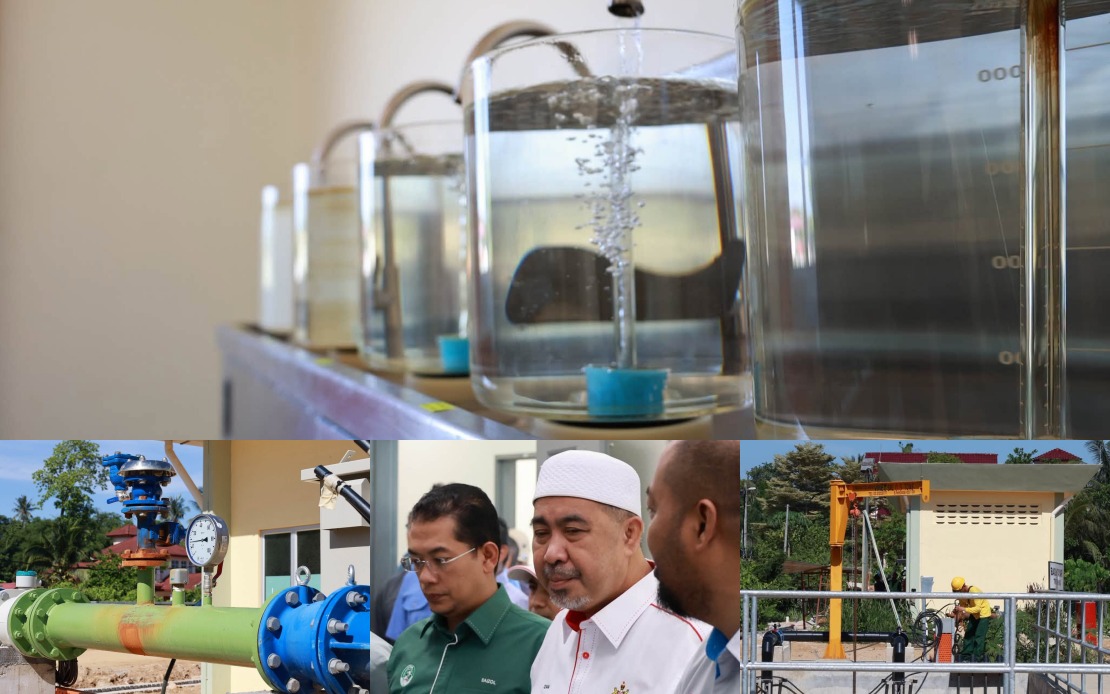
Kelantan's long-running water supply challenges are moving towards resolution with the imminent completion of the Chicha 2 Water Treatment Plant in Pasir Hor, which is expected to commence operations in September and directly benefit more than 13,000 consumers across the region. The RM54.98 million infrastructure project, which began construction in 2024, has achieved 97 per cent physical progress, according to Datuk Dr Izani Husin, chairman of the State Public Works, Infrastructure, Water and Rural Development Committee, who inspected the facility and briefed reporters during a site visit in Kota Bharu.
The water treatment plant represents a significant investment in expanding Kelantan's treated water capacity, with the facility capable of processing 20 million litres per day. Once fully operational, the infrastructure will extend supply coverage to residents in Pasir Hor, Telipot, Kota Seribong, Mulong and Tunjong—five localities that have historically experienced inconsistent water availability. Beyond merely expanding service to new areas, the plant's activation is anticipated to unlock approximately 10,000 inactive consumer accounts in the surrounding districts, reconnecting residents who have been unable to access the state's treated water distribution network.
The engineering approach adopted at Chicha 2 marks an innovation for Kelantan's water infrastructure portfolio. The 1.84-hectare facility extracts groundwater through a 100-metre-deep excavation process and employs an aeration system to produce high-quality treated water. Dr Izani highlighted that this aeration-based water treatment methodology represents the first deployment of such technology in Kelantan, and its proven effectiveness opens the possibility for similar systems to be implemented at other water treatment plants across the state. This methodological advancement is particularly noteworthy for Southeast Asian water managers grappling with the challenge of scaling sustainable treatment solutions.
Kelantan's water supply landscape has been characterised by persistent challenges that extend well beyond the immediate service areas targeted by Chicha 2. The state's non-revenue water rate—the proportion of treated water lost before reaching consumers—currently exceeds 50 per cent, a figure substantially higher than national targets and indicative of systemic inefficiencies throughout the distribution network. Dr Izani acknowledged that these losses stem from multiple infrastructure failures: ageing pipes that have corroded over decades, leaking distribution lines, underground pipe ruptures, and malfunctioning water meters that prevent accurate consumption tracking. These problems compound one another, creating a cascade of inefficiency that wastes enormous quantities of expensively treated water.
The state government has adopted a phased approach to resolving Kelantan's water security deficit, with a comprehensive target to achieve full resolution by 2030. This timeline reflects the scale and complexity of the rehabilitation effort required, acknowledging that water infrastructure challenges cannot be rectified through single projects alone. Rather, the strategy involves implementing multiple major infrastructure undertakings simultaneously while constructing additional water treatment plants to expand total treatment capacity. This systematic approach recognises that achieving adequate water supply security demands not merely adding new sources of treated water, but also substantially reducing losses throughout the existing distribution network.
For Malaysian consumers in Kelantan specifically, the Chicha 2 completion milestone carries immediate practical significance. Residents in the five target districts who have endured erratic water supplies will gain access to consistent, treated water once the plant transitions to full operation. More broadly, the project demonstrates government commitment to addressing rural and semi-rural water access—an issue that has historically received less attention than urban water infrastructure despite affecting substantial rural populations across Malaysia. The reactivation of 10,000 dormant accounts suggests that many households had disconnected from the formal water supply system, potentially due to previous service unreliability, and the facility's opening may enable these families to restore their connection to treated water.
The technological innovation embodied in the aeration treatment system warrants particular attention for policymakers across Southeast Asia. Water scarcity and quality challenges affect numerous countries throughout the region, and Kelantan's successful deployment of aeration-based purification offers a potential model for replication. This technology proves particularly valuable in contexts where groundwater serves as a primary or supplementary source, as it addresses common contaminants through relatively straightforward mechanical and chemical processes. The fact that this represents Kelantan's first such system suggests a learning curve lies ahead, but successful initial deployment could position the state as a centre of expertise for this treatment methodology.
The acknowledgment that water loss reduction forms a central pillar of Kelantan's strategy through 2030 indicates maturing understanding of water infrastructure management. While constructing new treatment plants captures public attention and yields measurable outputs, reducing non-revenue water requires sustained investment in network rehabilitation, leak detection systems, pressure management, and metre replacement—work that receives less political visibility but proves equally essential. The state's concurrent pursuit of both capacity expansion and loss reduction reflects best-practice water management principles increasingly adopted globally as populations and competing demands for freshwater intensify.
Public communication regarding the timeline for full resolution—specifically Dr Izani's request that residents exercise patience as challenges are addressed in phases—acknowledges the realistic constraints on how rapidly infrastructure rehabilitation can proceed. Water supply restoration at the state level involves coordinating multiple projects, managing construction schedules, and phasing expenditures across several fiscal years. This transparency, while perhaps frustrating for consumers currently experiencing supply difficulties, establishes reasonable expectations and demonstrates that officials recognise the ongoing nature of the challenge rather than promising unrealistic rapid fixes.
The Chicha 2 project exemplifies how Malaysian states are leveraging infrastructure investment to expand service coverage and improve reliability in underserved regions. As the facility approaches its September operational date, it will serve as a tangible indicator of progress on water security—a fundamental determinant of public health, economic development, and quality of life. For Kelantan, this milestone represents not merely the addition of treatment capacity, but a stepping stone within a broader 2030 roadmap aimed at ensuring that water supply challenges cease constraining the state's development trajectory and residents' wellbeing.

