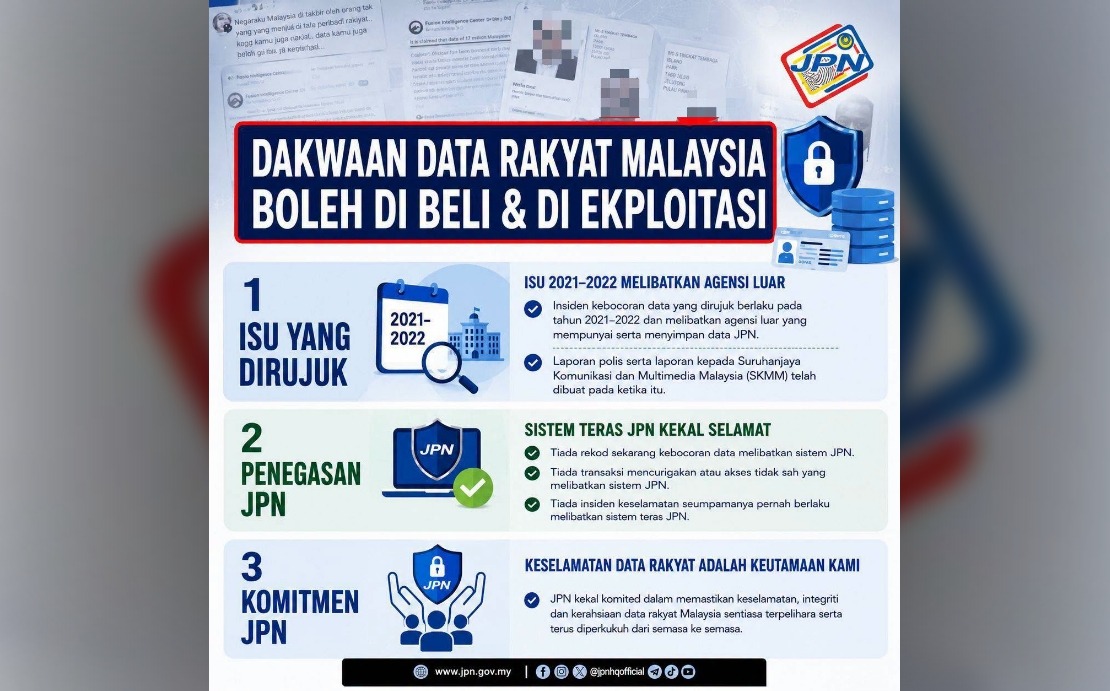
The National Security Council of Malaysia has moved to dispel public alarm over a data leak trending across social media platforms, emphasising that the compromised personal information originates from cybersecurity incidents predating 2022 and holds no connection to systems presently in use. Through a statement issued by the National Cyber Security Agency (NACSA), the council explained that the information appearing online had been illegally acquired through cyber intrusions directed at various systems in earlier years, and is now being circulated without consent across digital channels.
The timing of the leak's resurfacing underscores a persistent challenge in Malaysia's digital landscape: the republication and redistribution of historically stolen data. Cybercriminals and data brokers frequently repackage old breaches across underground forums and public platforms, creating the illusion of fresh compromises when in fact the underlying information may be years old. This pattern complicates public awareness efforts and can trigger unnecessary panic among citizens already concerned about their digital security. The council's clarification attempt to correct this misperception by anchoring the incident firmly in the past.
Under Malaysian law, the unauthorised distribution of such information constitutes a criminal offence regardless of where the hosting infrastructure operates. This principle becomes especially significant given the borderless nature of the internet, where data can be warehoused and shared across jurisdictions with varying legal frameworks. NACSA has consequently engaged international service providers to systematically remove affected websites and restrict access to the stored data. In tandem with MyNIC, Malaysia's domain registry, and the Personal Data Protection Department, the agency has escalated its technical response to contain the breach's continuing circulation.
The investigations now underway represent a collaborative effort between NACSA and the Royal Malaysia Police, who are conducting digital forensic work to trace those responsible for the initial intrusions and their subsequent illegal distribution. Identifying perpetrators across digital networks demands sophisticated analytical capacity and international cooperation, elements increasingly central to cybercrime investigation. The council's commitment to holding perpetrators accountable signals growing governmental resolve to prosecute cyber offenders, though the challenges of attribution and extradition remain substantial, particularly when actors operate from countries with limited treaty arrangements with Malaysia.
Malaysian authorities have cautioned citizens against patronising services offering access to unlawfully obtained data, framing such participation as complicity in cybercrime. This public health messaging reflects a strategic pivot toward individual responsibility and digital citizenship. When users knowingly access stolen information, they create demand that incentivises further breaches and fuels the underground economy surrounding data trafficking. The council's advisory attempts to break this cycle by highlighting legal and ethical dimensions of data consumption.
The incident has reinvigorated momentum behind the proposed Cyber Crime Bill, which the council identifies as crucial legislative infrastructure for addressing evolving threats. The bill introduces criminalisation of unauthorised system access and damage perpetrated without legitimate authority, directly addressing the mechanisms through which the pre-2022 breaches occurred. Additionally, it establishes identity theft as a distinct offence, encompassing the fraudulent assumption of another person's identity undertaken with intent to commit crime. These provisions represent a modernisation of Malaysia's legal arsenal, expanding definitions and penalties to match contemporary threat vectors that legacy legislation fails to adequately address.
Complementing legislative efforts, the Cyber Security Act 2024, which commenced operation in August 2024, mandates that entities managing Malaysia's National Critical Information Infrastructure implement rigorous protective protocols. These encompass adherence to codes of practice, comprehensive risk assessments, and recurrent security audits designed to elevate the nation's collective cyber resilience. By establishing baseline protections across essential services, this framework reduces systemic vulnerability to precisely the kind of intrusions that generated the leaked data now resurfacing online.
MyDigital ID, which has garnered registrations exceeding 16 million users, emerged as a focal point in the council's statement, likely because observers questioned whether the platform had been compromised. The council clarified that MyDigital ID functions as an identity verification mechanism rather than a data repository, authenticating users directly against records held by the National Registration Department. This architectural distinction proves significant: the platform does not accumulate personal data in centralised storage, but instead facilitates direct verification queries, substantially reducing breach exposure. Widespread deployment of MyDigital ID across governmental and private sector applications—spanning telecommunications, banking, and other financial services—promises enhanced transaction security and heightened defences against identity fraud.
The broader strategic vision outlined by MKN reflects an integrated approach to cybersecurity that combines legislative reform, technical infrastructure investment, international cooperation, and public engagement. Rather than treating cybersecurity as an isolated technical domain, the council's positioning acknowledges its centrality to digital transformation and economic development. Malaysians' willingness to embrace digital services depends fundamentally on confidence that personal information faces adequate protection, making cybersecurity not merely a defensive necessity but an enabler of digital economy participation.
For Malaysian and Southeast Asian observers, this incident illuminates persistent regional vulnerabilities. Cybercriminals demonstrably maintain access to databases breached years ago, with capacity to re-exploit this information through updated distribution channels. The sophistication of attack infrastructure—from initial intrusion through long-term data monetisation—exceeds individual company defences, necessitating coordinated national and regional responses. The council's acknowledgment that cybercrime transcends borders and that foreign service providers must be engaged to address it reflects regional interdependence in cybersecurity governance, a reality increasingly central to Southeast Asian strategic considerations.
As digital transformation accelerates throughout Malaysia and across the region, the resilience of underlying security infrastructure becomes progressively consequential. Breaches from 2022 and earlier circulating in 2024 demonstrate that vulnerability windows extend far beyond initial compromise, with historical data remaining exploitable years later. The government's multi-layered response—combining legal penalties, technical countermeasures, international cooperation, and public awareness campaigns—represents necessary complexity, yet also suggests the sustained commitment required to protect citizen information in an increasingly connected world.