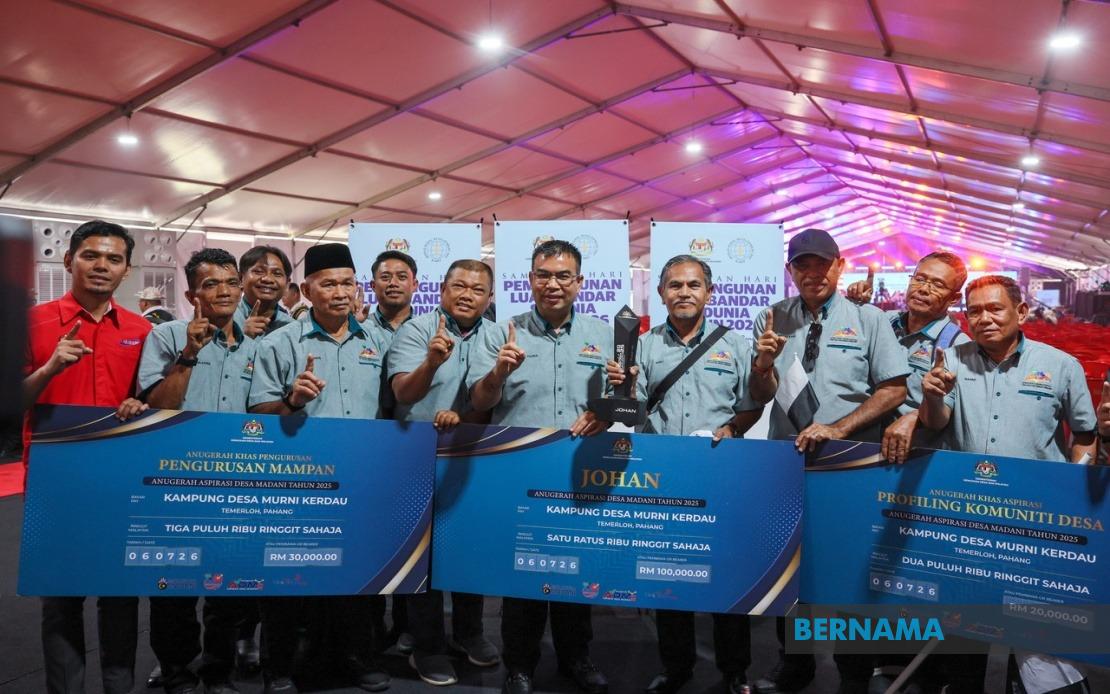
Desa Murni Kerdau, a village in Temerloh, Pahang, has been honoured with three prestigious awards at the World Rural Development Day 2026 celebration held at Tun Abdul Razak Stadium in Jengka Sentral. The accolades underscore the community's commitment to sustainable development and exemplary rural governance, marking a significant milestone for the settlement and its residents.
The village claimed the top honour of 2025 MADANI Rural Aspiration Award Champion, alongside two additional special awards recognising its work in rural community profiling and sustainable management practices. Deputy Prime Minister Datuk Seri Dr Ahmad Zahid Hamidi presented the main award, while Deputy Minister of Rural and Regional Development Datuk Rubiah Wang bestowed the two special recognitions during the ceremony. The presence of senior government figures underscores the national significance attached to rural development initiatives and the government's commitment to recognising grassroots success stories across Malaysia.
According to Mohamad Fazrul Ahmad, Chairman of the Village Development and Security Committee (JPKK) at Desa Murni Kerdau, the triple recognition validates the village's trajectory in fostering effective leadership structures and tangible improvements in residents' quality of life. He expressed gratitude to the Ministry of Rural and Regional Development for creating a platform that elevates and celebrates rural achievements, noting that such recognition motivates communities to sustain their development momentum.
The village's entrepreneurial ecosystem has flourished under its governance model, generating approximately twenty business operators engaged across diverse sectors including small and medium industries, agricultural production, and the automotive trade. This entrepreneurial diversity reflects successful economic diversification at the grassroots level, reducing dependency on single-sector employment and creating multiple income streams for households. Beyond traditional economic activities, Desa Murni Kerdau has positioned itself as a rural tourism destination through its "Kampung Stay" product, which attracts visitors seeking authentic village experiences and cultural immersion.
Structurally, the settlement comprises roughly two hundred households accommodating more than six hundred residents, functioning as an organised and cohesive community unit. The village's scale allows for manageable administration while maintaining sufficient population density to justify infrastructure investment and service provision. This demographic profile typifies successful rural settlements that achieve the balance between maintaining traditional community character and adopting contemporary governance standards.
The financial rewards from the awards will benefit residents directly, with funds allocated toward community improvement projects and development initiatives identified by villagers as priorities. This approach ensures that recognition translates into tangible upgrades in living conditions, whether through infrastructure enhancement, facility improvement, or social programme expansion. Such community-focused distribution of award proceeds strengthens the connection between governmental recognition and household-level development outcomes.
The achievement holds broader implications for rural Malaysia's development narrative. As urbanisation continues to draw populations toward metropolitan centres, villages that successfully establish viable enterprises and quality living standards serve as counterweights to urban drift. Desa Murni Kerdau demonstrates that rural areas need not be repositories of poverty or stagnation but can become engines of economic activity and social cohesion when managed with clear vision and community participation.
The MADANI award framework, emphasising rural aspiration, reflects the government's policy pivot toward inclusive development that values countryside communities alongside urban centres. By institutionalising recognition for villages excelling in governance, entrepreneurship, and sustainable practices, such awards create incentive structures encouraging other rural settlements to strengthen their development programmes and institutional capacities. The visibility generated through awards also facilitates knowledge-sharing, allowing other communities to study and adapt Desa Murni Kerdau's successful practices.
For Southeast Asian rural development practitioners, Desa Murni Kerdau's trajectory illustrates how traditional settlements can evolve into modern, economically resilient communities without abandoning cultural identity. The village's emphasis on entrepreneur cultivation, tourism diversification, and organisational governance provides a replicable model for other communities navigating similar development challenges. In a region where rural poverty remains endemic and youth migration toward cities threatens countryside sustainability, such examples carry instructive value.
Moving forward, the challenge for Desa Murni Kerdau will involve sustaining this momentum, consolidating entrepreneurial gains, and ensuring that development benefits reach all residents equitably. Continued investment in skills training, market access support, and infrastructure maintenance will determine whether the village can maintain its competitive advantage and continue attracting both residents and visitors. The awards represent recognition of achievement to date, but sustainable rural development remains an ongoing process requiring persistent commitment from both community leadership and supporting government ministries.

