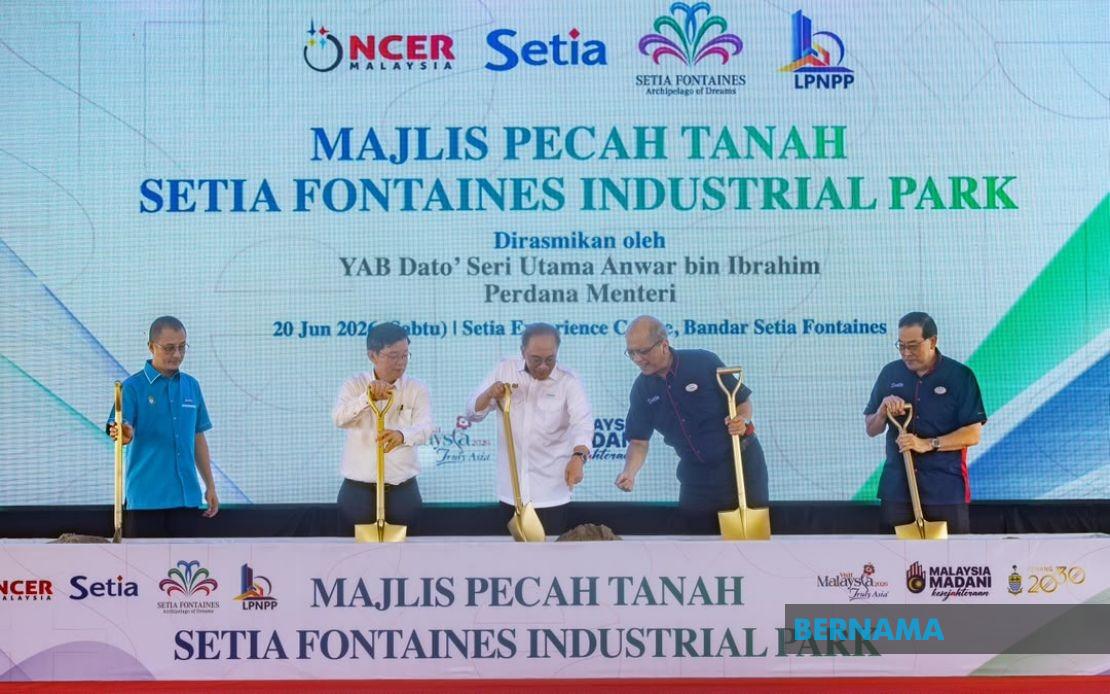
Prime Minister Datuk Seri Anwar Ibrahim has called for a fundamental shift in how development projects are approved and executed, insisting that both government-linked companies and private enterprises must meaningfully include lower- and middle-income groups in their economic opportunities. Speaking at the groundbreaking ceremony for the Setia Fontaines Industrial Park in Bandar Setia Fontaines, Kepala Batas, Anwar emphasised that rapid growth and investment cannot come at the expense of social cohesion, warning that without deliberate inclusion, Malaysia risks deepening existing wealth disparities.
The Prime Minister's remarks reflect growing concerns within government circles about how Malaysia's economic expansion is being distributed across different income segments of society. Anwar articulated this concern through specific reference to major institutional investors such as Khazanah Nasional Berhad, Permodalan Nasional Berhad, and the Employees Provident Fund, suggesting that each approval granted to these entities and private corporations should include tangible pathways for less affluent Malaysians to participate and benefit.
This approach addresses a critical vulnerability in Malaysia's development narrative. While official statistics often celebrate rising GDP figures and foreign direct investment inflows, these headline numbers frequently mask uneven distribution of prosperity. Anwar's intervention suggests that the government is concerned about a growing perception that development corridors and industrial parks primarily benefit established capital holders and skilled professionals, while workers and entrepreneurs from disadvantaged backgrounds struggle to access meaningful participation.
The inclusive development framework Anwar outlined goes beyond charitable corporate responsibility policies. Instead, he positioned economic opportunity creation as a structural requirement embedded within project approvals themselves, suggesting that future licensing and regulatory frameworks should explicitly mandate how projects will generate pathways for lower-income participation. This represents a potentially significant shift in how Malaysia's developmental state operates, moving from aspirational equality statements toward binding operational mechanisms.
The Setia Fontaines Industrial Park development in Seberang Perai exemplifies the kind of project Anwar believes should embody these principles. By locating advanced manufacturing capacity on the mainland peninsula rather than solely on the island or in the southern state region, the project aims to ensure that Seberang Perai's economic growth trajectory aligns with development momentum seen in other areas, preventing the emergence of regional prosperity gaps that could compound social tensions.
Anwar specifically highlighted the employment potential within this industrial park, noting that Malaysia's ongoing technological advancement and manufacturing sector evolution creates significant opportunities for workers willing to upgrade their capabilities. However, he identified a critical constraint: the mismatch between available jobs and worker qualifications. As Malaysia transitions from lower-value back-end manufacturing toward more sophisticated technology-intensive production, the skills gap becomes increasingly acute, potentially limiting how many domestic workers can actually access the well-remunerated positions these parks create.
Addressing this skills challenge requires unprecedented collaboration across Malaysia's education and industry ecosystems. Anwar called for enhanced coordination between industrial actors, technical and vocational training providers, and universities including Universiti Sains Malaysia, recognising that such partnerships are essential for ensuring local workers remain competitive. The rapid pace of technological change—with industry standards potentially shifting every one to two years—means that traditional education models focused on static curriculum will inevitably fail to meet market needs.
This emphasis on continuous skills alignment reflects a deeper truth about modern development in Southeast Asia: inclusive growth requires that opportunity pathways remain fluid and responsive. Merely creating jobs means little if the available workforce lacks the competencies those positions demand. Conversely, investing heavily in education produces frustration if local workers cannot apply their qualifications within accessible employment contexts. The three-way partnership Anwar advocated for—industry defining skill requirements, education institutions providing responsive training, and universities contributing research and advanced human capital development—represents a plausible model for maintaining inclusion during technological transition.
For Malaysian readers and policymakers, Anwar's intervention carries several implications. At the macroeconomic level, it signals commitment to defining inclusive development as a non-negotiable criterion for project approval, suggesting future regulatory frameworks may increasingly require documented inclusive strategies from investors. For workers and entrepreneurs from lower-income backgrounds, it suggests potential expansion of skills training and employment pathway programs linked to major infrastructure projects. For multinational and local corporations operating in Malaysia, it indicates that expectations for inclusive economic participation are hardening, moving beyond voluntary corporate social responsibility initiatives toward structural requirements.
The regional context amplifies these themes. Across Southeast Asia, rapid industrialisation and infrastructure investment have generated both prosperity and anxiety about unequal distribution of gains. Anwar's framing positions Malaysia as attempting to chart a middle path—pursuing technological advancement and attracting investment while deliberately constructing mechanisms to prevent wealth concentration. Whether Malaysia successfully implements these principles through actual project design and execution remains uncertain, but the rhetorical commitment signals that future development debates will increasingly centre on inclusion mechanisms rather than simply celebrating investment volumes.
For the Setia Fontaines project specifically, this framework suggests that success should be measured not merely by industrial output or capital attracted, but by demonstrable evidence that middle- and lower-income Malaysians have accessed professional employment, entrepreneurial opportunities, and skills development pathways. The coming years will reveal whether this inclusive development agenda remains primarily aspirational rhetoric or translates into binding operational requirements that genuinely reshape how Malaysia's developmental state functions.
%22%2F%3E%3C%2Fpattern%3E%3C%2Fdefs%3E%3Crect%20width%3D%22100%25%22%20height%3D%22100%25%22%20fill%3D%22url(%23ph5kreng)%22%2F%3E%3Crect%20width%3D%22100%25%22%20height%3D%22100%25%22%20fill%3D%22url(%23ph5krenp)%22%2F%3E%3Ctext%20x%3D%2250%25%22%20y%3D%2250%25%22%20text-anchor%3D%22middle%22%20dominant-baseline%3D%22central%22%20fill%3D%22rgba(255%2C255%2C255%2C0.95)%22%20font-family%3D%22Georgia%2C%20'Times%20New%20Roman'%2C%20serif%22%20font-weight%3D%22700%22%20font-size%3D%22226%22%20letter-spacing%3D%22-0.02em%22%3EHAWANA%3C%2Ftext%3E%3C%2Fsvg%3E)
%22%2F%3E%3C%2Fpattern%3E%3C%2Fdefs%3E%3Crect%20width%3D%22100%25%22%20height%3D%22100%25%22%20fill%3D%22url(%23ph1q69ng)%22%2F%3E%3Crect%20width%3D%22100%25%22%20height%3D%22100%25%22%20fill%3D%22url(%23ph1q69np)%22%2F%3E%3Ctext%20x%3D%2250%25%22%20y%3D%2250%25%22%20text-anchor%3D%22middle%22%20dominant-baseline%3D%22central%22%20fill%3D%22rgba(255%2C255%2C255%2C0.95)%22%20font-family%3D%22Georgia%2C%20'Times%20New%20Roman'%2C%20serif%22%20font-weight%3D%22700%22%20font-size%3D%22320%22%20letter-spacing%3D%22-0.02em%22%3ETV3%3C%2Ftext%3E%3C%2Fsvg%3E)