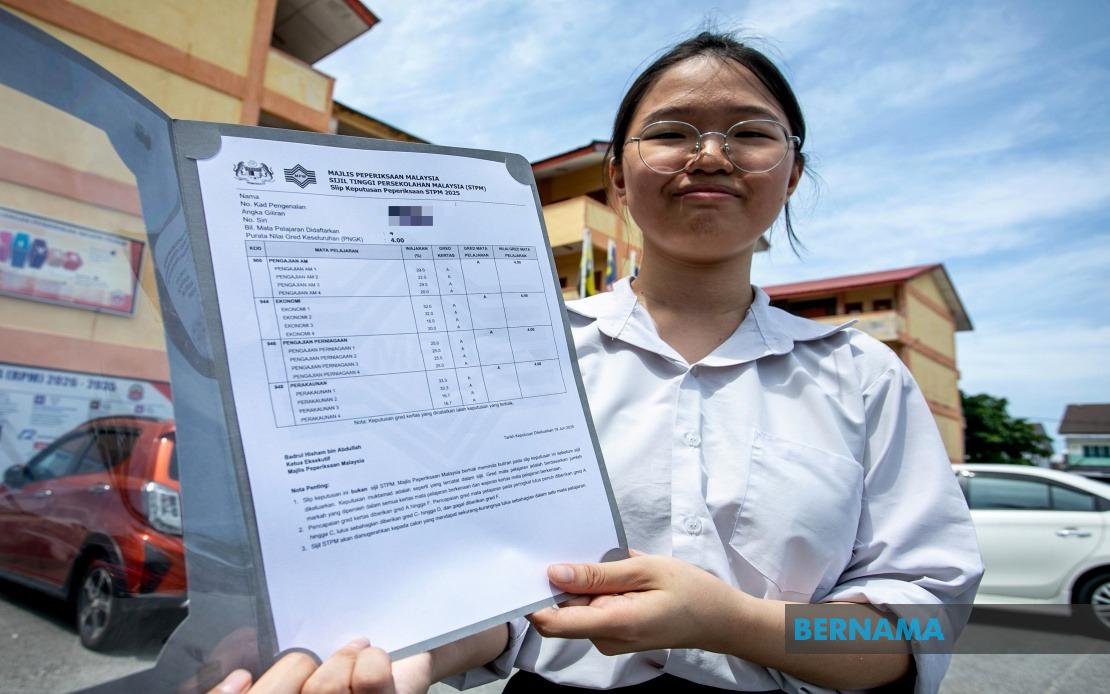
Yong Xin Yi's path to academic excellence tells a story familiar to many Malaysian students pursuing higher qualifications: relentless discipline, strategic time management, and an almost monastic commitment to study. The 20-year-old student from Sekolah Menengah Kebangsaan Jalan Tasek in Ipoh has become one of the standout performers in this year's Sijil Tinggi Persekolahan Malaysia examination, securing four As and achieving a perfect cumulative grade point average of 4.00. Her subjects—General Studies, Principles of Accounting, and Economics—represent a cross-section of disciplines requiring vastly different skill sets, yet she navigated them with equal proficiency.
The foundation of Xin Yi's success rests on a deceptively simple framework: a rigid five-hour revision block stretching from 5:00 pm through 10:00 pm each evening, complemented by meticulous attention during classroom instruction. This commitment, maintained consistently throughout her STPM preparation, illustrates an important principle often overlooked by students seeking shortcuts: that examination performance is fundamentally determined by the accumulation of small, consistent efforts rather than sporadic bursts of intense activity. Her approach suggests that the quality of classroom engagement directly reduces the cognitive burden when revising independently at home, a finding aligned with educational research on metacognitive awareness.
What distinguishes Xin Yi's strategy is her explicit recognition that classroom focus represents the cornerstone rather than a supplementary element of exam preparation. By internalising explanations directly from her instructors, she minimised conceptual confusion during evening revision sessions, allowing those designated hours to consolidate understanding rather than resolve fundamental misunderstandings. This prioritisation reflects a mature understanding of how human learning works—that initial exposure and comprehension matter as much as subsequent reinforcement. Many students invest heavily in revision materials and tutoring while neglecting the pedagogical goldmine of their regular classroom environment.
Completion of assigned homework formed another non-negotiable component of her study regimen. Rather than viewing homework as an administrative burden imposed by teachers, Xin Yi recognised it as a deliberate mechanism for mastering discrete topics. This perspective transforms homework from a task to be rushed through into an integral learning tool, effectively extending study time beyond the designated five-hour evening block. For Malaysian students often juggling multiple commitments, this recognition that homework serves learning rather than merely satisfying requirements could reshape how they approach their overall preparation.
Among her four subjects, General Studies emerged as the most formidable challenge. This examination demands not only content knowledge but also sophisticated writing ability and precise adherence to specific formatting and marking criteria—skills that transcend simple memorisation. Recognising this vulnerability, Xin Yi strategically redirected additional attention toward this subject, exemplifying the kind of adaptive resource allocation that separates successful from mediocre performers. She identified her weakness early and took deliberate corrective action rather than hoping the problem would resolve itself. This metacognitive approach—understanding one's own learning gaps and responding accordingly—represents a transferable skill extending far beyond examination halls.
Her success achieved particular significance within her school context: Xin Yi was among only five students from SMK Jalan Tasek to secure four As in this examination cycle, positioning her within an exclusive cohort of high achievers. This rarity underscores how challenging STPM remains for Malaysian students, despite—or perhaps because of—its importance as a qualification pathway to university and professional advancement. The examination's demanding standards mean that achieving four As demands sustained intellectual effort rather than mere natural aptitude.
Beyond academic metrics, Xin Yi's achievement carried profound personal significance rooted in family obligation and aspiration. As an only child, she bore heightened responsibility to justify her parents' investment in her education. Her mother works as a clerk while her father operates as a phone salesman—professions representing Malaysia's working-class backbone. Xin Yi framed her examination success explicitly as a vehicle for elevating her family's circumstances, viewing her academic credentials as instruments for future professional success that would reward her parents' sacrifices. This motivation structure, grounded in filial piety and socioeconomic aspiration, reflects values deeply embedded within Malaysian and wider Southeast Asian family culture.
Her post-secondary ambitions align logically with her examination performance. Xin Yi intends to pursue economics at Universiti Putra Malaysia, a choice she deliberated carefully rather than adopting on impulse. She weighed her personal interests against realistic career prospects, recognising that the economics field offers diverse professional pathways spanning government, commerce, finance, and international development sectors. This intentional subject selection contrasts sharply with Malaysian students who sometimes default to engineering or medicine based on prestige rather than genuine interest or aptitude.
Xin Yi's trajectory demonstrates how Malaysian secondary education can function as a transformative pathway for students from modest socioeconomic backgrounds. Her parents' occupations would not typically suggest children destined for academic stardom, yet through disciplined self-management and supportive family environments, she has positioned herself to access tertiary education at a premier Malaysian research university. Her case exemplifies how STPM, despite its rigours, remains fundamentally meritocratic—a qualification where diligent preparation substantially outweighs inherited advantage.
The broader implications of Xin Yi's success extend beyond her individual achievement. Her study methodology—structured evening revision, classroom attentiveness, homework completion, strategic targeting of weak areas—represents replicable practices rather than secret techniques inaccessible to other students. Malaysian educators and parents might usefully examine how these elements could be institutionalised within secondary schools, ensuring that time-management skills and strategic learning approaches become embedded within school culture rather than left entirely to individual initiative. Students recognising these patterns in their own preparation could strengthen their examination performance substantially.
Looking ahead, Xin Yi's pursuit of economics education signals potential entry into professional domains where Malaysia increasingly competes internationally. Whether she continues to postgraduate study, enters government economic planning, or pursues private sector finance, her STPM credentials position her advantageously. Her success story, while individually distinctive, also represents the quiet achievements of thousands of Malaysian students annually who transform examination challenges into life opportunities, working methodically through discipline and focus to unlock their potential.