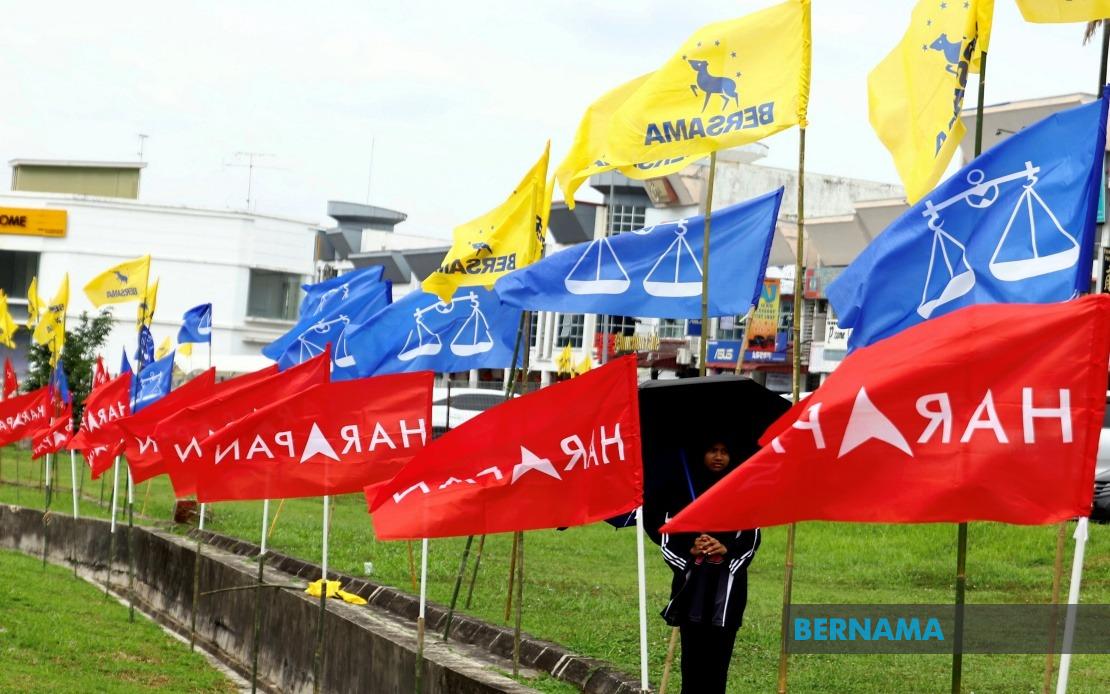
Johor's two-week electoral campaign comes to an abrupt halt at 11.59 pm tonight, silencing the ground and digital canvassing activities that have dominated the state since June 27. From 8 am tomorrow, voting will commence across 1,076 polling centres, where approximately 2.7 million registered voters will make selections that will shape Johor's governance and development priorities for the next five years. The Election Commission projects that a comprehensive picture of the results should emerge by 10 pm tomorrow evening, allowing both the winning coalition and the state's stakeholders to begin charting the path forward without undue delay.
The composition of candidates vying for the 56 state legislative seats reflects a notably condensed field compared to the 2018 election cycle. This time, 172 candidates from various parties and independent backgrounds seek office, a significant reduction from the 239 aspirants who contested five years earlier. Barisan Nasional and Pakatan Harapan each field 56 candidates, positioning themselves as the principal contenders. Perikatan Nasional presents 33 candidates, while smaller entities including Parti Bersama Malaysia with 15 hopefuls, MUDA with four, and single representatives from Parti Orang Asli Malaysia and Parti Sosialis Malaysia complete the ballot. Six independent candidates also feature in the race.
The dissolution of the Johor State Legislative Assembly on June 1 upended the previous parliamentary arithmetic, which had heavily favoured the ruling coalition. Before dissolution, Barisan Nasional controlled 40 seats, providing a commanding majority. Pakatan Harapan held 12 seats, Perikatan Nasional governed three, and MUDA occupied one. These numbers set expectations for how different constituencies might respond to voter sentiment that has potentially shifted since the last statewide election in 2022.
Early voting procedures concluded last Tuesday without controversy, with 20,607 members of the Malaysian Armed Forces, Royal Malaysia Police, General Operations Force and their family members casting ballots in advance. This process ensures that security personnel and defence officials can participate in the democratic exercise while maintaining operational readiness. The smooth execution of early voting has generally been regarded as a positive indicator of the broader electoral machinery's preparedness for tomorrow's main event.
Throughout the fortnight of campaigning, political parties have endeavoured to shape voter perception around a narrow range of issues. Economic difficulties, employment creation, welfare programmes and broader recovery strategies have dominated manifestos and stump speeches. Both major coalitions recognised that Johor's electorate remains preoccupied with household finances and job security, reflecting economic anxieties that extend across the entire Southeast Asian region. The final campaign push intensified last night as Prime Minister Datuk Seri Anwar Ibrahim, leading Pakatan Harapan, and Deputy Prime Minister Datuk Seri Dr Ahmad Zahid Hamidi, chairing Barisan Nasional, each mobilised their respective grassroots machinery to energise supporters in the closing hours.
Political analysts have identified voter turnout as perhaps the most crucial variable in determining how campaign sentiment translates into electoral outcomes. Dr Nazreena Mohammed Yasin of Universiti Tun Hussein Onn Malaysia cautions against oversimplifying the relationship between turnout figures and electoral results. Turnout patterns vary substantially across individual constituencies and demographic segments, she explains, meaning that high participation in one area might amplify support for one coalition while producing negligible effect elsewhere. Rather than viewing turnout as a predictive instrument, analysts should understand it as a contextual factor that could prove decisive specifically in marginal constituencies where winning margins remain exceptionally narrow. The 2022 Johor election achieved an overall turnout of 54.92 percent, providing a baseline against which tomorrow's participation will be measured.
The quality of party machinery and ground-level operational efficiency may ultimately prove more consequential than campaign messaging alone. Parties that effectively mobilise their supporters on polling day and manage the logistics of getting voters to polling stations possess a structural advantage. This becomes particularly pronounced in closely contested seats where victory margins typically measure in the hundreds rather than thousands of votes. The identified category of fence-sitters and undecided voters, whose last-minute decisions remain genuinely uncertain, hold disproportionate power in these marginal constituencies. Changes in winning margins compared to 2022 will provide analysts with crucial data regarding whether support for particular coalitions has genuinely strengthened, diminished or shifted directionally.
Election results should ultimately be evaluated against multiple criteria beyond raw seat counts, Dr Nazreena suggests. Voter confidence in government performance, candidate credibility, assessments of political stability and demonstrated competence in addressing economic challenges all factor into how Johor's electorate reaches its conclusions. These considerations extend beyond party loyalty or campaign promises to encompass tangible evidence of whether previous electoral mandates translated into delivery of promised services and economic benefits. The electorate's emerging sophistication means that voters increasingly scrutinise track records and substantive performance rather than rhetoric alone.
Associate Professor Dr Mazlan Ali of Universiti Teknologi Malaysia observes that both major coalitions have emphasised political stability as their dominant campaign narrative throughout the election cycle. This messaging reflects the context of Malaysia's Unity Government arrangement at the federal level, where Barisan Nasional and Pakatan Harapan have forged unprecedented cooperation. Mazlan notes that the campaign has been substantially shaped by the track records and federal positioning of these two major coalitions, with their respective state-level records also influencing voter calculations. While individual parties have presented various manifestos and detailed pledges, voter decisions appear increasingly influenced by demonstrated governmental competence and the coalitions' capacity to deliver on past commitments rather than future promises alone.
Mazlan anticipates that heightened public engagement with this particular election will drive voter participation above the 54.92 percent threshold established in 2022. Greater public interest typically correlates with higher turnout, a dynamic that should magnify the significance of each individual ballot cast. Higher participation means that marginal seats become even more unpredictable and that late-deciding voters acquire greater aggregate influence over final outcomes. The combination of heightened public attention, economic concerns that transcend regional boundaries and Malaysia's evolving political architecture suggests that tomorrow's Johor election carries implications extending well beyond state-level governance into broader questions about federal stability and coalition durability.
The Malaysian electoral commission's institutional readiness to deliver results by 10 pm demonstrates administrative maturation across Malaysia's election management apparatus. The concentration of 2.7 million voters at 1,076 locations creates logistical complexity that requires meticulous coordination between poll workers, security personnel and administrative officials. The commission's confidence in rapid result compilation reflects their confidence in both the scale of their operations and the relative stability of contemporary Malaysian electoral procedures. For Southeast Asian observers, Johor's election tomorrow represents another data point in the region's democratic trajectory and offers lessons about voter behaviour, coalition dynamics and the interplay between economic conditions and electoral outcomes across the broader region.

