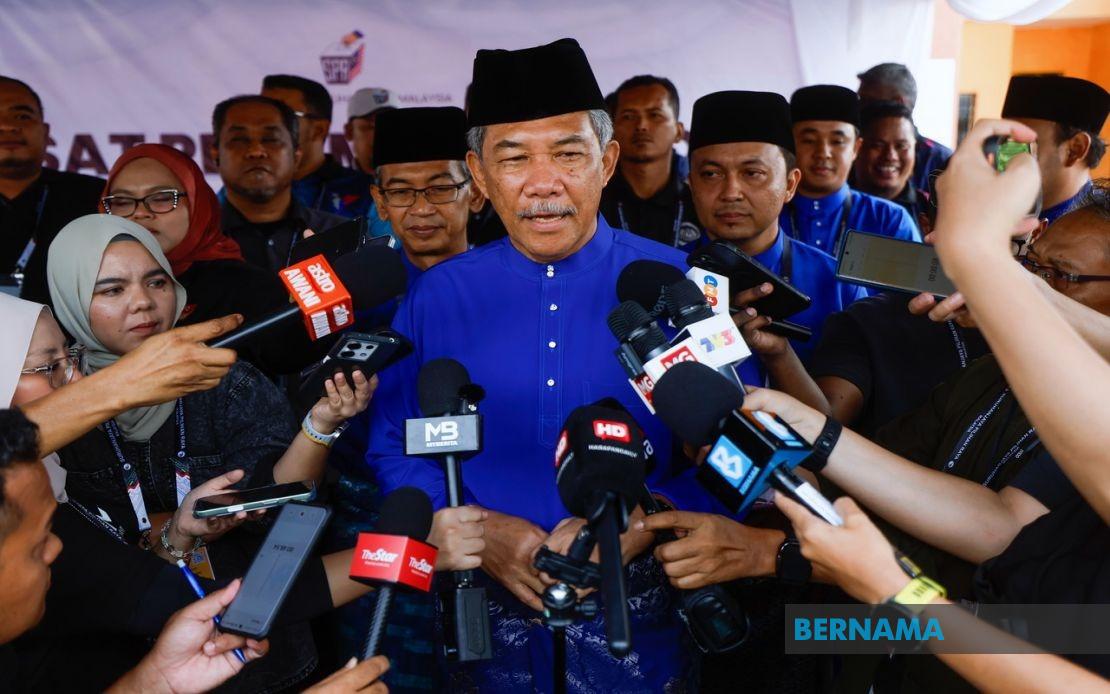
The Barisan Nasional's number two has issued a forceful directive to party campaigners in Negeri Sembilan to steer clear of the state's adat institution as an election battleground, signalling deep concern that entangling cultural traditions with electoral politics could destabilise the voting process. Datuk Seri Mohamad Hasan, speaking after nomination proceedings concluded in Rembau on July 18, stressed the need to respect Negeri Sembilan's adat framework while keeping it insulated from party politicking. The warning comes as the 16th state election campaign gains momentum following the dissolution of the state assembly on June 5, with early voting scheduled for July 28 and election day set for August 1 across all 36 state seats.
As UMNO deputy president alongside his role as BN deputy chairman, Mohamad carries authority within the coalition's machinery and his intervention suggests internal pressure or past instances where adat-related messaging had surfaced on the campaign trail. His explicit instruction to party operatives reflects a strategic calculus that maintaining electoral legitimacy depends on the state's governing institutions, particularly those rooted in Negeri Sembilan's constitutional heritage, remaining above the fray of partisan competition. The adat institution carries considerable weight in the state's political culture and constitutional framework, commanding respect across communal lines in ways that could unravel if instrumentalised by rival parties.
Mohamad's concern appears directed at preventing a scenario where either BN or opposition parties attempt to mobilise customary or traditional issues as wedge campaign tactics. Such manoeuvres, he cautioned, would only "complicate the situation" within the state and generate needless divisiveness during what should remain a civilised democratic exercise. The deputy chairman emphasised that there exists no legitimate rationale for deploying adat matters as campaign material, suggesting that any attempts to do so would represent a miscalculation by those seeking to boost voter appeal through cultural grievance narratives.
Beyond the adat issue, Mohamad outlined BN's ongoing electoral coordination with Perikatan Nasional, characterising the relationship as a practical understanding rather than a formal coalition arrangement. This distinction carries significance in Malaysian political terminology, as it allows both blocs to maintain organisational independence while cooperating tactically in specific constituencies. BN and PN have agreed to maximise combined voter support in seats where only one coalition is fielding candidates, a mechanism designed to prevent vote-splitting that could benefit the opposition Democratic Action Party and other non-coalition contestants.
The electoral understanding between BN and PN in Negeri Sembilan differs markedly from their more formal merger in Johor, where the two coalitions essentially operated as a single political force. Mohamad's reference to the Johor model suggested that such a tight integration would be inappropriate or unnecessary in Negeri Sembilan's electoral context, where the two blocs apparently believe they can achieve better results through selective cooperation rather than complete alignment. This pragmatic approach reflects lessons learned from recent Malaysian elections, where coalition discipline and strategic candidate placement have proved decisive in tight three-way contests.
For Negeri Sembilan voters and political observers, the significance of Mohamad's intervention extends beyond internal party management. The state has historically experienced distinct constitutional arrangements regarding its Yang Dipertuan Besar and adat council, institutional features that command allegiance cutting across conventional party lines. Attempts to politicise these traditions could fracture the cross-party consensus that has typically protected such institutions from electoral weaponisation, potentially weakening their legitimacy and the state's broader political stability.
The timing of Mohamad's statement, delivered immediately after nominations closed, suggests he anticipated that certain campaigners might be tempted to exploit cultural narratives in the final campaign fortnight. His explicit public warning functioned as both a clarification to BN cadres and a signal to opposition parties that such tactics would be viewed as boundary-crossing within Negeri Sembilan's political norms. The deputy chairman's seniority and dual positions within both UMNO and BN lend weight to the directive, making it difficult for subordinate party members to disregard without risking repercussions.
For Malaysian politics more broadly, Mohamad's statement reflects a recurring tension between electoral competition and institutional respect. State elections in Malaysia frequently generate pressure to mobilise all available voter motivations, including those rooted in customary or religious frameworks. However, democratic systems require certain institutions to operate beyond partisan contestation, and Mohamad's intervention acknowledges that protecting such institutions ultimately serves all parties' interests by maintaining the legitimacy and stability that allow electoral competition to continue across successive cycles.
The Negeri Sembilan election will test whether BN's machinery actually adheres to this guidance throughout the campaign period, or whether grassroots enthusiasm and competitive pressures produce violations. The state's adat institution, while less publicly prominent than federal religious councils, possesses genuine constitutional and cultural weight that makes it a potential flashpoint if either coalition judges it electorally advantageous to mobilise grievances related to traditional governance or customary law. Mohamad's early warning may reflect previous instances, whether in Negeri Sembilan or other states, where such lines were crossed.
Ultimately, the July 28 early voting and August 1 election will reveal whether Malaysian political culture has sufficiently matured to maintain such boundaries during genuine competitive contests, or whether the heat of electoral battle tends to erode agreements about what institutions should remain off-limits. Mohamad's intervention positions BN, at least rhetorically, as committed to protecting Negeri Sembilan's adat framework from politicisation—a positioning that could prove electorally advantageous if voters reward restraint and punish opportunistic cultural manipulation.

