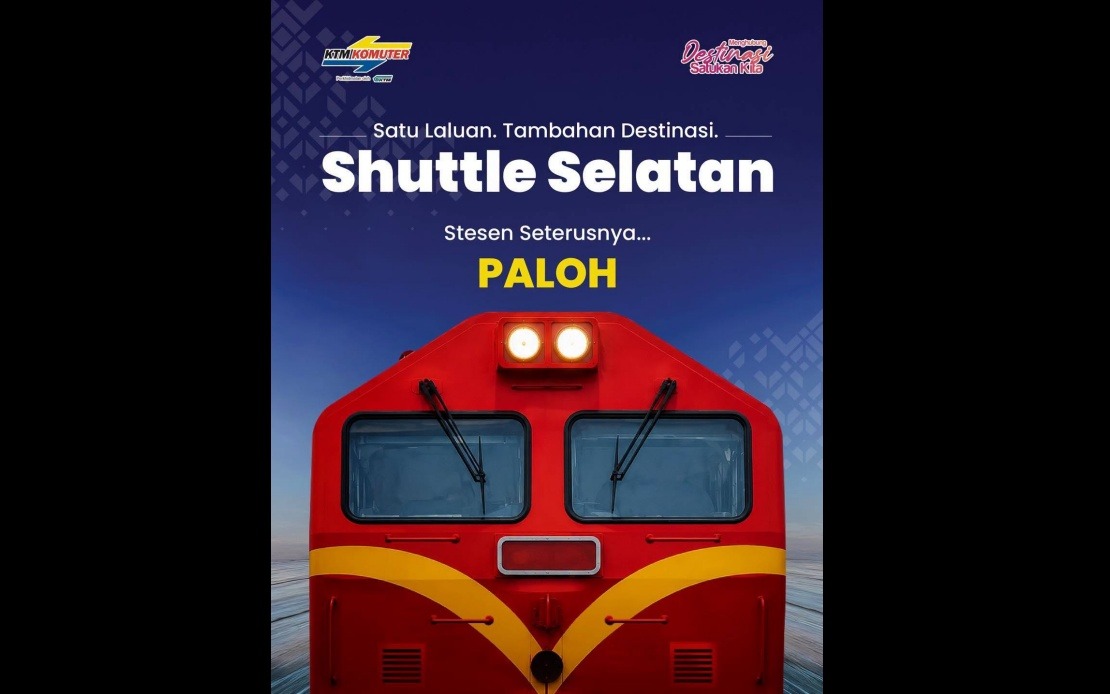
Keretapi Tanah Melayu Berhad (KTMB) is significantly broadening its reach within Johor's transport network by introducing an extended Southern Shuttle service starting August 8, marking a decisive move to strengthen the rail connectivity backbone of the state's central corridor. The expanded network will now link Paloh directly to JB Sentral through a carefully planned seven-station route, effectively positioning rail as a viable alternative to personal vehicle usage for thousands of commuters traversing this economically vital region.
The new service architecture encompasses stations at Paloh, Kluang, Renggam, Layang-Layang, Kulai, Kempas Baru and JB Sentral, with the complete journey duration set at approximately two hours. This geographic coverage is strategically significant for Malaysia's regional development agenda, as it directly addresses the mobility needs of workers, traders, and families distributed across Johor's interior and coastal zones. The route design deliberately targets the central Johor corridor, leveraging sections of the newly completed Gemas-Johor Bahru Electrified Double-Track Project (PLBEGJB), which positions this service within the broader infrastructure modernisation framework that the Transport Ministry has championed.
Operationally, KTMB will deploy substantial capacity through the deployment of ten daily services, split evenly between Paloh-to-JB Sentral and return journeys, with each train configured to accommodate up to 400 passengers per trip. This scheduling volume reflects confidence in projected demand and signals KTMB's commitment to frequency levels that genuinely serve commuter patterns rather than token availability. The timetable demonstrates particular attention to cross-border worker requirements, with the earliest Paloh departure occurring at 3.55 am, arriving in JB Sentral by 5.52 am to facilitate onward connections towards the Singapore frontier, whilst the final evening service departs JB Sentral at 8.30 pm, arriving in Paloh at 10.27 pm to accommodate shift-based employment patterns.
Financial accessibility emerges as a critical lever in the service's value proposition, with KTMB maintaining promotional pricing that substantially undercuts standard fares. The complete Paloh-to-JB Sentral journey now costs RM7.70per person on a one-way basis, down from the standard RM15.30 rate. This promotional structure remains in effect until electric train deliveries commence, essentially functioning as an extended introduction period designed to build passenger loyalty and normalise rail usage among communities previously reliant on bus services or private transportation. For Malaysian observers tracking transport affordability, this pricing strategy directly addresses accessibility concerns that have historically deterred lower-income workers from adopting rail services despite clear economic and environmental benefits.
The implementation of extended MyRailLife Pass coverage from August 8 through December 31 adds a crucial equity dimension to the expansion, ensuring that children aged four to six, students from Year One through Form Six, and persons with disabilities (PwDs) access the service without individual fare payments. This universal pass integration demonstrates policy-level thinking about inclusive transport systems and removes financial barriers for precisely those demographic groups most vulnerable to transport cost burdens. The initiative sits within a broader regional movement towards fare-free or heavily subsidised public transport for priority populations, aligning Malaysian practice with international best practice observed across comparable Southeast Asian jurisdictions.
A particularly valuable operational feature involves inter-line connectivity at Kempas Baru Station, where passengers can transfer seamlessly to the Kempas Baru-Pasir Gudang-Kempas Baru service. This junction functionality transforms what might otherwise be a linear corridor route into a more comprehensive network architecture, enabling residents and industrial workers to access Pasir Gudang's manufacturing and petrochemical zones without requiring separate transport modes. For regional economic development planning, this kind of network integration proves essential in maximising agglomeration benefits and workforce accessibility to employment concentrations, particularly significant given Pasir Gudang's status as an industrial anchor for eastern Johor.
The expansion arrives remarkably quickly following the initial Southern Shuttle launch, completing the rollout to Paloh within less than three months. This rapid timeline suggests both genuine operational readiness and political determination to leverage the newly completed PLBEGJB infrastructure investment. For Malaysian transportation observers, such velocity is noteworthy in a sector traditionally characterised by extended planning cycles and implementation delays, indicating either streamlined decision-making or pre-existing contingency planning that enabled swift mobilisation once political approval materialised.
Early passenger metrics from the initial two-route phase recorded 3,209 travellers, representing an encouraging baseline that validates the fundamental concept of dedicated Southern Shuttle services in this corridor. Whilst the absolute figure remains modest relative to overall Johor transport volumes, the response trajectory matters more significantly than the current snapshot. These passengers represent individuals who actively selected rail over competing modal options, suggesting that convenient scheduling, reliable service delivery, and appropriate pricing can successfully redirect travel behaviour even among populations with established vehicle ownership or commuting patterns.
The service explicitly targets workforce mobility requirements, economic activity support, and—importantly—the development trajectory of the Johor-Singapore Special Economic Zone (JS-SEZ), a collaboration framework with significant implications for regional labour mobility and supply-chain integration. By facilitating daily commuting across the Johor corridor towards key economic nodes like Kulai and JB Sentral, the service creates operational efficiencies for companies operating within JS-SEZ frameworks, reducing recruitment constraints imposed by geographic distance and improving workforce accessibility. For Malaysian policymakers tracking cross-border economic integration, this service expansion embodies the transport infrastructure requirements that enable higher-order economic collaboration.
Beyond immediate service provision, the extension exemplifies government strategy to reduce private vehicle dependency through quality public transport alternatives. The Transport Ministry's designation of this initiative as a strategic priority reflects understanding that transport policy constitutes development policy, with modal shift towards rail delivering improvements in urban congestion, air quality, and equity outcomes simultaneously. Johor's status as Malaysia's second-largest state economy makes transport efficiency particularly consequential, and each passenger shifted from vehicle to rail generates cumulative benefits across congestion reduction, fuel consumption patterns, and carbon footprint trajectories.
Looking forward, the service's trajectory depends substantially on delivery timelines for the promised electric train fleet. Current promotional fares cannot persist indefinitely, and long-term viability requires that KTMB achieves operational efficiencies sufficient to sustain meaningful discounting while maintaining service quality. The August 8 expansion establishes a foundation, but the actual transformation of Johor's transport landscape hinges upon consistent service delivery, progressive fleet modernisation, and political commitment to prioritising rail investment within constrained national budgets. For Malaysian commuters in the central Johor corridor, the coming months will reveal whether the Southern Shuttle expansion represents transformative transport restructuring or an optimistic initiative destined for operational challenges.

