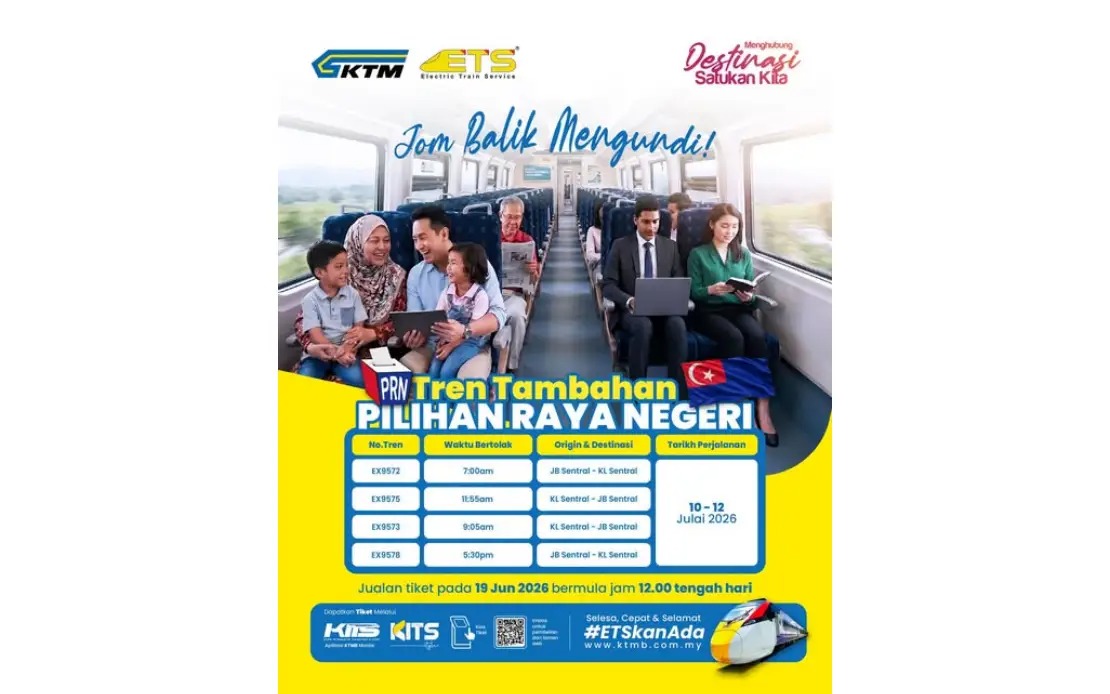
Keretapi Tanah Melayu Berhad has moved to ease travel logistics for the upcoming Johor state election by introducing supplementary Electric Train Service (ETS) departures on its southern corridor. The additional capacity responds to the anticipated surge in demand as registered voters make their way home to cast ballots in what represents a significant state-level electoral contest in Malaysia's southernmost peninsula region.
The railway operator announced the expansion through its official social media channels, confirming that the enhanced service will operate across a three-day window spanning July 10 to 12. This timeframe bookends polling day itself, scheduled for July 11, and provides flexibility for voters to travel either ahead of or immediately following the election. The carefully timed availability acknowledges the practical reality that many Johoreans work or reside elsewhere in Malaysia and require convenient transport options to participate in their state's democratic process.
Ticket purchasing commenced at noon on the announcement date, with KTMB offering multiple avenues for booking to maximise accessibility. Prospective travellers can purchase fares through the KTMB Mobile application, the dedicated KITS Style platform, the operator's online portal at online.ktmb.com.my, or by visiting physical ticket kiosks at stations across the network. This multi-channel approach reflects contemporary travel patterns and caters to both digitally native and traditionally-inclined passengers seeking southern-bound journeys.
The decision to augment rail capacity reflects broader recognition among Malaysia's transport authorities that democratic participation requires practical facilitation. Elections impose temporary peaks in intercity demand as the electorate mobilises, and strategic infrastructure planning must accommodate these foreseeable surges. The Johor election follows the State Legislative Assembly's dissolution on June 1, with the Election Commission subsequently announcing the July 11 polling date. This timeline provided KTMB with sufficient notice to coordinate scheduling adjustments and secure additional rolling stock for deployment.
For Johor-based voters scattered across Kuala Lumpur, the Klang Valley, and other peninsular employment centres, rail transport presents an economical and predictable alternative to road congestion. The southern ETS corridor typically carries significant daily traffic, and electoral periods intensify this movement as voters prioritise returning home. By proactively expanding capacity rather than allowing services to operate at constrained levels, KTMB demonstrates responsiveness to civic needs during critical electoral moments.
The announcement carries implications beyond mere convenience. Transport accessibility directly influences electoral participation rates, particularly among working-age citizens whose occupational mobility might otherwise discourage voting. When voters face genuine logistical barriers—overcrowded trains, unavailable seats, inflated prices—turnout can suffer disproportionately among those without flexible work arrangements or private transport resources. By ensuring adequate service provision, KTMB supports more inclusive democratic participation across socioeconomic strata.
From a broader Southeast Asian perspective, Malaysia's approach to managing election-related transport demand reflects mature democratic infrastructure. Neighbouring countries facing comparable urbanisation and geographic dispersion of populations have grappled with similar challenges, often with less coordinated solutions. The integration of public transport planning with electoral administration demonstrates institutional coordination that strengthens governance capacity more broadly.
The three-day service window also allows KTMB to manage operational complexity methodically. Rather than attempting to accommodate the entire voting population within a single-day peak, the extended availability distributes demand across consecutive days. Early voters and those returning immediately post-election both find available capacity, reducing crowding and enhancing the overall passenger experience during an already eventful period for the travelling public.
For the Johor electorate specifically, rail accessibility proves particularly valuable given the state's geographic characteristics and the dispersal of its working population. Johor's economic significance as a manufacturing and logistics hub means many residents work outside their home districts. The ETS network, connecting major urban centres along the corridor, provides the most practical option for voters seeking to return rapidly without facing extended travel times or highway congestion risks.
The broader context of this announcement reflects how Malaysian institutions coordinate across sectors during electoral cycles. Transport authorities, election administration bodies, and state governments work in concert to ensure that voting rights translate into genuine participation opportunities. Such coordination, though sometimes invisible to voters, undergirds democratic functionality by removing practical obstacles to civic engagement.
As Johoreans prepare for their state election, the availability of enhanced rail services represents a tangible expression of commitment to facilitating voting. The announcement, though administrative in tone, carries substantive significance for tens of thousands of citizens who depend on public transport infrastructure to exercise their democratic prerogatives. The action demonstrates that election administration encompasses not merely scheduling polls and managing voting locations, but ensuring that voters can physically reach polling stations without undue hardship or expense.