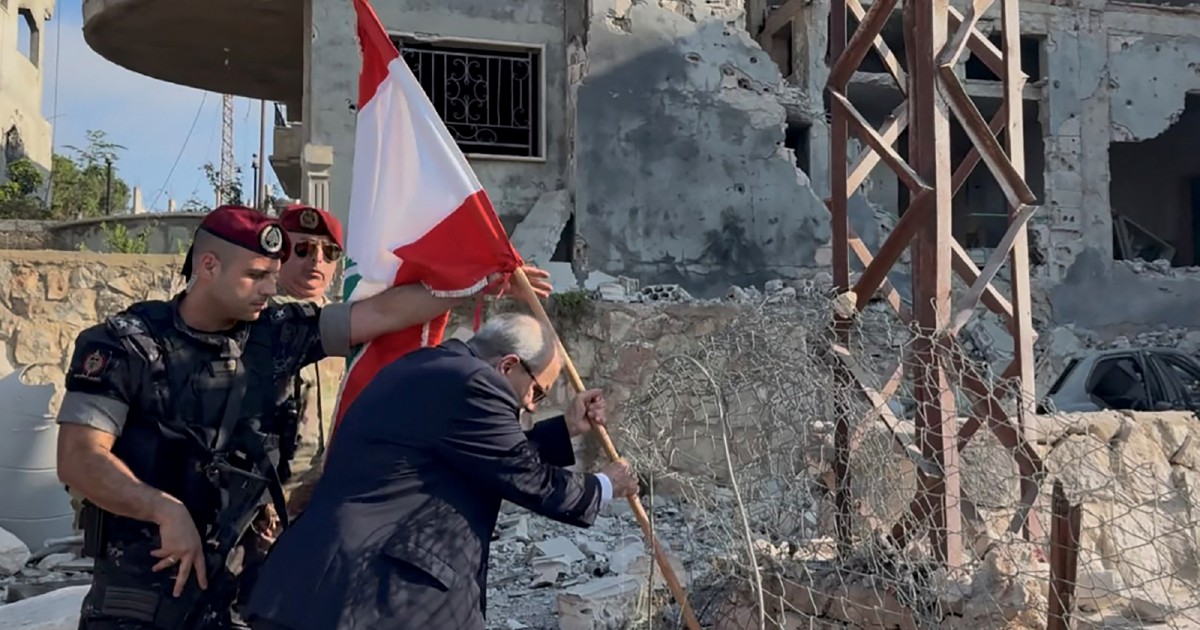
Lebanese Prime Minister Nawaf Salam has reiterated his government's resolve to achieve a comprehensive Israeli withdrawal from Lebanese territory, signalling renewed momentum in diplomatic efforts as the country works to consolidate control over regions affected by conflict. Speaking during a Wednesday visit to Zawtar al-Gharbiyah, a village in southern Lebanon where national armed forces have recently moved in, Salam underscored the importance of full territorial restoration in negotiations that will define Lebanon's post-conflict reconstruction phase.
The prime minister's comments represent a formal articulation of Lebanon's negotiating position at a critical juncture. Rather than accepting partial Israeli disengagement or maintaining a status quo of disputed zones, Beirut is framing the complete withdrawal of Israeli forces as a non-negotiable objective. This stance carries significant weight given that Israel has historically maintained some degree of military presence or influence over Lebanese border areas, creating long-standing tensions that periodically reignite into broader conflict cycles.
Salam's visit to Zawtar al-Gharbiyah serves symbolic and practical purposes simultaneously. The deployment of Lebanese army units into this location represents a tangible reassertion of state authority in the south, traditionally one of Lebanon's most volatile and contested regions. By personally touring these newly-established military positions, the prime minister demonstrates governmental commitment to rebuilding state institutions and security infrastructure that have been hollowed out by years of conflict and economic collapse.
The timing of these remarks carries strategic implications for regional diplomacy. Lebanon has been navigating a delicate balance between maintaining dialogue channels with international mediators, particularly the United States, while asserting clear red lines about national sovereignty and territorial integrity. The unequivocal language around complete withdrawal suggests Beirut is hardening its negotiating position rather than softening expectations, potentially in response to domestic political pressure to demonstrate strength after months of disruption and displacement.
For Malaysian and regional observers, Lebanon's experience illustrates the persistent complications of military occupation and ceasefire negotiations in the Middle East. The demand for complete withdrawal echoes similar positions taken by other occupied territories throughout the region, yet the practical achievement of such objectives frequently proves elusive without sustained international pressure or shifts in strategic calculations by occupying powers. Lebanon's case is further complicated by its internal fragmentation, where Hezbollah and other armed groups have historically filled security vacuums that weakened state capacity.
The Lebanese army's recent deployment into southern areas represents one of the most significant reinstatement of state control in decades, reversing decades of de facto vacuum in those territories. This institutional rebuilding is essential for establishing the conditions under which international agreements regarding Israeli withdrawal could be enforced. A weakened, fragmented state apparatus would struggle to maintain territorial control even if foreign forces departed, potentially creating conditions for renewed instability or intervention by non-state actors.
Israel's calculus regarding its military footprint in Lebanon involves multiple layers of security concerns and strategic interests. Israeli officials have historically cited threats to northern communities as justification for maintaining operational capabilities near the Lebanese border. Achieving genuine, verifiable Israeli withdrawal would require addressing these underlying security anxieties through alternative mechanisms, whether international peacekeeping arrangements, demilitarisation agreements, or confidence-building measures that extend beyond simple force removal.
The broader international community, including the United Nations, maintains various mandates and peacekeeping frameworks theoretically designed to monitor borders and prevent cross-border military operations. Lebanon's appeal for complete Israeli withdrawal implicitly calls upon these international mechanisms to function effectively, supporting Lebanese state sovereignty, and preventing the re-emergence of Israeli military presence. Whether international structures can deliver such outcomes remains contested, particularly given broader geopolitical shifts and competing international priorities.
For Southeast Asian countries concerned with preserving the rules-based international order and respecting territorial sovereignty, Lebanon's situation presents cautionary lessons about the durability of disputed territorial arrangements. Nations themselves facing maritime boundary disputes or occupation concerns may view this case as highlighting both the possibility of negotiated settlements and the challenges of enforcing them without sustained international will and commitment to implementation.
Lebanon's economic devastation and political instability have been partly attributed to the prolonged state of quasi-conflict and uncertainty regarding its southern border. Complete Israeli withdrawal could potentially unlock Lebanese reconstruction efforts, international investment, and economic stabilisation that currently remain constrained by security risks and diplomatic complications. This economic dimension reinforces why Salam's government frames full withdrawal not merely as a security issue but as fundamental to national recovery and development.
The prime minister's village visit and formal statement constitute part of a broader rhetorical strategy aimed at multiple audiences simultaneously. Domestically, it reassures Lebanese citizens that their government maintains clear objectives and is not capitulating to external pressures. Regionally and internationally, it signals that Beirut will not accept face-saving compromises that preserve Israeli military presence under different nomenclature or operational frameworks.
Moving forward, the practical challenge for Lebanon's leadership involves translating this declarative commitment into diplomatic achievements and verifiable outcomes. The government must build sufficient international pressure to make complete withdrawal strategically rational for Israel while simultaneously strengthening its own state institutions and security capacity to fill any vacuum left by Israeli forces. The stakes extend beyond Lebanon's borders, influencing broader regional patterns of settlement, occupation, and disputed territories that remain unresolved throughout the Middle East.

