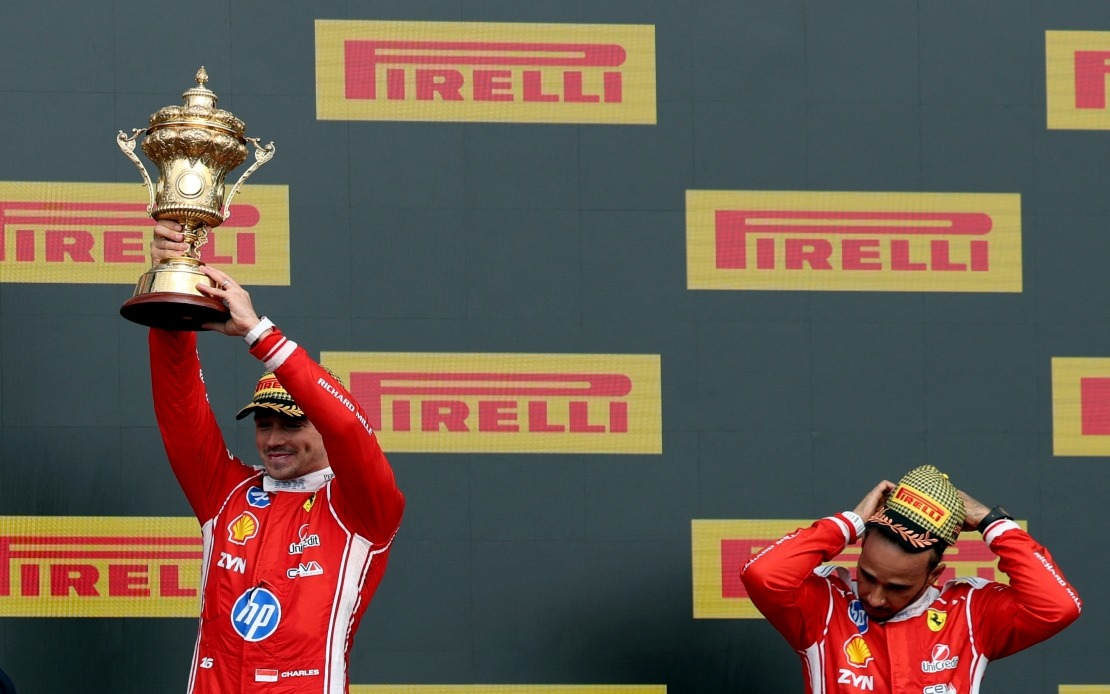
Charles Leclerc delivered a commanding performance at Silverstone on Sunday, capturing the British Grand Prix in a race that hinged on mechanical misfortune and controversial pit-stop strategy in the closing stages. The Ferrari driver's success came at the expense of championship leader Kimi Antonelli, whose Mercedes entry fell victim to a critical mechanical failure that extinguished what had appeared a commanding drive toward victory. George Russell ultimately secured second place through a combination of fortune and tactical execution, while Lewis Hamilton finished third after a race marked by penalties and intense mid-field competition that proved secondary to the drama at the front.
Leclerc's path to victory began explosively at the opening corner, where he launched past pole-sitter Antonelli with such conviction that he not only claimed the lead but also forced Hamilton into second position. The Monegasque driver then methodically constructed a commanding advantage throughout the opening phase of the race, demonstrating the pace refinement that Ferrari has achieved through concentrated development work over recent weekends. His ability to assert dominance so decisively from the outset provided the platform upon which his eventual triumph was built, suggesting that the Scuderia has successfully addressed the handling concerns that had compromised its performance in preceding races.
Antonelli's early-race difficulties proved temporary, however. The 19-year-old championship leader possessed considerably fresher rubber following a strategic pit-stop decision that left Mercedes gambling on tire degradation. After losing several seconds during his stop, Antonelli embarked on a methodical recovery that closed the gap with alarming rapidity, erasing a margin that had briefly exceeded four seconds through a combination of superior tire grip and Mercedes' acknowledged straight-line advantage. By lap 33, with barely ten laps remaining in regulation distance, Antonelli had compressed Leclerc's lead to under three seconds, positioning himself to capitalize on Ferrari's apparent strategic miscalculation and potentially seize a sixth consecutive victory that would have bolstered his already commanding 66-point championship advantage.
Then the mechanical gremlin struck. Antonelli, pushing aggressively and repeatedly utilizing the track limits at Copse corner, suddenly reported a structural failure to his pit wall. Mercedes initially suspected damage to the front wing before engineers diagnostically pinpointed the genuine culprit: a shattered front-left wheel shield that had compromised the car's structural integrity and steering characteristics. The damage forced two unscheduled visits to the pit lane, with the second stop proving unable to fully restore the car's balance despite removing the fractured component. What had promised to be a masterclass in strategic recovery transformed into a desperate struggle for points retention, with Antonelli repeatedly running beyond track limits as he battled to maintain directional control.
Hamilton's afternoon proved equally complicated despite his early advancement to second. The Mercedes driver incurred a five-second penalty for a false start infringement during his first pit stop, a punishment that cascaded through the race mathematics and deposited him behind Russell in the order. His front tires began exhibiting the characteristic graining that has plagued Mercedes throughout the season, forcing him to relinquish second position to Antonelli during a tense pass at Copse. Yet through intelligent racecraft and sufficient tire preservation, Hamilton methodically climbed back through the order in the race's middle phases, establishing himself in a credible points-scoring position as the laps wound down.
Russell's contribution to Mercedes' eventual success came through less elegant means. The British driver reported gearbox irregularities early in proceedings and subsequently discovered a slow right-rear puncture that necessitated an additional unscheduled stop, compounding what had already proven a frustrating afternoon. Yet when Verstappen's aggressive driving precipitated a gravel excursion at Stowe corner with precisely four laps remaining, triggering the Safety Car that bunched the field, Russell found himself repositioned into an unexpected position of advantage. Ferrari's decision to pit Hamilton for fresh soft compound tires proved strategically counterintuitive, leaving Russell circulating on already-used rubber but maintaining track position that proved decisive when the Safety Car was ultimately withdrawn rather than triggering a contested restart.
The aborted restart decision generated considerable consternation throughout Silverstone, with vocal sections of the crowd expressing audible disappointment as anticipated final-lap drama evaporated. The FIA subsequently attributed the confusion to a software malfunction that had prematurely indicated racing would resume, before prudent judgment determined that insufficient laps remained to justify another start-stop sequence. This technical breakdown meant that Russell inherited second place without executing the on-track passes that typically define such climactic moments, leaving Hamilton third and fundamentally transformed the championship mathematics by preventing the Mercedes driver from leveraging his tire advantage to challenge his teammate during a potential sprint finish.
Leclerc's triumph constitutes his first victory since the 2024 United States Grand Prix, providing tangible validation of Ferrari's recent technical refinements that had proven elusive through the preceding sequence of races. The Italian manufacturer had slipped backward competitively before Hamilton's commanding performance in Spain suggested that Mercedes possessed superior straight-line efficiency, yet Sunday's outcome demonstrated that careful development work has restored the Scuderia's technical equilibrium. The psychological significance of returning to the winner's circle following several disappointing weekends cannot be underestimated, particularly given the momentum considerations that govern Formula One team dynamics and driver confidence trajectories.
Antonelli's mechanical failure carries profound championship ramifications that extend well beyond Silverstone's confines. His 66-point advantage, which had represented a commanding position following five consecutive victories, now diminishes measurably following a race where he departed empty-handed. At nineteen years of age, the Mercedes driver has demonstrated remarkable consistency and racecraft throughout the campaign, yet Sunday illustrated the vulnerability inherent in any championship campaign when mechanical reliability fails. His philosophical response—acknowledging that the team possessed legitimate victory prospects before being undone by technical factors beyond driver control—reflected professional maturity, though the points deficit that now materializes will require careful management and consistent performance as the season progresses toward its conclusion.

