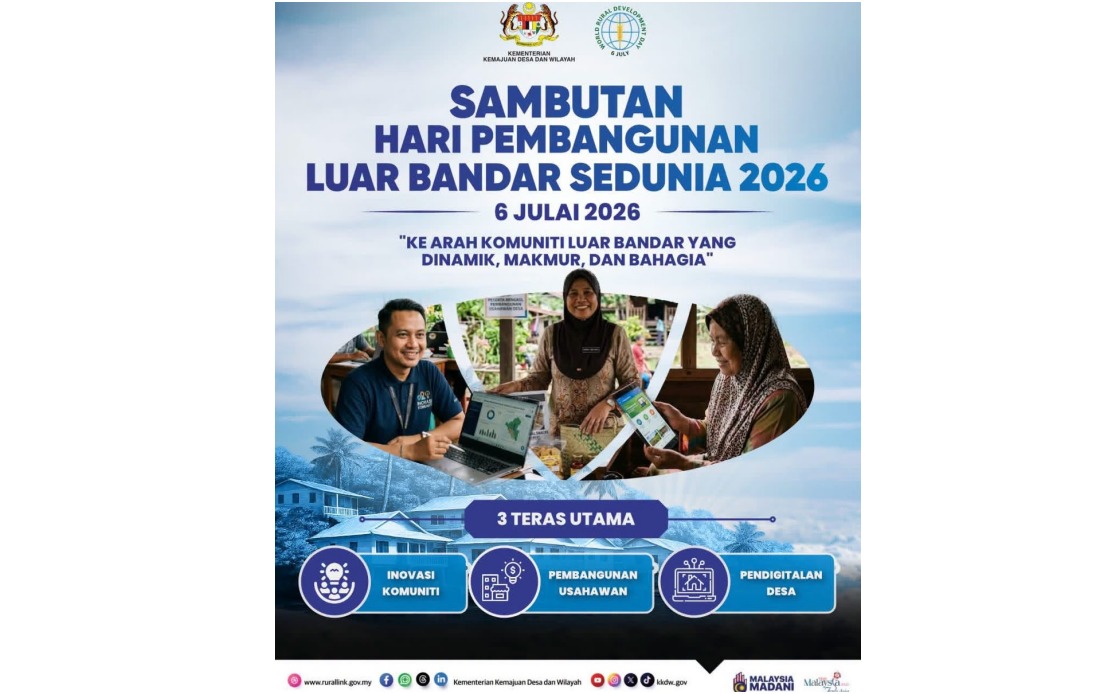
Malaysia enters the global observance of World Rural Development Day tomorrow with its inaugural national celebration at Tun Abdul Razak Stadium in Jengka, near Maran in Pahang. The milestone reflects the country's commitment to honouring the communities and stakeholders whose efforts underpin rural progress and advance broader national development objectives aligned with the Sustainable Development Goals.
Deputy Prime Minister and Minister of Rural and Regional Development Datuk Seri Dr Ahmad Zahid Hamidi will formally launch the event, which carries the theme "Toward Vibrant, Prosperous and Happy Rural Communities." The ceremony represents a watershed moment for Malaysia's rural development agenda, positioning these communities not as peripheral but as integral to the nation's social and economic fabric. The ministry's choice of venue—a major stadium rather than a modest community hall—underscores the significance attached to rural affairs at the highest levels of government.
The celebration strategically anchors itself around three pillars that the Ministry of Rural and Regional Development has identified as foundational to rural transformation. Community innovation forms the first thrust, empowering grassroots actors to devise solutions tailored to local circumstances rather than imposing top-down interventions. Rural digitisation constitutes the second pillar, addressing the persistent digital divide that has historically limited rural populations' access to information, markets and services. The third emphasises rural entrepreneurship development, recognising that sustainable prosperity emerges when communities generate their own economic activities and wealth rather than relying solely on government transfers or external investment.
These three interconnected priorities reflect an understanding that rural development in the 21st century demands more than infrastructure spending. Expanding economic opportunities requires that rural residents possess the digital literacy and technological access to participate in e-commerce, access agricultural extension services online, and connect with distant markets. Strengthening community capacity depends on fostering innovative thinking and risk-taking among entrepreneurs who might otherwise lack resources or confidence to establish ventures. The ministry frames this comprehensive approach as demonstrating sustained government commitment to elevating rural living standards and quality of life.
The programme agenda reveals the breadth of activities planned for the occasion. The Rural Aspiration Award MADANI will recognise exemplary rural initiatives and leaders, providing visibility and encouragement to communities excelling in development work. Simultaneously, the Felda Plan Excellence Award acknowledges outstanding performance within the Federal Land Development Authority scheme, which has historically served as a mechanism for rural settlement and agricultural development. The launch of the My Rural Insight Journal introduces a new platform for documenting and disseminating rural development knowledge, experiences and best practices across the country.
A significant announcement scheduled for the event involves Felcra Bhd's Interim Distributable Profit Distribution for the 2026 period, signalling that rural development corporations remain engaged in generating returns for their beneficiaries. These concrete deliverables—awards, publications, financial distributions—demonstrate that the celebration extends beyond ceremonial acknowledgment to tangible outcomes affecting rural constituents. The ministry has invited public attendance and structured exhibition booths showcasing initiatives from various agencies involved in rural development, transforming the event into an interactive platform for information sharing and community engagement.
The global context gives additional weight to Malaysia's inaugural participation. The United Nations General Assembly formally established World Rural Development Day on September 6, 2024, designating July 6 as the annual observance date. This timing deliberately connects to the establishment anniversary of the Centre on Integrated Development for Asia and the Pacific (CIRDAP), an international organisation focused on rural and regional development across the Asian region. The inaugural global celebration occurred on July 6, 2025, and Malaysia now joins the international community in formally recognising rural development's importance, starting with the 2026 observance.
For Malaysia specifically, participation in this global initiative carries several implications. It signals the country's alignment with international development frameworks and commitment to addressing rural challenges through coordinated approaches. Membership in the WRDD observance provides opportunities for Malaysia to learn from other nations' rural development strategies while potentially sharing its own experiences with rural upgrading, agricultural modernisation and community empowerment programmes. The association with CIRDAP particularly strengthens ties with fellow Asia-Pacific nations grappling with similar rural development questions.
The timing of Malaysia's formal adoption also reflects evolving government priorities. Rural communities have historically commanded political attention during election cycles, but sustained institutional focus has been more variable. By creating a dedicated annual celebration and directing high-level political participation, the government signals that rural development constitutes a permanent policy commitment rather than a cyclical concern. This institutionalisation creates accountability mechanisms—the annual observance demands that progress be demonstrated and challenges acknowledged.
Looking ahead, the challenge extends beyond celebrating rural development to implementing the innovations, digital initiatives and entrepreneurial support systems that the rhetoric emphasises. Rural digitisation particularly demands sustained investment in broadband infrastructure, digital skills training and relevant online platforms tailored to rural economic activities. Community innovation requires creating space for experimentation and accepting occasional failures as learning opportunities. Rural entrepreneurship development depends on ensuring that credit facilities, business counselling and market information reach aspiring rural enterprises, particularly among younger populations who might otherwise migrate to cities.
The Jengka gathering occurs against a backdrop of persistent rural-urban disparities in income, employment opportunities and service access. Malaysia's urbanisation and rapid economic development have left many rural regions economically dependent on commodity agriculture, fisheries or forestry—sectors vulnerable to price fluctuations and environmental pressures. Younger rural residents continue to migrate cityward, creating demographic challenges for rural sustainability. The World Rural Development Day celebration implicitly acknowledges these structural challenges while proposing that innovation, technology and entrepreneurship can catalyse rural transformation.
For Malaysian policymakers and development professionals, the inaugural World Rural Development Day observance provides an opportunity to take stock of what works, what requires adjustment, and where additional resources or policy attention is needed. The celebration succeeds not merely in honouring rural communities but in reinforcing commitment to systematic approaches that treat rural prosperity as essential to national wellbeing and equitable development.

