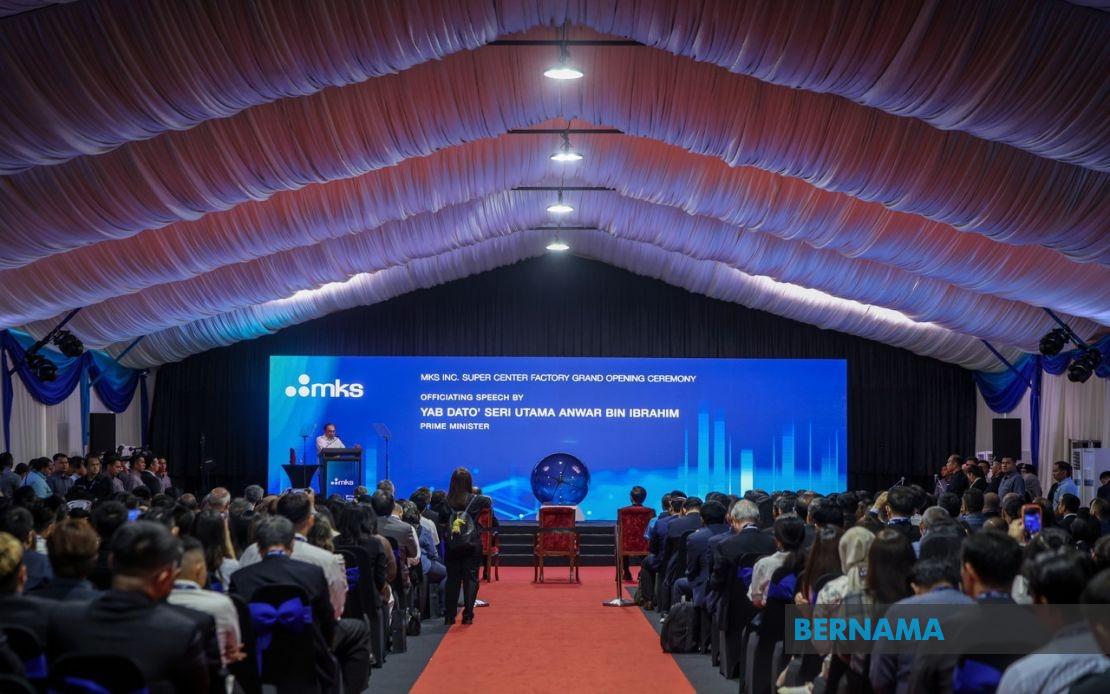
Prime Minister Datuk Seri Anwar Ibrahim has underscored Malaysia's strategic advantage in maintaining an independent and neutral foreign policy, arguing that this balanced approach is translating into tangible economic returns and reinforcing the nation's standing on the world stage. Speaking at the opening of the MKS Super Centre factory in Bandar Cassia Technology Park in Batu Kawan on June 20, Anwar positioned Malaysia's willingness to engage with countries across competing geopolitical spheres as a cornerstone of its prosperity and influence.
The Prime Minister's comments reflect a deliberate pivot in how Malaysia frames its role in an increasingly fractured global order. Rather than aligning exclusively with any single power or bloc, Anwar emphasised that Malaysia's approach of welcoming partnerships with the United States, China, India, and Russia—among others—has demonstrated the nation's centrality and relevance. This posture, he suggested, has convinced international investors and trading partners that Malaysia remains a stable, principled actor capable of managing complex relationships without sacrificing its own interests.
Anwar specifically cited Petronas, Malaysia's national oil and gas corporation, as a concrete manifestation of this strategy. The company's recent agreement in Turkmenistan exemplifies how Malaysia's diplomatic flexibility creates openings for commercial ventures that might otherwise face obstacles due to geopolitical tensions. By maintaining cordial ties across rival blocs, Malaysia positions its national champions to pursue opportunities that competitors constrained by strict alignments cannot access. For a resource-dependent nation seeking to diversify revenue streams, such flexibility is invaluable.
The Prime Minister's remarks carry particular resonance given Malaysia's historical commitment to non-alignment and strategic autonomy, principles deeply rooted in the nation's post-independence foreign policy doctrine. However, Anwar's framing suggests an evolution in how these principles are being leveraged. Rather than viewing non-alignment merely as a defensive posture to avoid entanglement in great-power competition, the government is now presenting it as an offensive economic strategy—a selling point that attracts investment and cooperation.
The timing of these comments is instructive. Malaysia has recently hosted high-profile visits from leaders representing different geopolitical camps, including former United States President Donald Trump and officials from China, India, and Russia. Each engagement has been accompanied by discussions on trade, investment, and technological cooperation. Anwar's public recognition of this pattern signals to both domestic and international audiences that Malaysia is consciously cultivating these relationships as part of a coherent strategy rather than pursuing ad-hoc diplomacy.
For Malaysian businesses and policymakers, the implications are significant. A government that actively bridges divides between major powers creates space for Malaysian companies to forge partnerships, access markets, and secure resource agreements that might face scrutiny if Malaysia were perceived as being captured by any single bloc. This is particularly important for sectors like energy, manufacturing, and infrastructure, where geopolitical considerations increasingly influence investment decisions. By maintaining its independent posture, Malaysia reduces the risk that sanctions, trade restrictions, or ideological pressures targeting other nations will spill over and constrain Malaysian enterprises.
The event at which Anwar made these remarks—the grand opening of an MKS manufacturing facility in Penang—underscores the connection between diplomatic positioning and industrial investment. Penang Chief Minister Chow Kon Yeow's presence highlighted the sub-national dimension of these policies; state governments benefit when international investors view Malaysia as a hospitable, predictable environment untethered to external pressures. The participation of the Deputy Minister of Investment, Trade and Industry Sim Tze Tzin reinforced the message that economic diversification and foreign direct investment are central to the government's strategic priorities.
However, Anwar's articulation of Malaysia's neutral stance also hints at the delicate balancing act required to maintain such a position. The Prime Minister noted that Malaysia expresses its position on contentious global issues whilst simultaneously welcoming participation from all countries. This formulation suggests that neutrality does not mean silence or indifference but rather selective, principled advocacy combined with pragmatic engagement. Malaysia has not shied away from statements on issues like the Ukraine conflict or regional territorial disputes, yet it has simultaneously preserved relationships with all major stakeholders. This nuance is crucial for understanding how the strategy functions in practice.
The economic dimension of Malaysia's non-aligned approach becomes increasingly valuable as global supply chains fragment and nations seek alternative suppliers and partners. Companies considering operations in Southeast Asia often view Malaysia as preferable to locations perceived as being locked into particular geopolitical camps, precisely because the nation maintains relationships across blocs. This appeal to multinational enterprises seeking geographic diversification and political insurance is an often-overlooked advantage that small and mid-sized nations can exploit more readily than major powers.
Looking forward, the sustainability of Malaysia's balanced approach will depend on the nation's ability to avoid being forced into explicit alignments as geopolitical tensions potentially intensify. The emergence of competing economic blocs—whether framed around the BRICS or Western-led arrangements—could test Malaysia's commitment to non-alignment. However, Anwar's public articulation of the strategy's benefits suggests the government recognises that preserving flexibility is essential not only for diplomatic credibility but also for economic competitiveness in an uncertain global environment.
The Prime Minister's emphasis on Malaysia's centrality also reflects confidence that the nation's geographic position, demographic profile, and economic structure make it sufficiently attractive that major powers will accommodate Malaysian neutrality rather than demand exclusive alignment. In this reading, Malaysia's non-aligned strategy is not a temporary expedient but a durable competitive advantage that will remain valuable regardless of which great powers rise or decline in the coming years.