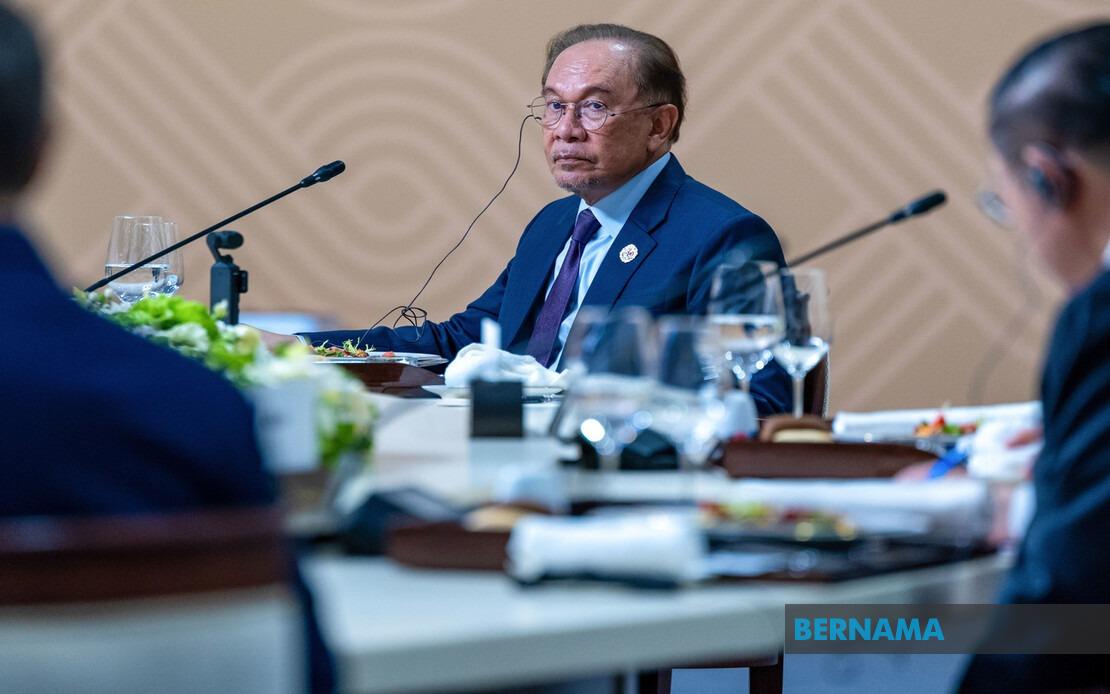
Prime Minister Datuk Seri Anwar Ibrahim's recent four-day diplomatic circuit through Central Asia and the Russian Volga region demonstrates Malaysia's evolving approach to international economic engagement. The successive visits to Tashkent, Kazan, and Ashgabat were not hastily arranged opportunistic calls but carefully calibrated stops that collectively address a fundamental challenge confronting middle-income nations: how to secure sustainable growth when the global economic architecture itself is fragmenting under the weight of strategic competition, trade restrictions, and geopolitical uncertainty.
The timing and substance of these engagements reflect Malaysia's recognition that the post-Cold War international order has entered a transformative phase. Trade barriers, sanction regimes, and export controls that were once exceptional tools have become routine instruments of statecraft among major powers. For a nation whose prosperity historically depended on open markets and integrated supply chains, this shifting landscape presents both acute vulnerabilities and untapped opportunities. Malaysia cannot afford to rely on traditional trading relationships alone; instead, it must cultivate a diversified portfolio of economic partnerships that provide flexibility and cushion against disruptions in any single market or region.
In Tashkent, what was scheduled as a brief courtesy visit with President Shavkat Mirziyoyev evolved into substantive working discussions on multiple economic cooperation domains, building on groundwork laid during a 2024 official visit. The Uzbek capital has become an increasingly important hub for Central Asian connectivity, and Malaysia's engagement there signals an attempt to tap into emerging opportunities in a region historically marginal to Southeast Asian business calculations. The shift underscores how Malaysian policymakers now view geographic proximity as less decisive than strategic value and complementarity of interests.
The Kazan summit presented a different but equally important dimension of Malaysia's diplomatic strategy. By participating in the ASEAN-Russia Commemorative Summit, Malaysia reinforced the regional bloc's commitment to maintaining engagement with multiple global powers while preserving strategic autonomy from exclusive alignments. The signing of the ASEAN-Russia Strategic Programme on Trade and Investment Cooperation 2026-2035 codifies mutual recognition that future competitiveness will hinge on innovation, technological advancement, and economic adaptability rather than traditional commodity exports. For Malaysia specifically, discussions with the Republic of Tatarstan—often overshadowed by Moscow in international perceptions—opened pathways into biotechnology, halal industries, maritime development, Islamic finance, and advanced manufacturing cooperation.
This focus on regional and provincial actors rather than solely engaging Moscow represents a sophisticated evolution in economic diplomacy. Modern international business increasingly flows through specialized industrial clusters, innovation hubs, and provincial governments that can move faster and more flexibly than national capitals. Tatarstan's track record as a technological innovator and industrial hub makes it a practical gateway for Malaysian companies seeking Russian market entry without the bureaucratic friction of direct central government engagement. This multi-level approach recognizes that sustained commercial relationships are built through practical opportunities at the micro level, not merely through headline agreements at state level.
Turkmenistan, the final destination, illustrated perhaps the deepest dimension of Malaysia's economic positioning strategy. Petronas's three-decade presence in the country represents a rare example of patient, long-term capital commitment that transcends cyclical commercial calculations. The approximately USD12 billion investment scale reflects institutional persistence that has transformed Petronas from a foreign operator into a genuine development partner, contributing not merely extractive value but infrastructure, technological transfer, and human capital advancement. Recent landmark agreements effectively deepen this relationship by securing Petronas stakes in one of the world's largest gas fields while expanding exploration and production-sharing arrangements.
This energy partnership carries implications extending well beyond traditional hydrocarbon commerce. Recent geopolitical crises have demonstrated how swiftly disruptions in one region cascade through global energy markets and supply chains. For Malaysia, deepening energy cooperation with Turkmenistan provides strategic diversification away from traditional Middle Eastern and Southeast Asian sources while offering long-term price stability and supply security for downstream industries. The partnership equally benefits both nations: Turkmenistan gains a reliable long-term investor committed to developing its resource base, while Malaysia secures energy supply chains less susceptible to sudden geopolitical realignment.
Yet viewing these engagements purely through trade and investment statistics misses their deeper strategic significance. Modern economic diplomacy operates across multiple intersecting domains simultaneously. Food security considerations overlap with technological capability. Energy cooperation connects to industrial development and infrastructure investment. Digital innovation creates both opportunities for efficiency gains and vulnerabilities to technological dependence. Malaysia's discussions across Tashkent, Kazan, and Ashgabat deliberately wove together these seemingly disparate threads—education and research collaboration, halal ecosystem development, Islamic finance services, and traditional commercial exchanges.
This holistic approach reflects the primacy of relationship-building in contemporary economic statecraft. Trust and mutual confidence constitute the foundation upon which durable commercial relationships rest. Prime Minister Anwar's personal involvement in these discussions communicated at the highest level that Malaysia views these partnerships as enduring commitments rather than transactional arrangements. The personal dimension of diplomacy—often dismissed in quantitative analysis focused on GDP numbers—proves essential for navigating complex negotiations and building confidence that survives inevitable commercial disagreements.
Malaysia's expanding engagement in Central Asia and Russia also addresses a structural reality confronting many Southeast Asian economies. As competition intensifies between major powers and regional blocs form around competing technologies and standards, countries positioned within multiple networks enjoy greater flexibility than those locked into narrow partnerships. ASEAN's defining strength has always been maintaining centrality—avoiding exclusive alignment with any single power while preserving engagement across competing spheres of influence. Malaysia's regional diplomacy now extends this principle vertically, building relationships at national, provincial, and sectoral levels simultaneously.
The strategic imperative driving these visits reflects sober assessment of evolving global economic dynamics. Trade fragmentation, technological bifurcation, and geopolitical competition will likely intensify rather than diminish. Supply chain resilience increasingly depends not on cost minimization alone but on diversification across geographies with different political alignments and risk profiles. Malaysian manufacturers and resource companies require multiple market outlets and diverse sourcing options to maintain competitiveness. Government-level economic diplomacy creates the foundational relationships and policy frameworks that enable this commercial diversification at the enterprise level.
Looking forward, Malaysia's Central Asian engagements establish precedent for deeper regional integration potentially spanning physical infrastructure, digital connectivity, financial services, and cultural exchange. The halal ecosystem discussions, in particular, signal recognition that Malaysia's Islamic credentials and expertise constitute diplomatic assets with value extending far beyond traditional Middle Eastern relationships. Central Asian nations with significant Muslim populations represent untapped markets for Malaysian halal certification, food products, and Islamic financial services.
The broader implication of this diplomatic cycle is Malaysia's deliberate positioning within an increasingly multipolar global economy. Rather than choosing exclusive alignment with traditional developed-market partners or embracing alignment with rising Asian powers, Malaysia is methodically expanding its partnership portfolio. This approach demands persistent relationship management across multiple jurisdictions and sophisticated navigation of competing interests. Yet for a trading nation whose historical prosperity depended on connectivity and openness, this diversified engagement strategy represents rational adaptation to a more contested international environment where strategic autonomy and economic resilience depend on breadth of partnership rather than depth of concentration.