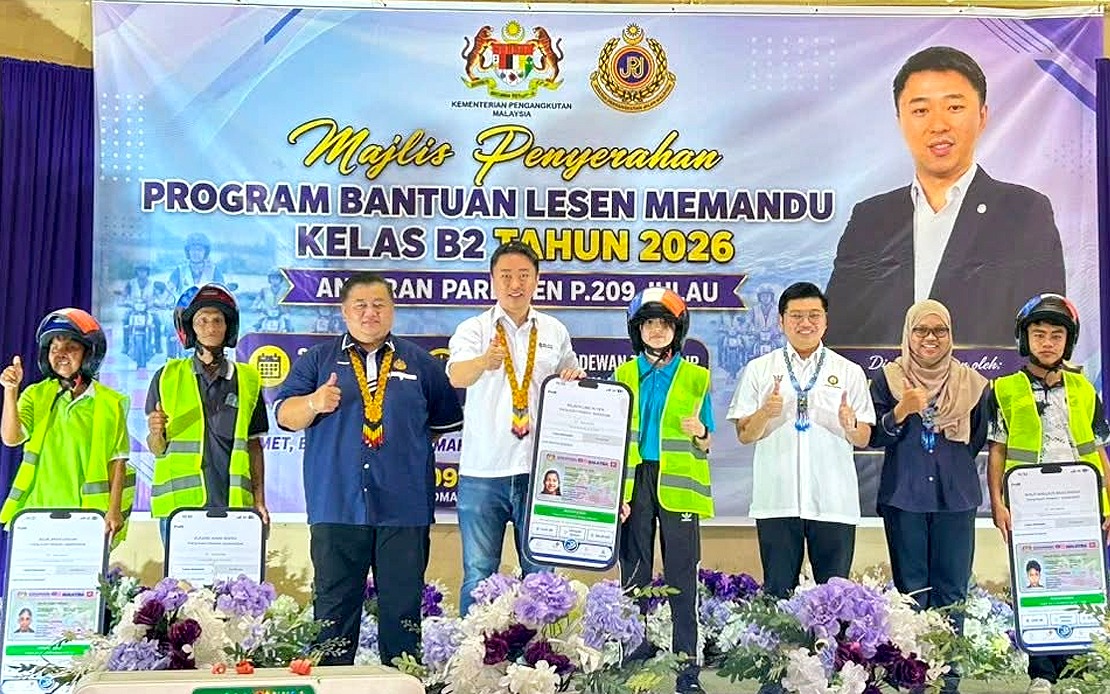
The Julau parliamentary constituency has marked a milestone in rural development with the successful completion of its 2026 Class B2 Driving Licence Assistance Programme, benefiting 885 residents from outlying areas. The closing ceremony, held at the Julau Closed Stadium in Sarikei, highlighted the tangible impact of the initiative on rural livelihoods, particularly as participants now qualify to purchase subsidised petrol for their motorcycles—a critical advantage in a region where transport costs directly affect agricultural productivity and daily survival.
For residents of remote settlements such as Rumah Ajau, Ulu Kuntau, and Pakan, the licence programme represents far more than a bureaucratic formality. Bajik Undum, at 57 years old the oldest female participant, exemplifies the programme's relevance to an ageing rural demographic. She had previously depended on her motorcycle to reach her orchard and transport produce to market, yet was forced to purchase petrol at full, non-subsidised rates because she lacked a valid driving licence. The financial burden of unsubsidised fuel had accumulated over years, eroding margins already thin in smallholder agriculture. Now that she holds a Class B2 licence, she can access the fuel subsidy scheme, directly reducing her operational costs and improving her economic position.
The broader context underscores why this programme matters acutely for Sarawak's rural economy. Motorcycles remain the primary transport mode for many smallholders and labourers in dispersed rural communities where road infrastructure limits the viability of four-wheeled vehicles. Rising petrol prices have squeezed household budgets and farm profitability across Southeast Asia, but the impact is most severe in regions with limited alternative income sources. By extending subsidy eligibility to newly licensed riders, the programme addresses a structural disadvantage that rural dwellers had faced—being locked out of government support mechanisms simply because formal documentation was unavailable or cost-prohibitive to obtain.
Kudang Jenggi, the eldest male participant at 64, brings into sharp focus the security and dignity dimensions of the initiative. Working as a bird's nest house caretaker in Bayong, Sarikei, he previously travelled without a valid licence, exposing himself to penalties and anxiety at roadblocks. Beyond the legal risk, his testimony reveals a psychological burden: the constant low-level stress of operating outside formal regulatory channels, even in regions where enforcement may be sporadic. The licence provides not only fuel subsidy access but also peace of mind and the ability to conduct his livelihood without fear of sanction. For workers in precarious rural employment, such assurance is invaluable.
Daniel Padong's case illustrates the compounding effect of rising fuel prices on agricultural smallholders. His daily commute to an oil palm plot has become increasingly expensive as petrol prices climb, yet his income from smallholding remains vulnerable to commodity price fluctuations beyond his control. By qualifying for subsidised fuel, he can at least stabilise one major cost component of his operation. This modest but real relief may be the difference between maintaining viability and abandonment of the holding, with implications for rural employment and food security in his community.
The timing of the programme's completion coincides with an era of sustained global commodity price volatility and energy cost pressures affecting Southeast Asian households disproportionately. Malaysia's fuel subsidy, though reduced from historical levels, remains a critical social policy tool, yet its benefits have not always reached those most dependent on personal transport in remote areas. The Driving Licence Assistance Programme effectively extends subsidy eligibility to a previously underserved population, addressing a equity gap that might otherwise have widened.
The event's officiation by Julau MP Datuk Larry Sng Wei Shien, who also chairs the Malaysian Timber Industry Board (MTIB), signals political recognition of the initiative's importance. His presence alongside Sarawak Road Transport Department (JPJ) director Norizan Jili demonstrates coordinated government commitment to rural transport accessibility. Such high-level attendance reflects broader policy intent to close infrastructure and service gaps between urban and rural Malaysia, though execution and sustainability remain open questions.
From a governance perspective, the programme's success in enrolling 885 participants suggests effective outreach and accessibility in Julau's dispersed settlements. Whether this represents comprehensive coverage of all eligible residents or a subset remains unclear, but the scale indicates serious administrative effort. The question now is whether this cohort represents a one-time intervention or the foundation for ongoing, regular licence assistance in rural Sarawak. Sustainability of such programmes depends on dedicated funding, administrative capacity, and political will to prioritise rural inclusion in subsidy schemes.
The broader implications extend beyond Julau to other rural constituencies across Malaysia and the region. If the programme demonstrates replicable success in bridging documentation gaps and extending subsidy access to agricultural workers and smallholders, it could serve as a model for other states facing similar rural development challenges. However, policymakers must also grapple with underlying questions: whether fuel subsidies are the most efficient mechanism for rural support, and whether parallel programmes addressing licence accessibility should be strengthened to prevent future cohorts facing similar barriers.
For the 885 newly licensed riders now accessing subsidised petrol, the immediate financial relief will be tangible. Over months and years, accumulated fuel savings can be reinvested into smallholding improvement, household needs, or education—compounding benefits beyond the transport sector. Yet the programme's deeper significance lies in its assertion that rural residents deserve equal access to government support mechanisms. In a region where rural-urban divides remain pronounced, such inclusion is not merely economic but foundational to social cohesion and equitable development.

