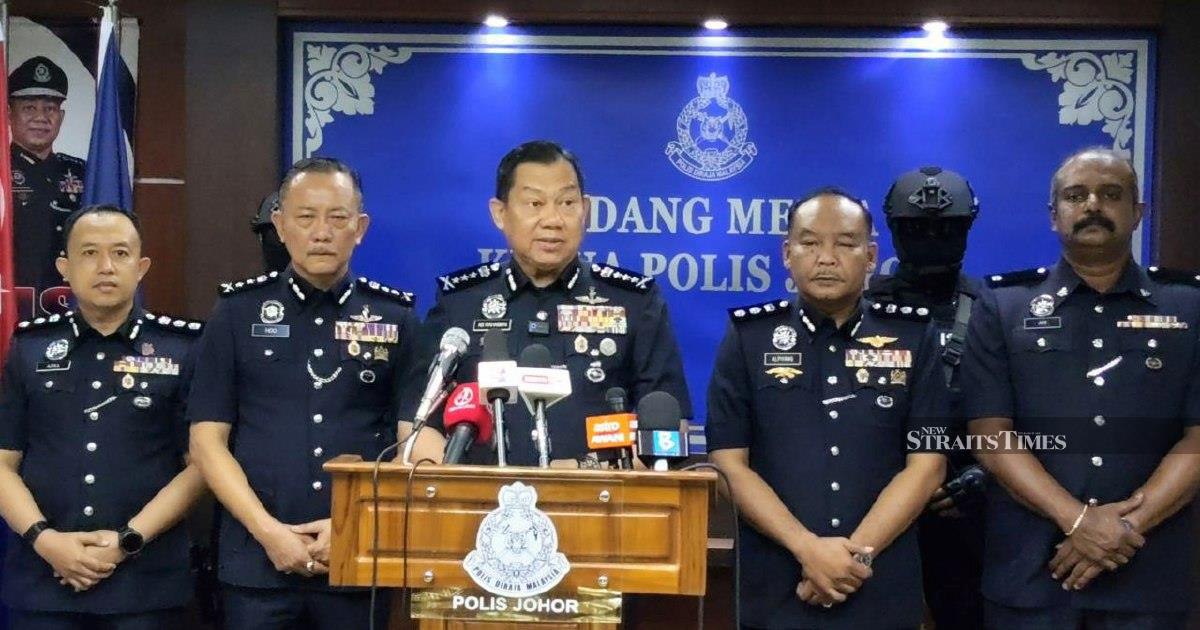
Law enforcement authorities in Johor Baru conducted coordinated raids on Saturday that culminated in one of the larger methamphetamine seizures in the state, confiscating 60.78 kilogrammes of the drug with an estimated street value of RM3.04 million. The operation resulted in eight arrests, marking a significant disruption to what investigators believe was a small-to-medium scale trafficking network operating in the southern corridor.
Among those detained was a school dropout whose role in the conspiracy underscores an ongoing concern about youth involvement in drug supply chains across Malaysia. The teenager functioned as a transporter within the network, suggesting that organised groups continue to exploit young people—particularly those with limited educational prospects or economic opportunities—to reduce their own exposure to law enforcement detection.
The Johor Baru police operation reflects broader enforcement priorities in Peninsular Malaysia, where methamphetamine remains a persistent threat to public health and security. Unlike heroin, which was historically the dominant narcotic in Southeast Asia, methamphetamine has emerged as the drug of choice across the region over the past decade, driven by ease of manufacture and rising demand in urban centres. The scale of Saturday's seizure—while significant—indicates that medium-level operations remain viable despite police campaigns.
Methamphetamine trafficking networks operating in Johor typically serve supply chains extending northward into the Klang Valley and southward through Singapore and into Indonesia. The timing and location of Saturday's raids suggest that investigators had been monitoring this particular group for some time, likely gathering intelligence through informants or telecommunications surveillance before executing the coordinated swoop. This methodical approach has become standard practice among Malaysia's anti-narcotics divisions in recent years.
The involvement of a teenage courier illustrates a darker aspect of Malaysia's drug problem: recruitment and coercion of minors. Many young people arrested in transporter roles claim they were either blackmailed through debt or family connections, or offered modest sums that seemed attractive given their circumstances. The school dropout status suggests limited alternative economic pathways were available to this individual, a pattern replicated across several states where youth unemployment and underemployment remain challenging.
From a supply-chain perspective, 60.78 kilogrammes represents a meaningful intermediate cache rather than a wholesale stockpile. Such quantities are typically distributed among multiple street-level retailers or sold in bulk to mid-level dealers for further subdivision. The RM3.04 million valuation is calculated on wholesale rates; street-level markup would dramatically inflate the final revenue generated when the drug is retailed to consumers in gram quantities.
Johor's geographic position makes it a natural transit point for drugs destined for consumption across Malaysia. The state shares both land and maritime borders with Johor Bahru's neighbouring jurisdictions, and its port infrastructure provides additional vulnerabilities. Police and customs authorities have intensified cooperation at these chokepoints, yet traffickers continue adapting routes and methodologies to evade detection. The Johor operations command, which oversees law enforcement in the state, has been granted additional resources in recent budget cycles to address these challenges.
The arrest of eight suspects provides investigation leads that may unravel the broader network's structure. Police will typically interrogate detainees about their suppliers, downstream distributors, and financial facilitators. Such interrogations have led in the past to secondary arrests and disruption of wider criminal enterprises. The timing of the announcement—released within hours of the operation—serves as a public messaging tool to reinforce police effectiveness, particularly important as public confidence in drug enforcement efforts has fluctuated in recent years.
For Malaysian policymakers and enforcement agencies, this seizure represents ongoing success in tactical operations but raises questions about strategic effectiveness. While individual busts capture headlines, methamphetamine availability and purity in street markets have not meaningfully declined, suggesting that large-scale production or import capacity exceeds what police interdiction operations can constrain. Demand reduction through rehabilitation programmes and youth intervention schemes remains underfunded compared to supply-focused enforcement.
The case also highlights the transnational dimensions of methamphetamine trafficking in Southeast Asia. Production facilities, primarily located in Myanmar and Thailand, feed supply networks throughout the region. Malaysia serves not only as a consumption market but as a transit territory for onward shipment to Indonesia, Bangladesh, and Singapore. Regional cooperation mechanisms, while improving, remain fragmented, allowing traffickers to exploit jurisdictional gaps.
International comparisons suggest that the prevalence of young people in Malaysian drug trafficking chains reflects both the scale of the market and deliberate strategies by organised crime syndicates to insulate senior figures. The school dropout's arrest, while satisfying immediate enforcement objectives, does little to address the structural factors—poverty, educational underachievement, and limited social mobility—that make such recruitment possible. Without complementary investments in prevention and rehabilitation, police operations will likely yield cyclical arrests without fundamental impact on the underlying problem.

