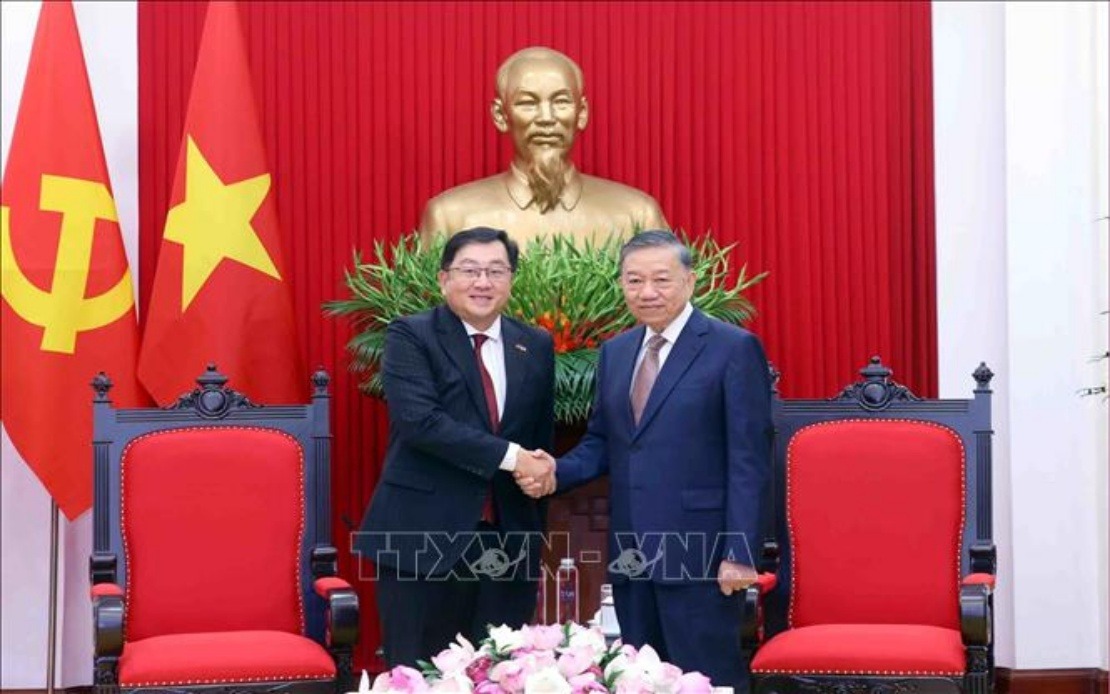
The relationship between Vietnam and Malaysia is entering a period of notable acceleration, with both nations demonstrating commitment to elevating their strategic partnership across multiple fronts. This was underscored during a farewell reception in Hanoi on Wednesday, when Vietnamese President To Lam met with Datuk Tan Yang Thai, the Malaysian ambassador concluding his posting in Vietnam. The characterisation of ties as increasingly dynamic reflects not merely diplomatic courtesy, but a substantive deepening of engagement that carries significant implications for regional stability and economic integration across Southeast Asia.
During the meeting, President Lam conveyed expressions of goodwill toward Malaysia's leadership, specifically requesting that His Majesty Sultan Ibrahim and Prime Minister Datuk Seri Anwar Ibrahim consider visits to Vietnam at their earliest convenience. This gesture, while customary in diplomatic protocol, signals Vietnam's appetite for high-level engagement with Malaysia's political establishment and reflects the premium Hanoi places on reinforcing personal connections between leaders. The reciprocal invitation from Tan for President Lam to visit Malaysia demonstrates how both capitals view these bilateral interactions as platforms for advancing shared interests rather than routine courtesies.
The political dimension of the Vietnam-Malaysia relationship has solidified considerably during Tan's tenure, according to the Vietnamese leader's assessment. Regular exchanges at multiple governmental levels—spanning party structures, state apparatus, parliamentary bodies, and administrative channels—have created a dense network of institutional linkages that transcend the traditional ambassador-to-foreign ministry relationship. This multi-layered approach to bilateral engagement reduces misunderstandings, creates multiple pathways for dialogue during disagreements, and establishes informal working relationships that often prove decisive in resolving issues before they escalate into formal disputes. For Malaysian diplomacy, these mechanisms represent valuable channels for coordinating positions on regional issues from maritime governance to transnational challenges.
The economic dimension of the partnership reveals perhaps the most compelling evidence of deepening integration. In the first six months of 2026 alone, two-way trade between the countries reached US$10.8 billion, representing a remarkable 40 per cent increase compared to the equivalent period in the previous year. This trajectory places Malaysia among Vietnam's most significant commercial partners within ASEAN and demonstrates the mutual economic benefits driving the relationship forward. Malaysia's position as Vietnam's third-largest source of foreign direct investment from ASEAN nations—and the tenth-largest globally among 154 countries and territories—underscores how Vietnamese economic policymakers view Malaysian capital, technology, and entrepreneurial expertise as valuable inputs into their development agenda.
Beyond traditional merchandise trade and investment flows, both nations have identified shared priorities in emerging economic domains that are reshaping regional development patterns. The emphasis on digital and green economic development represents a recognition that Southeast Asia's competitive advantage in the global economy increasingly depends on technological sophistication and environmental sustainability. Energy and electricity connectivity projects, particularly initiatives aimed at regional power trading and renewable energy infrastructure, offer pathways to reduce energy costs while advancing climate commitments. Maritime cooperation, meanwhile, addresses both the economic imperative of securing sea lanes vital to trade and the security challenge of managing an increasingly crowded maritime domain responsibly.
President Lam's articulated agenda for deepening the Comprehensive Strategic Partnership suggests that Vietnam views the relationship as having substantial untapped potential. The call for strengthening political trust through expanded exchanges and implementation of existing high-level agreements indicates that both sides have negotiated frameworks that require sustained commitment to translate into concrete outcomes. Enhanced cooperation in defence and security matters addresses regional geopolitical realities without explicitly invoking tensions with third powers, reflecting the diplomatic sophistication both nations bring to bilateral negotiations. The emphasis on maritime affairs is particularly noteworthy given competition in Southeast Asian waters and the imperative for code-of-conduct frameworks that prevent misunderstandings.
On the economic front, Vietnam's suggestions for facilitating balanced trade and investment flows address legitimate concerns about ensuring that commercial benefits accrue to both parties equitably. The particular focus on digital economy collaboration and green economy development reflects global economic trends and the recognition that these sectors offer growth opportunities unavailable in traditional industries. Scientific and technological cooperation, alongside innovation initiatives, acknowledges that Vietnam's development trajectory depends increasingly on knowledge transfer and collaborative research rather than low-cost manufacturing alone—a shift that offers Malaysian companies opportunities to participate in Vietnam's value-chain upgrade.
Ambassador Tan's remarks during the farewell reception convey genuine appreciation for Vietnam's developmental achievements while positioning Malaysia as committed to supporting regional unity and resilience through ASEAN. His specific commitment to advancing cooperation in digital economy, green economy, and renewable energy mirrors Vietnam's stated priorities, suggesting alignment in both capitals regarding the strategic sectors that should anchor bilateral cooperation. The diplomat's pledge to leverage his experience and demonstrated affection for Vietnam to continue promoting bilateral relations indicates that personal relationships and professional networks often constitute crucial informal infrastructure underpinning formal state-to-state ties.
For Malaysian policymakers and business interests, the expanding Vietnam relationship presents multiple opportunities aligned with Malaysia's own strategic objectives. The digital economy emphasis offers avenues for Malaysian technology firms and financial services companies to expand regional presence, while green economy initiatives create partnership possibilities in renewable energy, sustainable manufacturing, and environmental services. The trade growth trajectory suggests that Malaysian exporters are successfully penetrating Vietnamese markets and that Malaysian investment in Vietnam continues generating attractive returns, encouraging further business expansion. The positioning of Malaysia as a trusted development partner—rather than a competitor—in Vietnam's growth narrative creates space for collaborative initiatives that might prove elusive in relationships clouded by strategic competition or historical tensions.
The broader ASEAN context illuminates the significance of Vietnam-Malaysia partnership expansion. As Southeast Asia navigates evolving geopolitical circumstances and competes in an increasingly multipolar global order, cohesion among major regional players amplifies collective bargaining power. The emphasis both capitals place on people-to-people exchanges and civil society connections acknowledges that durable international relationships rest ultimately on public support and mutual understanding among ordinary citizens rather than elite agreements alone. Educational exchanges, cultural initiatives, and business networks create constituencies in each country invested in maintaining positive relations and managing disagreements constructively.
The transition of ambassadors, while appearing routine administratively, often marks natural junctures for assessing partnership trajectories and recalibrating priorities. The warm reception extended to the departing Malaysian envoy and the confidence expressed in his successor suggest continuity in strategic orientation while creating space for fresh initiatives and approaches. Both nations appear committed to maintaining momentum in bilateral engagement and expanding the relationship beyond traditional commerce and diplomatic formality into domains—digital innovation, energy transition, maritime governance—that will substantially define regional relevance in coming decades.

