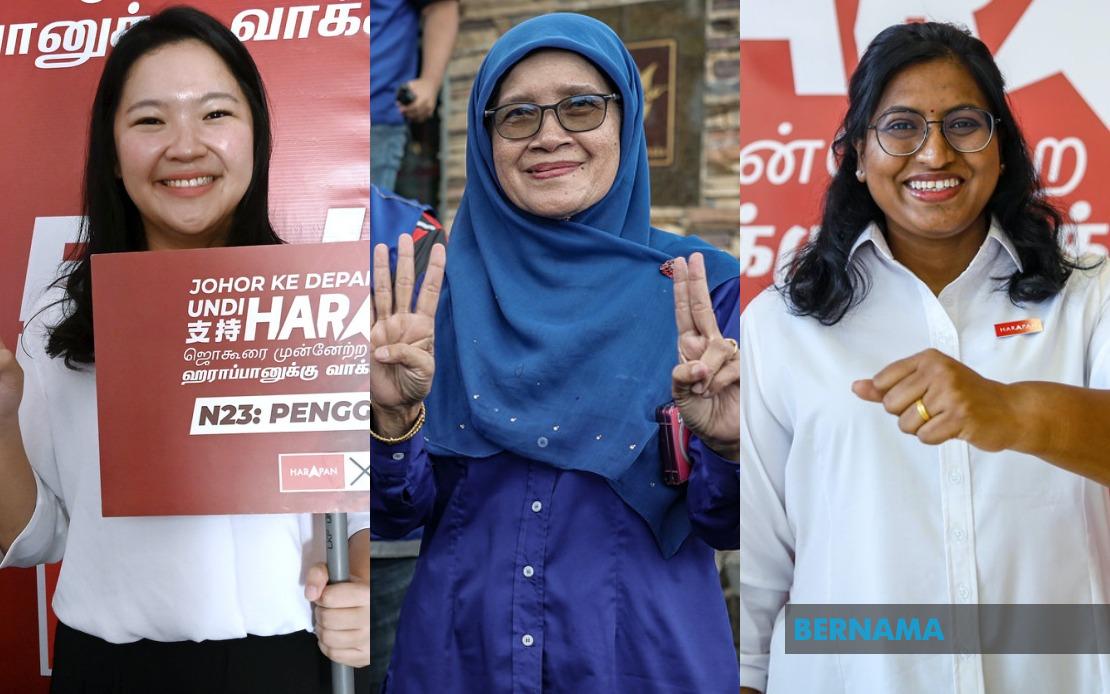
Women candidates achieved a modest but notable success in Johor's 16th state election, with ten of the 34 female aspirants winning seats in the State Legislative Assembly. The results, announced in July, demonstrate that Malaysia's largest southern state continues to back women in substantive political roles, though questions remain about whether progress is keeping pace with demographic representation and nationwide gender equality targets.
The distribution of victorious women candidates reflected the broader political dynamics of the election. Barisan Nasional's dominance in Johor translated to seven female representatives gaining seats, while Pakatan Harapan's three successful women candidates underscored the coalition's competitive position in specific constituencies. This split broadly mirrored the overall contest outcome, in which BN secured 48 of 56 state assembly seats, leaving PH with eight. The gender breakdown of winners thus offers a window into both coalition performance and the varying degrees to which different political blocs have embraced female candidacy.
Among the BN victors, Nadhirah Afiqah Abdull Rahim's triumph in Serom carried particular significance as she made her electoral debut. Leading the Ledang Puteri UMNO branch, Nadhirah accumulated 9,406 votes over her nearest rival, demonstrating that newcomers—particularly women—can command voter confidence even in competitive multi-cornered contests. Her performance suggests that name recognition and grassroots party machinery can offset the traditional advantage of incumbency, a pattern worth monitoring in future elections across the region.
Nor Rashidah Ramli's performance in Parit Raja revealed something more striking: a substantial swing toward BN among voters in a seat previously contested with narrower margins. Her majority of 13,576 votes represented a threefold increase from the 4,219-vote margin achieved in the 2022 state election, despite facing three-way competition. This surge in support for a female representative amid a broader BN recovery in Johor suggests that gender was not a limiting factor—and may even have contributed to the coalition's narrative of inclusive leadership during a period of political consolidation.
Among the longer-serving BN female representatives, continuity dominated. Alwiyah Talib's successful defence of Endau for a third consecutive term underscored the stability that incumbent female legislators can bring to their constituencies. Norlizah Noh's decisive 16,344-vote majority in the Johor Lama seat—secured against both PN and PH challengers—similarly reinforced confidence among voters in proven female leadership. These victories are particularly significant because they occurred in a competitive three- or four-cornered electoral environment, where vote-splitting could easily disadvantage any candidate lacking deep local roots.
One contest stood out as politically noteworthy: Chan San San's capture of the Johor Jaya seat, traditionally regarded as a stronghold of the opposition Democratic Action Party (DAP). Chan's accumulation of 35,971 votes to win against PH and independent candidates marked a symbolic BN breakthrough in a constituency where the DAP had expected to retain influence. This upset victory by a female BN representative illustrates how gender and political affiliation can intersect in unexpected ways, and how voter preferences may shift across different election cycles.
On the Pakatan Harapan side, the three female victors represented a younger generation of opposition politics. Felicia Poh Rui Ling's maiden election success in Penggaram, where the 28-year-old defeated her BN rival by 4,137 votes, pointed toward PH's capacity to recruit and field competitive women candidates despite the coalition's overall loss of ground in Johor. The retention of Mengkibol by Chu Poh Yee and Skudai by lawyer Kartiyaini Jeyapalan—who triumphed in a four-cornered contest with a substantial 15,280-vote majority—reinforced that PH's female representatives could hold their seats even as the coalition struggled more broadly in the state.
The aggregate statistics reveal the continued structural underrepresentation of women in electoral politics. The 34 women candidates constituted only 19.8 per cent of the 172-candidate field, a ratio that persists across Malaysian elections despite policy advocacy and internal party efforts to improve gender balance. With ten winners from 34 candidates, the conversion rate for female aspirants (29.4 per cent) marginally exceeded that for male candidates (27.5 per cent), suggesting that once nominated, women competitors performed broadly comparably to men—yet nomination rates remained the bottleneck.
From a regional perspective, Johor's election results carry implications for how Southeast Asia approaches female political representation. Malaysia has long positioned itself as a regional leader on women's empowerment, yet the persistence of single-digit percentage representation in state assemblies suggests that formal commitments to gender parity have not translated into proportionate seat acquisition. Johor's ten successful women candidates expanded the female presence in the 56-member assembly, yet the state remains far from reflecting its female population in elected office.
The election also illustrated how female candidates performed across different political formations and campaign strategies. BN's seven female victors benefited from the machinery and resources of the dominant coalition, whilst PH's three successful women candidates succeeded partly through grassroots mobilization and appeal to younger voters seeking alternative politics. Both patterns indicate that pathways exist for female political advancement, though institutional and structural barriers—including campaign finance, candidate selection processes, and voter preferences—continue to shape outcomes.
Looking forward, the Johor results suggest neither dramatic progress nor stagnation on gender representation in Malaysian state politics. The ten elected women will bring diverse perspectives to state assembly debates on education, healthcare, local government, and economic development. Yet the 80 per cent male majority in the assembly means that female legislators must continue to build coalitions and influence policy through persuasion rather than numerical dominance. For Malaysia and the broader Southeast Asian region, the challenge remains translating electoral success for individual women candidates into systemic change in nomination practices and voter expectations that would eventually produce legislative bodies reflecting demographic reality.

