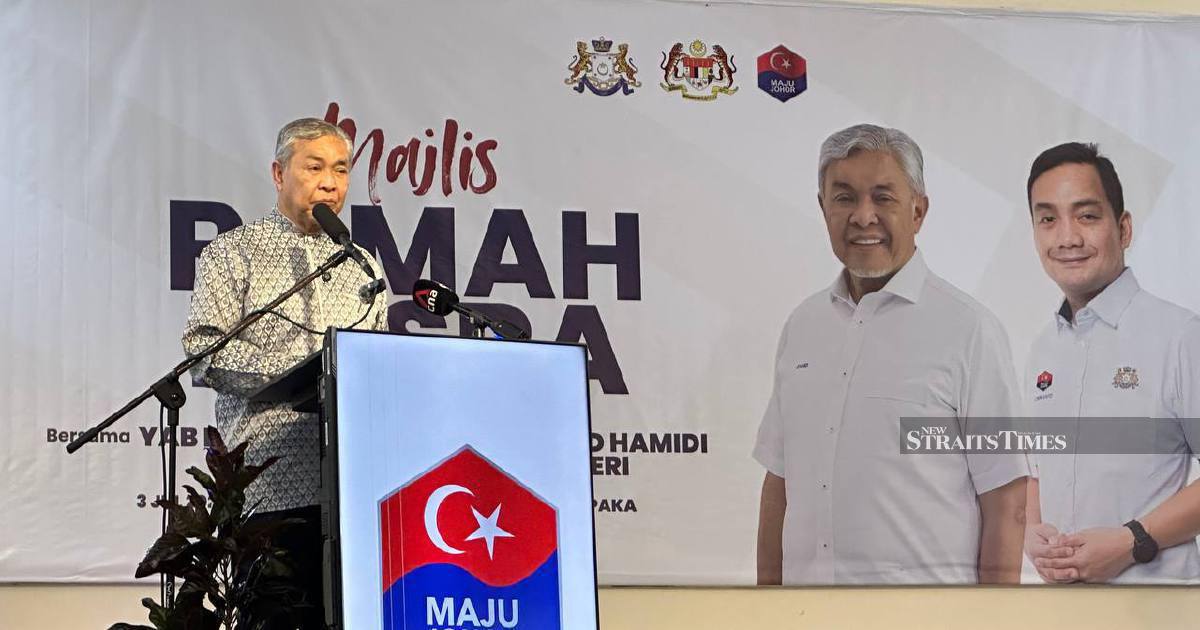
Barisan Nasional chairman Datuk Seri Dr Ahmad Zahid Hamidi has made an unusual public appeal to his unity government allies, requesting they refrain from revisiting past controversies that centre on Umno and the broader Barisan Nasional coalition during the Johor state election campaign. The statement, made in Johor Baru, reflects mounting tensions within Malaysia's complex governing arrangement as the crucial Johor polls draw near, signalling potential friction between coalition partners despite their public commitment to electoral cooperation.
The appeal underscores a fundamental challenge facing Malaysia's unity government, which brings together parties with starkly different electoral bases and historical grievances. Zahid's intervention suggests that as campaigns intensify, coalition partners may be tempted to resurrect old criticisms—whether related to governance failures, financial scandals, or policy disagreements—in pursuit of competitive advantage in Johor. Such tactics, whilst potentially effective electorally, risk fracturing the delicate consensus that has held the unity government together since its formation.
For Malaysian readers, the significance of Zahid's plea extends beyond mere political manners. The Johor election carries outsized importance in national politics. As Malaysia's second-largest state by population and economic output, Johor's electoral outcome will send powerful signals about the health and durability of the unity government at the federal level. A fractious campaign in Johor, marred by coalition partners attacking one another, could undermine public confidence in the government's ability to function cohesively. Conversely, demonstrated restraint and unity messaging might strengthen the government's narrative heading into the next federal election.
The timing of Zahid's statement is particularly revealing. As the Johor campaign gains momentum, coalition partners are likely calculating how aggressively to position themselves against competitors. For some parties, especially those in coalition with Umno, there may be electoral incentive to distance themselves by highlighting past controversies or policy disagreements. Zahid's intervention represents an attempt to pre-emptively suppress such manoeuvres, though the very need for such an appeal suggests the restraint is not automatic among coalition members.
Umno's position within the unity government makes this appeal especially delicate. As the dominant component of Barisan Nasional and a partner in the federal coalition, Umno carries the weight of Malaysia's recent political turbulence. The party and its leaders have faced serious allegations, investigations, and public scepticism regarding governance standards. Zahid himself, as party chairman, operates within this contested environment. His request that allies avoid raising old issues may thus be interpreted as self-protective, though he frames it as necessary for coalition cohesion.
The political risk in Johor is substantial for the unity government. If coalition partners begin openly attacking one another's records during the campaign, voters may conclude the government is more focused on internal competition than delivering results. This perception could benefit opposition blocs that, whilst not necessarily cohesive themselves, can present a more unified alternative. The Democratic Action Party and other opposition figures would likely seize upon any signs of coalition discord to argue that the unity government is inherently unstable and self-interested.
Historically, Malaysian coalition politics has often devolved into such finger-pointing during elections. The 2018 federal election saw Pakatan Harapan coalition partners criticise one another's records and priorities even as they campaigned together. The Johor campaign offers an opportunity to test whether lessons from that experience have been absorbed, or whether electoral pressure will once again expose fault lines within governing alliances.
Zahid's intervention also reflects broader concerns about political maturity in Malaysia. Democratic competition should occur through positive campaigns and clear policy differentiation, not through rehashing past scandals and controversies. However, Malaysian politics has long weaponised historical grievances, particularly when they serve immediate electoral purposes. Zahid's appeal, whether effective or not, at least signals awareness that such tactics carry institutional costs.
For the unity government's credibility with ordinary Malaysians, maintaining coalition discipline during the Johor campaign is essential. Citizens expect their government to function as a coherent entity, capable of managing disagreements internally whilst presenting unified governance externally. When coalition partners publicly berate one another, it signals that the government is fragmenting—a perception that directly undermines public confidence in policy implementation and institutional stability.
The weeks ahead will reveal whether Zahid's appeal gains traction with coalition partners. If they heed his call, Johor's campaign may demonstrate that Malaysia's unity government can maintain sufficient cohesion to govern effectively. If old attacks resurface despite his plea, the implications for federal politics could be significant, suggesting the coalition is primarily a marriage of convenience that dissolves under electoral pressure. Either outcome will carry lessons extending well beyond Johor itself.

