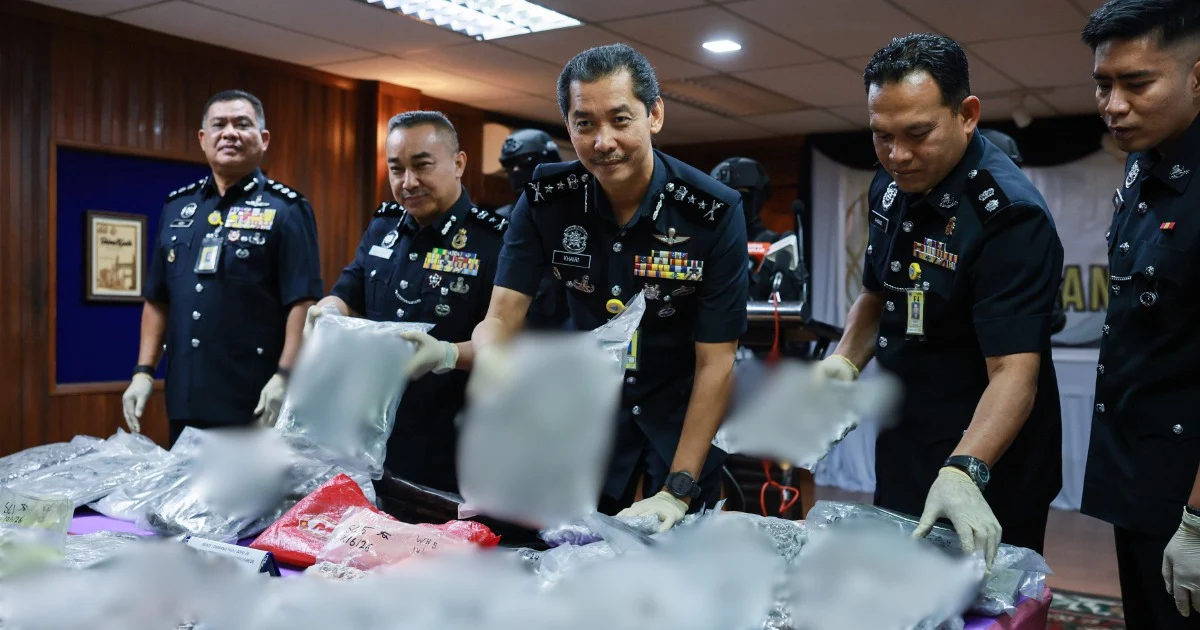
Law enforcement authorities in Kuala Terengganu have apprehended two brothers following a significant drug trafficking investigation that culminated in the seizure of narcotics valued at RM1.76 million from their family residence in Kampung Duyong Besar. The arrest marks another substantial drug bust in the northern region, reflecting intensified efforts by police to combat the distribution of illicit substances at the distribution and storage levels of the supply chain.
The operation appears to have targeted individuals suspected of playing a critical role in the regional drug trade rather than street-level dealers. By focusing on storage facilities and distribution hubs, law enforcement aims to disrupt the organisational infrastructure that enables large-scale trafficking operations. The substantial quantity of narcotics recovered suggests the suspects were involved in more than casual distribution and likely served as intermediaries connecting production or import networks to smaller retailers throughout the region.
The choice of location—a residential property in Kampung Duyong Besar—illustrates a common tactic employed by traffickers who attempt to conceal their activities within seemingly ordinary domestic settings. This approach allows suspects to operate with reduced visibility compared to dedicated commercial facilities, though it inevitably places family members and neighbours at risk from both the criminal activities and subsequent law enforcement interventions. The valuation of the seized materials at RM1.76 million underscores the significant financial stakes involved in mid-level trafficking operations.
For Malaysian readers, the bust exemplifies the persistent challenge of drug trafficking across the peninsula and into Terengganu specifically. Despite sustained enforcement campaigns, the consistent discovery of large quantities of narcotics suggests that supply remains robust and profitable. The capacity of traffickers to accumulate drugs worth nearly two million ringgit in a single location indicates that interdiction efforts, while occasionally successful, have not fundamentally constrained the operations of organised distribution networks.
The northern corridor, encompassing states like Terengganu, has long experienced significant drug trafficking activity due to proximity to international trafficking routes and porous border regions. The relatively undeveloped nature of certain areas provides concealment opportunities unavailable in more densely populated urban centres. Additionally, the existence of established distribution networks means that traffickers maintain reliable channels for moving product and capital, creating resilience that survives individual arrests.
The detention of both brothers simultaneously raises questions about family involvement in criminal enterprises. In some trafficking networks, family ties provide trusted relationships essential for managing high-value operations where monetary theft or informant betrayal could prove catastrophic. The use of a family home rather than a commercial facility may reflect both the need for security and the pragmatic reality that family members are less likely to report operations to authorities compared to non-familial associates.
From an enforcement perspective, the operation demonstrates that surveillance and intelligence-gathering capabilities remain functional in identifying significant trafficking operations. The precision required to locate and execute a raid on a facility holding nearly two million ringgits' worth of material suggests that police monitoring of suspected traffickers was reasonably comprehensive. However, the continued ability of traffickers to stockpile such quantities indicates that despite these successes, the overall volume of drugs moving through Malaysian territory continues to exceed law enforcement capacity to systematically dismantle supply chains.
The RM1.76 million valuation warrants examination, as street-level prices for drugs vary considerably from wholesale or bulk purchase rates. The actual cost to traffickers may have been substantially lower, reflecting the significant profit margins that incentivise participation in these criminal activities despite severe legal penalties. This economic reality ensures a persistent supply of individuals willing to assume the risks associated with trafficking, particularly in regions where legitimate economic opportunities remain limited.
The timing of this arrest occurs amid broader regional concerns about drug trafficking as both a public health and security issue. Southeast Asia remains a critical transit zone for heroin, methamphetamine, and synthetic drugs originating from Myanmar and destined for global markets. Malaysia's position within this trafficking corridor, combined with its relatively developed infrastructure and financial systems, makes it an attractive transit point and distribution hub for traffickers seeking to penetrate markets across the peninsula and in neighbouring countries.
Police have not yet disclosed details regarding the specific substances recovered, whether they included traditional narcotics such as heroin or represented the newer generation of designer drugs increasingly prevalent in the region. The classification and composition of the seizure would provide important context regarding the nature of the trafficking operation and its position within broader supply networks operating throughout Malaysia and Southeast Asia.
The apprehension of these two brothers will undoubtedly proceed through the court system, where charges related to trafficking in dangerous drugs may carry penalties ranging from lengthy prison sentences to potential capital punishment depending on drug quantities and classifications. The case also provides an opportunity for law enforcement to extract intelligence regarding supplier networks, distribution methods, and downstream distribution partners, potentially opening avenues for further arrests and dismantling of associated trafficking operations.
Looking forward, this bust exemplifies both the achievements and limitations of conventional drug enforcement strategies. While the seizure of nearly two million ringgits' worth of narcotics represents a genuine disruption to criminal operations, the persistent discovery of such quantities indicates that supply-side interdiction alone remains insufficient to address underlying demand or constrain the profit-driven nature of the drug trade. Sustained enforcement, complemented by demand-reduction programmes and transnational cooperation targeting production and smuggling routes, will remain necessary to meaningfully impact drug trafficking throughout Malaysia and the broader region.